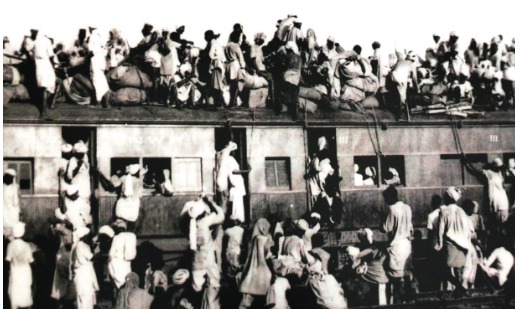
While India celebrated 80th Independence Day on 15 August, it also observed ‘Vibhajan Vibhishika Smriti Diwas’ (Partition Horrors Remembrance Day) on 14 August, recalling the horrors of Partition inflicted upon India in 1947, when the Congress leadership agreed to divide India into two countries, India and Pakistan. It is under the Narendra Modi government that the country has officially recognised the horrors suffered by millions of Hindus and Sikhs due to the Partition of India.
One needs to learn from this history so that past mistakes are not repeated. That is why one needs to ask this question: ‘Was Partition Unavoidable?’ Earlier Congress leadership and Left historians have established a myth that had Partition not happened, there would have been a bloodbath on the streets because of the growing tensions between Muslims led by the Muslim League and Hindus consolidating behind the Congress and some other non-Muslim organisations.
The RSS Perspective
It would also be important to assess, in this context, the RSS’ perspective on this issue, as it was arguably the only organisation on the ground that saved the lives of millions of people. The RSS was led by its second Sarsanghchalak, M.S. Golwalkar, at that time. Right from Sardar Vallabhbhai Patel to several public personalities, everyone, including even the bitter critics of the organisation, were all praise for its ground connect at that crucial juncture when the law-and-order machinery had collapsed and hapless Hindus and Sikhs were being brutally killed, raped and maimed by marauding mobs of fanatic Muslims in Punjab, Sindh, North-West Frontier Province, East Bengal, and Jammu and Kashmir.
Seshadri’s Historical Argument
One of the most influential functionaries of the Sangh, H.V. Seshadri, a former general secretary, brought out the RSS’ perspective in his seminal work, The Tragic Story of Partition. The work was first published in 1982. Seshadri (1926-2005), considered to be a leading ideologue of the organisation, was its Sarkaryavah (general secretary) from 1987 to 2000. He was a full-time worker (pracharak).
Citing a series of evidence to support his argument in this work, Seshadri writes: “There are indeed very solid grounds for believing that had our leadership stood firmly against Partition, things would have definitely taken a different turn. Unity of Bharat could have been upheld and internal strife too obviated. Britain’s new stance had, as we have just seen, put Jinnah in a tight corner. His own ranks, which had flocked round him in an outburst of religious zeal, were getting into a disarray in the face of hard realities. Desertions from his camp had started. All its inherent weaknesses and inner contradictions had begun to erupt. Jinnah was only too well aware of the predicament in which he was placed when Lord Louis Mountbatten (the last British Viceroy) told him that if he did not accept whatever had been offered, he would lose even that forever. This was a bare statement of fact which Jinnah also knew quite well.”
Congress’ Missed Opportunity
On the other hand, the Congress was placed in a position of unassailable strength. According to Seshadri, if only the Congress had seized that golden opportunity to rouse the nation to accept the challenge, whether of the British or the Muslims or both, to the nation’s integrity, the nation would have most certainly responded to it to the last man. “The Army and police too were in a ferment. And as the British government themselves had expressed, they could no longer be relied upon to put down that national resistance,” said Seshadri.
He added, “Further, all over the country, the Hindus were rapidly organising themselves into a patriotic force. Thousands of Hindu youths had become imbued with a spirit of heroism, discipline, and sacrifice at the nation’s altar. This indomitable Hindu force was ready to do everything and stand by our national leadership in case they had resolved to resist Partition at all costs.”
Golwalkar’s Last Appeal
The RSS Sarsanghchalak(Chief Mentor) MS Golwalkar’s whirlwind tour of the country during those days was proving a great source of morale for the people, asserts Seshadri. In his stirring speeches, he was invoking the inspiring vision of the integrated picture of Bharat Mata and calling upon the people to consider no sacrifice too great in the cause of safeguarding the unity of the Motherland.
However, when Golwalkar heard on the radio that the national leaders had finally accepted Partition, he exclaimed in anguish: “If only our leaders had tarried for just six more months, Jinnah would have come to terms with Nehru, giving up his demand for Pakistan.” Left without the sheet-anchor of the British and faced with prospects of direct confrontation with the organised might of the patriotically inspired nationalist forces, Jinnah would surely have foreseen his fate if he were to rely on the threat of force.
Reassessing Partition’s Outcome
According to Seshadri, in such a situation, the fears of large-scale bloodshed were entirely unfounded. Even if there had been some violence, it would have been nothing in comparison with what actually took place.
In fact, the carnage that overtook the country in the wake of Partition left the leadership so shocked and disillusioned that Pyarelal Nayyar, personal secretary and a close associate of Mahatma Gandhi, wrote in his historical biography, ‘Mahatma Gandhi: The Last Phase’: “Two years later (after independence) on 16 October 1949, Pandit Nehru declared before an audience in New York that if they had known the terrible consequences of Partition in the shape of killings, etc., they would have resisted the division of India.”
“If only we had known!” exclaimed Dr Rajendra Prasad. As for Acharya Kripalani another veteran Congress leader and freedom fighter, his choicest epithets were reserved in later years for those in the Congress leadership on whom he put the entire responsibility for Partition.
(The article was originally published in moneycontrol.com. Link of original article: https://www.moneycontrol.com/news/opinion/india-s-partition-rethinking-the-choices-that-shaped-1947-14005209.html)