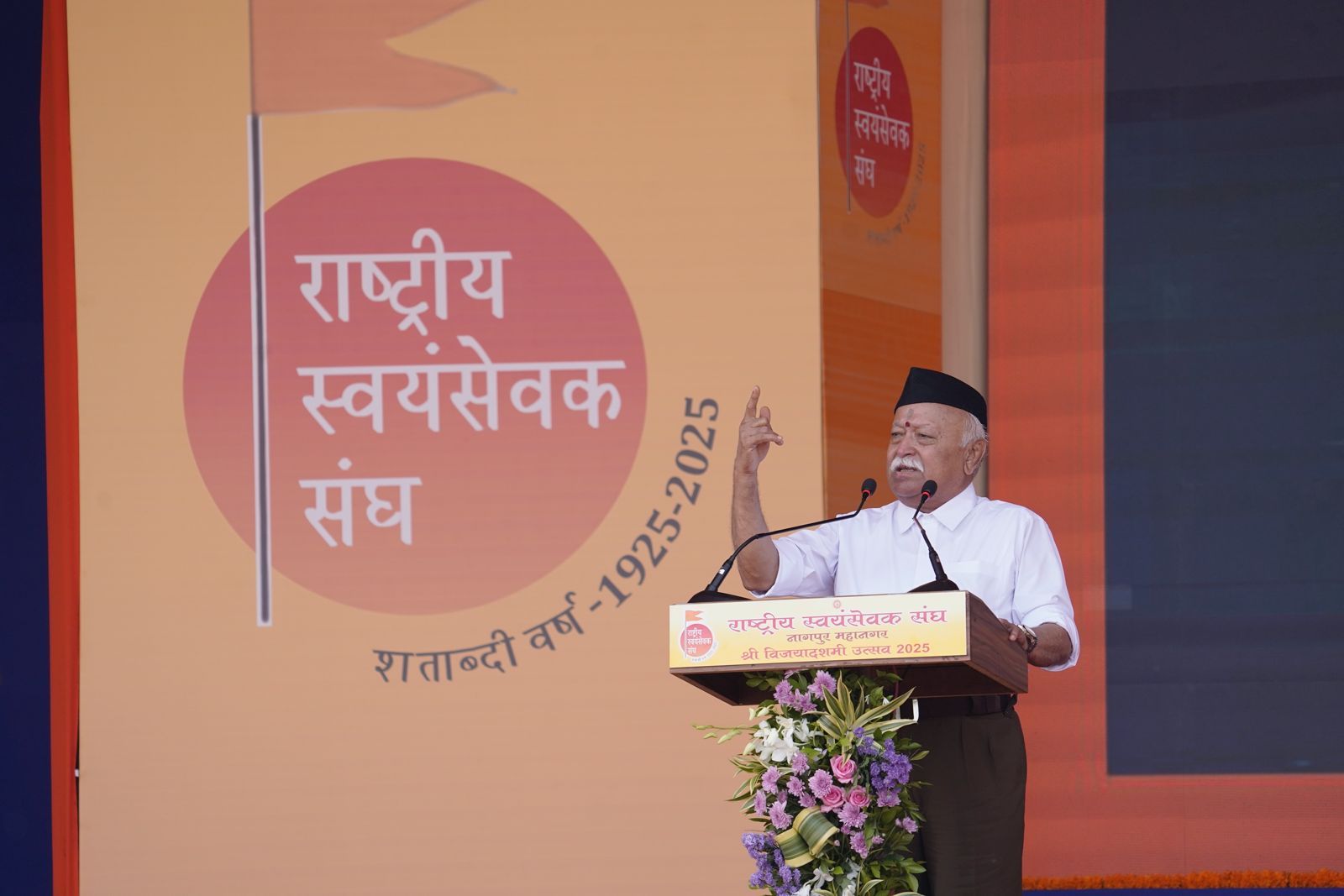
On 20 October 2026, as the Rashtriya Swayamsevak Sangh closes its centenary year at Reshimbagh in Nagpur, it returns to the festival on which it was born.
On Vijayadashami, 27 September 1925, Dr Keshav Baliram Hedgewar founded the Rashtriya Swayamsevak Sangh in Nagpur with a small group of young men. Announcing the formation of the Sangh, he called upon them to prepare themselves physically and intellectually for a larger national purpose: “All of us must train ourselves physically, intellectually and in every way so as to be capable of achieving our cherished goal.”
A hundred years later, that small gathering has become what is widely described as the largest voluntary organisation in the world. In March 2026, the Sangh reported 88,949 daily shakhas meeting at 55,683 locations across India, more than 1.5 lakh service activities run by swayamsevaks, and some 32 organisations working in fields from labour and education to tribal welfare that draw their inspiration from its ideas. Dr Keshav Baliram Hedgewar founded the RSS on Vijayadashami in 1925. The significance of this choice becomes clearer when viewed against the festival’s place in Bharat’s civilisational memory. Across its diverse regional traditions, Vijayadashami brings together the ideas of Dharma, courage, disciplined strength and the restoration of righteous order. These associations provide the context for examining the day on which Hedgewar began the Sangh’s organisational work.
A Festival of Victory in Bharat’s Civilisational Memory
Vijayadashami, the tenth day of the bright fortnight of Ashwin, is one of the few festivals observed across the full length and breadth of India, under many names and through many stories. What unites them is a single idea of the victory of Dharma, the righteous order that sustains society, over the forces that would destroy it.
In North India, Dussehra culminates in the burning of Ravana, Kumbhakarna and Meghnad, commemorating Shri Ram’s victory at Lanka. The living tradition of Ram Lila was inscribed on UNESCO’s Intangible Cultural Heritage list in 2008. In Bengal, Assam and Odisha, Vijayadashami marks the close of Durga Puja and Devi’s victory over Mahishasura. Kolkata’s Durga Puja received UNESCO recognition in 2021.
The Mahabharata brings another dimension to the festival. After their year in disguise, the Pandavas retrieved their weapons from a Shami tree, and Arjuna prepared to face the Kaurava army. This tradition underlies the worship of the Shami tree and the exchange of Apta or Shami leaves as “gold” in Maharashtra and Karnataka, symbolising prosperity.
Vijayadashami also takes distinct regional forms across Bharat:
- Mysuru Dasara in Karnataka carries forward a royal tradition associated with the Vijayanagara empire’s Mahanavami celebrations.
- Kullu Dussehra in Himachal Pradesh begins on Vijayadashami, bringing hundreds of village deities together in procession.
- Bastar Dussehra in Chhattisgarh centres on Devi Danteshwari and is among India’s longest festivals.
- Ayudha Puja in Tamil Nadu, Karnataka and Kerala honours tools, instruments, vehicles and books.
- Vidyarambham in Kerala marks a child’s initiation into learning through the writing of first letters in rice.
Two traditions offer a further lens through which to understand the festival’s association with strength and action. Shastra Puja, the worship of weapons, honours the means of protecting society and affirms the responsibility to use power in the service of Dharma. Ayudha Puja extends this reverence to the instruments of everyday work, from the plough and loom to books and tools.
Seemollanghan, or crossing the boundary, carries a different but related significance. In parts of western India, Vijayadashami traditionally marked the time to venture beyond village or territorial boundaries after the monsoon. Associated with the worship of weapons and the Maratha tradition of military campaigns, the practice came to symbolise readiness for action. In some regions, people still walk to the edge of their settlement and worship the Shami or Apta tree.
Together, these traditions express a coherent philosophy: Dharma must be upheld, strength must be cultivated and disciplined, and the resolve to act must follow preparation.
Why Hedgewar Chose Vijayadashami
Dr Hedgewar did not pick a date at random. By 1925 he had already lived a full public life. Sangh biographies record that as a schoolboy he joined nationalist protests, including during the Dussehra fair at Rampayali. As a medical student in Calcutta(now Kolkata) he came into contact with the revolutionary movement. He worked within the Congress and was imprisoned during the Non-Cooperation Movement, and he would go to jail again during the Jungle Satyagraha of 1930.
From this experience he drew a diagnosis that set him apart from many contemporaries. Political freedom was necessary, but it was not enough. A study of India’s history persuaded him that the country had fallen to successive invaders not for want of courage or culture, but because Hindu society was fragmented, divided by caste, region and language, and had lost the habit of acting together. Unless patriotism, character, discipline and a sense of unity were cultivated in a large number of ordinary people, freedom would neither be won nor kept. In words preserved by the Sangh: “The Hindu culture is the life-breath of Hindusthan… Mere geographical lumps do not make a nation… Strength, it should be remembered, comes only through organization.”
Vijayadashami already carried every element of that diagnosis. Read through Hedgewar’s eyes, it holds four connected meanings:
- Vijaya is the victory of Dharma, not merely the defeat of an enemy. The real adversary was the disunity and inertia within society that had made it vulnerable.
- Shakti must be organised. A society may have numbers, traditions and cultural depth, yet without discipline and collective purpose that strength can neither protect nor advance the nation.
- Victory demands character and sacrifice. Hedgewar’s aim was to produce dedicated individuals who would subordinate personal interest to national purpose. Sangh writers call this vyakti nirman, the making of persons.
- Organised strength exists to serve society. Sangathan was never meant as an end in itself, but as the means for society to stand on its own feet.
The festival’s oldest ritual, Seemollanghan, acquired a new meaning too. In a colonised country, a march beyond the frontier was neither possible nor the need of the hour. The boundaries that needed crossing were internal: caste distinctions that kept Hindus apart, the comfort of private life that kept citizens passive, and the fatalism that colonial rule had bred. When boys of every background stood in one line in the shakha, played together and ate together, each of them made his own small Seemollanghan. Shastra Puja, likewise, came to mean the sanctification of samarthya, or capability: physical endurance, moral discipline and the collective strength of an organised society.
Put simply, Vijayadashami reminds us that victory belongs not merely to the powerful, but to the organised, disciplined and selfless force that stands for Dharma.
Vijayadashami in the Life of the Sangh
Vijayadashami is the most important of the six utsavs, or festivals, that every shakha observes through the year. The others are Varsha Pratipada (the Hindu New Year, which is also Doctorji’s birth anniversary), Hindu Samrajya Dinotsav (Shivaji’s coronation), Guru Purnima, Raksha Bandhan and Makar Sankranti. Vijayadashami is also the Sangh’s foundation day, and it is observed in three characteristic ways.
- Shastra Puja. Swayamsevaks perform the ritual worship of weapons, honouring the tradition that the means of protecting society are sacred and must serve Dharma.
- Path Sanchalan. Swayamsevaks in full ganavesh, or uniform, march in disciplined columns through towns and villages. For the Sangh it is a public demonstration of organised, peaceful strength; for many neighbourhoods it has become a familiar part of the festival. In the centenary year, according to Prachar Pramukh Sunil Ambekar, 62,555 Vijayadashami utsavs were held across the country, with 32,45,141 swayamsevaks in uniform and, by his account, an equal number of ordinary citizens taking part. “Most participants in the Path Sanchalan were under 40,” he noted.
- The Sarsanghchalak’s address. At Reshimbagh in Nagpur, the Sarsanghchalak delivers the year’s most important speech. Mohan Bhagwat is the sixth to carry this tradition. The address reviews the national situation and indicates the direction in which the Sangh intends to move. Journalists and analysts read it closely for that reason.
In recent years the Nagpur utsav has also invited chief guests from outside the Sangh: mountaineer Santosh Yadav in 2022, the first woman to be chief guest; singer and composer Shankar Mahadevan in 2023; former ISRO chairman K. Radhakrishnan in 2024; and former President Ram Nath Kovind at the centenary utsav on 2 October 2025. For the utsav of 20 October 2026, the chief guest is Sanjay Gupta, Editor-in-Chief of Dainik Jagran.
A Century On: The Expanse of the Sangh
The Sangh did not plan a celebration for its hundredth year. Sarkaryavah (General Secretary) Dattatreya Hosabale reminded the Akhil Bharatiya Pratinidhi Sabha (ABPS) in Bengaluru in March 2025 that “RSS has never celebrated its anniversaries, such as Silver or Golden Jubilees.” The centenary year, running from Vijayadashami 2025 to Vijayadashami 2026, was instead declared a year of expansion, outreach and self-examination. Sunil Ambekar, Akhil Bharatiya Prachar Pramukh, observed in January 2026: “It seems that society has decided to celebrate the Sangh centenary.”
The numbers the Sangh reported over the year bear that out.
| Measure | Reported figure | Reported by, and when |
| Daily shakhas | 88,949 | Annual report, ABPS, Samalkha (Haryana), March 2026 |
| Locations with daily shakhas | 55,683 | Annual report, ABPS, March 2026 |
| Daily shakhas, five months earlier | 87,398 at 55,052 locations | Dattatreya Hosabale, November 2025 |
| Weekly milans (gatherings) | 32,362 | Dattatreya Hosabale, November 2025 |
| Places with some form of Sangh activity | More than 1 lakh | Sunil Ambekar, January 2026 |
| Service (seva) activities | More than 1.5 lakh | Sunil Ambekar, August 2026 |
| Organisations inspired by the Sangh | 32 | Sunil Ambekar, July 2025 |
| Vijayadashami utsavs, centenary year | 62,555, with 32,45,141 swayamsevaks in uniform | Sunil Ambekar, January 2026 |
| Hindu Sammelans held by March 2026 | About 37,000, with more to follow | Dattatreya Hosabale, March 2026 |
The shakha remains the core. A shakha is a daily gathering of an hour, held in an open ground, for physical exercise, games, songs, discussion and a prayer to Bharat Mata before the saffron flag. There is no membership register and no fee. Its purpose is to shape habits of discipline, cooperation and concern for society. The rise from 87,398 shakhas in November 2025 to 88,949 by March 2026, alongside the steady addition of new locations, indicates that the Sangh’s growth is still happening at the level of the neighbourhood and the village. Between April and June 2025 alone, 28,571 people registered through the Sangh’s online “Join RSS” platform, and Ambekar has repeatedly pointed to what he called a “visible surge” of interest among young people.
Service is the visible face of the work. The more than 1.5 lakh seva activities include schools and single-teacher Ekal Vidyalayas in tribal and remote areas, health centres, hostels, skill training, self-help groups and disaster relief. Much of this runs through Sewa Bharati and allied bodies. Swayamsevaks were among the first responders after the Wayanad landslide and in many other emergencies. The Sangh’s own language for this is not charity but seva, service offered as a duty to society. Hosabale put it plainly at the March 2026 ABPS: “The country gives us everything; we must also learn to give something back.”
The inspired organisations extend the idea into every field. Swayamsevaks over the decades have founded or built organisations in nearly every sphere of national life. Among the best known are the Akhil Bharatiya Vidyarthi Parishad among students, the Bharatiya Mazdoor Sangh among workers, the Bharatiya Kisan Sangh among farmers, Vidya Bharati in education, Vanvasi Kalyan Ashram among tribal communities, Sewa Bharati in social service, the Vishwa Hindu Parishad in religious and cultural life, Swadeshi Jagran Manch in economic thought, Sanskar Bharati in the arts, and Rashtra Sevika Samiti, the parallel organisation for women. Thirty-two such organisations, including the Bharatiya Janata Party in the political sphere, were represented at the Sangh’s prant pracharak meeting in July 2025. Each is autonomous, with its own leadership, constitution and programmes. What they share is not a chain of command but a common inspiration and a common emphasis on character and service.
The centenary was a year of reaching out. Ambekar described the year’s central aim as: “Reaching out to the unreached is one of the main objectives of the centenary year.” It included household contact campaigns, Hindu Sammelans at the level of the village and the urban basti (about 37,000 had been held by March 2026, against a plan of around 80,000), seminars for prominent citizens, social harmony meetings, and 2,134 programmes in 18 prants marking the 350th martyrdom anniversary of Guru Tegh Bahadur, attended by nearly seven lakh people.
These figures are the Sangh’s own reported data. But they are consistent across reports, they are presented every year to an assembly of nearly 1,500 elected representatives from all 46 prants, and they describe an organisation whose growth comes from its foundations rather than from any single event.
Panch Parivartan: The Seemollanghan of the Second Century
If the first century was about building an organisation, the Sangh says the second will be about transforming society through it. The programme it has placed at the centre of the centenary is Panch Parivartan, a five-fold transformation that every swayamsevak is asked to practise first in his own life and then carry to his neighbourhood:
- Samajik Samarasata (social harmony): ending caste discrimination in daily life, so that temples, water sources and cremation grounds are open to all. It continues the principle of the Udupi declaration of Hindu religious leaders, Na Hindu Patito Bhavet: no Hindu is fallen or untouchable.
- Kutumb Prabodhan (family awakening): strengthening the family as the first school of values, through regular time together, shared meals and conversation across generations.
- Paryavaran (environment): saving water, planting trees, reducing plastic and adopting “green home” practices.
- Swa-adharit Jeevan Shaili (a self-reliant way of life): swadeshi in consumption, pride in one’s language, dress and heritage, and freedom from what Hosabale has called the “colonised mind.”
- Nagrik Kartavya (civic duty): respect for the Constitution and the law, and the everyday duties of a citizen, from traffic rules to voting.
None of the five calls for a government programme. That is deliberate. “Sangh works only through society,” Ambekar has said, and “Society should not depend on the Government or on any great person, but should become self-reliant.” In his centenary Vijayadashami address, Sarsanghchalak Mohan Bhagwat made the same point: “Changes in society’s behaviour do not come through speeches or texts.” They come through example, through people who live the change. That is precisely the work of the shakha.
At the ABPS in March 2026, Hosabale called on the sajjan shakti, the good people of every community, to cooperate. He described this as the “Power of the Good” and warned that without such cooperation, the “power of the bad” comes to dominate public life. “Discussions on Panch Parivartan should happen among young people,” he added.
This is where Vijayadashami’s oldest idea returns. The new Seemollanghan is no longer only about crossing caste lines within the shakha. It is about the swayamsevak crossing the boundary of the shakha itself, carrying its discipline into the family, the street, the workplace and the environment. As Ambekar put it, recalling Doctorji’s own words from 1940, the entire Hindu society outside the shakha is the Sangh’s field of work. “The basic objective of the Sangh,” he said, “is cultural awakening.”
What the World Should Understand
For much of the Western press, the RSS is still seen through a few photographs: men in uniform, a march, a raised flag. Readers in London, New York, Toronto or Frankfurt deserve a fuller picture, and the Vijayadashami tradition supplies it.
It is a civil society organisation in the truest sense. The Sangh has no formal membership, takes no government funds and runs no electoral campaign of its own. Its work is carried out overwhelmingly by volunteers who give an hour a day, and by full-time pracharaks who dedicate their lives to the work, remaining unmarried and drawing no salary. Western readers familiar with Alexis de Tocqueville’s admiration for America’s voluntary associations will recognise the principle: a society that organises itself to solve its own problems, rather than waiting for the state.
Its idea of strength is moral before it is physical. Shastra Puja and Path Sanchalan can look martial to an outsider. In the Sangh’s own understanding they are about discipline, readiness and the capacity to serve, as was evident when swayamsevaks reached the sites of floods, earthquakes and landslides before many official agencies did. In his centenary address, Bhagwat explicitly warned against street violence, vigilantism and provocative displays of strength, and called for respect for every community’s beliefs, icons and places of worship.
Its civilisational idea is open, not closed. The Sangh grounds its thinking in Vasudhaiva Kutumbakam, the world as one family, and in Bharat’s long tradition of accepting many paths to truth. Bhagwat’s 2025 address argued that the prevailing global development model is not wrong but “incomplete,” and that Bharat should offer the world a model rooted in balance between individual, society and nature. His visit to the United States, Canada and the United Kingdom in August and September 2026 carried that message directly to Western audiences.
The diaspora already lives this tradition. Across the world, Hindu families gather for Navaratri garba in community halls, Durga Puja in rented venues and Ram Lila in public parks. In many countries, independent organisations such as the Hindu Swayamsevak Sangh run weekly shakhas for children and families, built on the same ideals of character, culture and service. For a second-generation Indian in Leicester or New Jersey, Vijayadashami is often the festival that ties them most visibly to Bharat. Understanding its deeper meaning, the victory of Dharma through organised and selfless effort, is a way of understanding why a century-old organisation founded in Nagpur continues to draw young people in their tens of thousands.
From Nagpur 1925 to Nagpur 2026
When Dr Hedgewar’s young volunteers met in 1925, there was no guarantee their effort would outlast the year. The Sangh went on to survive three bans, in 1948, during the Emergency and in 1992, as well as decades of hostility from sections of the political and intellectual establishment. It did so by doing the same simple thing every day: gathering people for an hour, building character, and sending them back into society to serve.
On 20 October 2026, swayamsevaks will once again perform Shastra Puja, march in Path Sanchalan and gather at Reshimbagh to hear the Sarsanghchalak, as they have every Vijayadashami for a hundred years. This time, the ceremony will also close the centenary year. The figures will be quoted: nearly 89,000 daily shakhas, more than 1.5 lakh service activities, 32 inspired organisations. But the Sangh would be the first to say that numbers are not the point. The question Hedgewar asked in 1925 is the one his successors are asking in 2026: is society becoming more organised, more harmonious and more capable of standing on its own?
That is the true meaning of Vijaya. Ravana’s effigy burns in a moment. The victory of Dharma over disunity, inertia and self-forgetfulness is the work of generations, and it is won not by a few heroes but by an organised society acting with discipline and selflessness. For the Rashtriya Swayamsevak Sangh, Vijayadashami was where that work began. At the threshold of its second century, it remains the day on which the Sangh renews its resolve to cross the next boundary.
Sources
- RSS, Vision and Mission (founding on Vijayadashami 1925; Hedgewar’s words on Hindu culture and organisation)
- Organiser, ABPS 2026: A holistic perspective for the entire Bharat, 23 March 2026 (88,949 shakhas, 55,683 locations; ABPS at Samalkha)
- Organiser, Every swayamsevak thinks with a holistic perspective for entire Bharat: Dattatreya Hosabale, 15 March 2026 (Hosabale quotes; Panch Parivartan; Sammelans; Guru Tegh Bahadur programmes)
- Madhyamam, RSS added 10,000 new shakhas in last one year: Dattatreya Hosabale, 2 November 2025 (87,398 shakhas at 55,052 places; 32,362 weekly milans)
- Organiser, Reaching out to the unreached is the main objective of the centenary year: Sunil Ambekar, 4 January 2026 (Vijayadashami utsav figures; Ambekar quotes)
- Organiser, Dr Hedgewar inspired ordinary citizens to serve the Nation: Sunil Ambekar, 26 August 2026 (more than 1.5 lakh service activities)
- The Week (PTI), RSS three-day prant pracharaks’ meeting, 3 July 2025 (32 inspired organisations; Join RSS registrations)
- Organiser, ABPS 2025: RSS unveils expansion-outreach plan for centenary year, 23 March 2025 (Hosabale on anniversaries)
- Organiser, Vijaydashmi Utsav 2025: From the past through the present, to the future, 7 October 2025 (Bhagwat’s centenary address; Kovind’s remarks)
- News On AIR, RSS centenary and Vijayadashmi programme begins in Nagpur, 2 October 2025
- Organiser, RSS to celebrate Vijayadashami Utsav on October 20, 25 September 2026 (2026 utsav and chief guest)
- UNESCO, Ramlila, the traditional performance of the Ramayana and Durga Puja in Kolkata
- The Tribune, Mountaineer Santosh Yadav to be first woman chief guest at RSS Dussehra event; ISRO ex-chairman to be chief guest at RSS event; India.com, Shankar Mahadevan at RSS event
- RSSFacts, An Indian Idea for a Divided World: What the RSS’ Global Engagement Signifies (Bhagwat’s 2026 overseas visit)