India recently celebrated the birth anniversary of Mahatma Gandhi (Mohandas Karamchand Gandhi) on October 2, which prompts a question: who carried forward his legacy of Swadeshi (literally, “of one’s own country”) in the decades after independence in 1947?
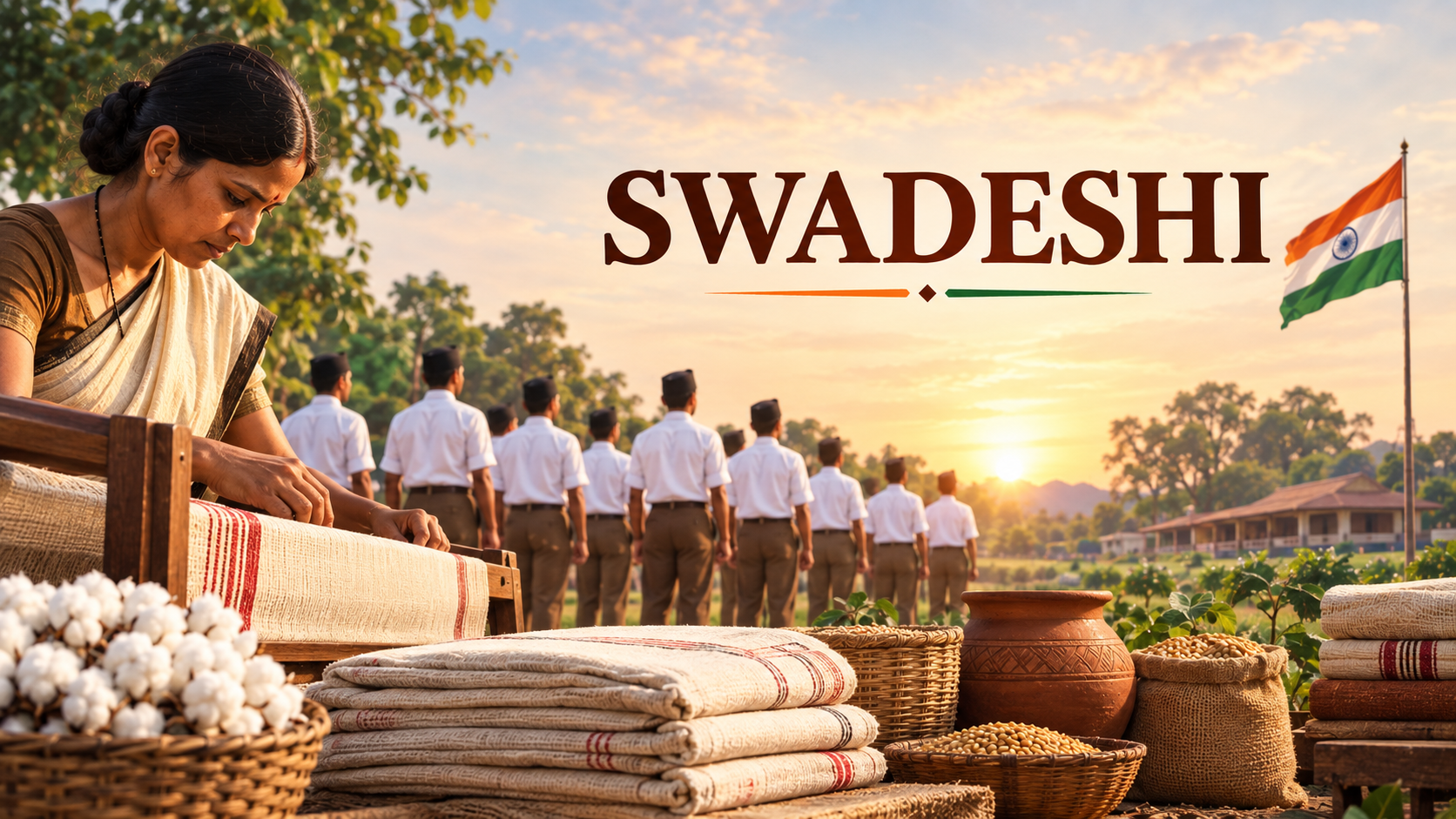
There is a striking similarity between Gandhian philosophy and the philosophical framework of the Rashtriya Swayamsevak Sangh (RSS), the Hindu cultural and social organisation founded in 1925, when it comes to Swadeshi. Detractors have long dismissed Swadeshi as a parochial, protectionist idea confined to economics. For both Gandhi and the RSS, however, it is a wholesome framework that goes much beyond economics.
How Gandhi Defined Swadeshi
In Gandhi’s own words: “After much thinking I have arrived at a definition of Swadeshi that, perhaps, best illustrates my meaning. Swadeshi is that spirit in us which restricts us to the use and service of our immediate surroundings to the exclusion of the more remote. Thus, as for religion, in order to satisfy the requirements of the definition, I must restrict myself to my ancestral religion. That is the use of my immediate religious surrounding. If I find it defective, I should serve it by purging it of its defects. In the domain of politics, I should make use of the indigenous institutions and serve them by curing them of their proved defects. In that of economics, I should use only things that are produced by my immediate neighbours and serve those industries by making them efficient and complete where they might be found wanting. It is suggested that such Swadeshi, if reduced to practice, will lead to the millennium, because we do not expect quite to reach it within our times, so may we not abandon Swadeshi even though it may not be fully attained for generations to come.”
In a 1916 speech at the Gurukul Kangri, Gandhi said: “There is no salvation for us without true Swadeshi, not the Swadeshi which can be conveniently put off. Swadeshi, for me, has a deeper meaning. I would like us to apply it in our religious, political, and economic life. It is not, therefore, merely confined to wearing Swadeshi cloth on occasions. That we have to do for all time, not out of a spirit of jealousy or revenge, but because it is a duty we owe to our dear country.”
How the RSS Defined Swadeshi
Dattopant Thengadi, a leading ideologue of the RSS and founder of the Swadeshi Jagaran Manch (SJM), an RSS-inspired organisation promoting economic self-reliance, said in his seminal work The Third Way: “Swadeshi is the outward, practical manifestation of patriotism. Patriotism is not considered as isolationism… Patriots are not against internationalism. Their plea for national self-reliance is not incompatible with international cooperation, provided that the latter is on an equal footing — with due regard to the national respect of every country.”
Between 1990 and 2000, as India liberalised its economy and opened up to global markets, the RSS passed a series of resolutions advocating Swadeshi amid what it saw as unchecked globalisation and reckless liberalisation. In 1994, the Akhil Bharatiya Pratinidhi Sabha (ABPS), the RSS’s highest decision-making body, declared: “The vow of Swadeshi and intense nationalism alone can provide self-reliance and self-respect to the country. India carried on its struggle for independence against foreign domination on the basis of these lofty ideals. The enormous latent energies of the people will certainly get roused when this goal is pursued.”
The Modi Government and Swadeshi
The synergy between RSS thought and Gandhian philosophy is also reflected in the functioning of the Narendra Modi government over the last 12 years. Modi was a full-time worker (pracharak) in the RSS before entering politics, and the Bharatiya Janata Party (BJP), India’s governing party, is an ideological mentee of the RSS.
Since 2014, the Modi government has revived the idea of Swadeshi, taking it out of academic debate and translating it into policy through initiatives such as Atmanirbhar Bharat (“Self-Reliant India”), Make in India and Vocal for Local. Every year since 2014, PM Modi has reiterated his government’s commitment to Swadeshi. This year, too, he placed atmavishwas (self-confidence), atmagaurav (self-respect) and Atmanirbhar Bharat at the centre of his Independence Day address, describing them as essential to India’s progress.
At the Red Fort in Delhi, in his address marking India’s 80th Independence Day, PM Modi called on the country to think big, pursue ambitious goals and strengthen its national capabilities. He also urged citizens to embrace the principles of Make in India, Swadeshi and Vocal for Local.
Launched in 2014, Make in India sought to boost domestic manufacturing, while Atmanirbhar Bharat was introduced in 2020 to advance economic self-reliance. Vocal for Local has been part of the government’s broader effort to promote the production and consumption of goods made in India.
Conclusion: A Legacy Carried Forward
Gandhi saw Swadeshi as a spirit that shapes religious, political and economic life alike. The RSS has echoed this view by treating it as an expression of patriotism and self-reliance rather than isolationism. The Modi government has carried this shared vision from the realm of ideas into policy through Make in India, Atmanirbhar Bharat and Vocal for Local, making Swadeshi a living national agenda in post-independence India.