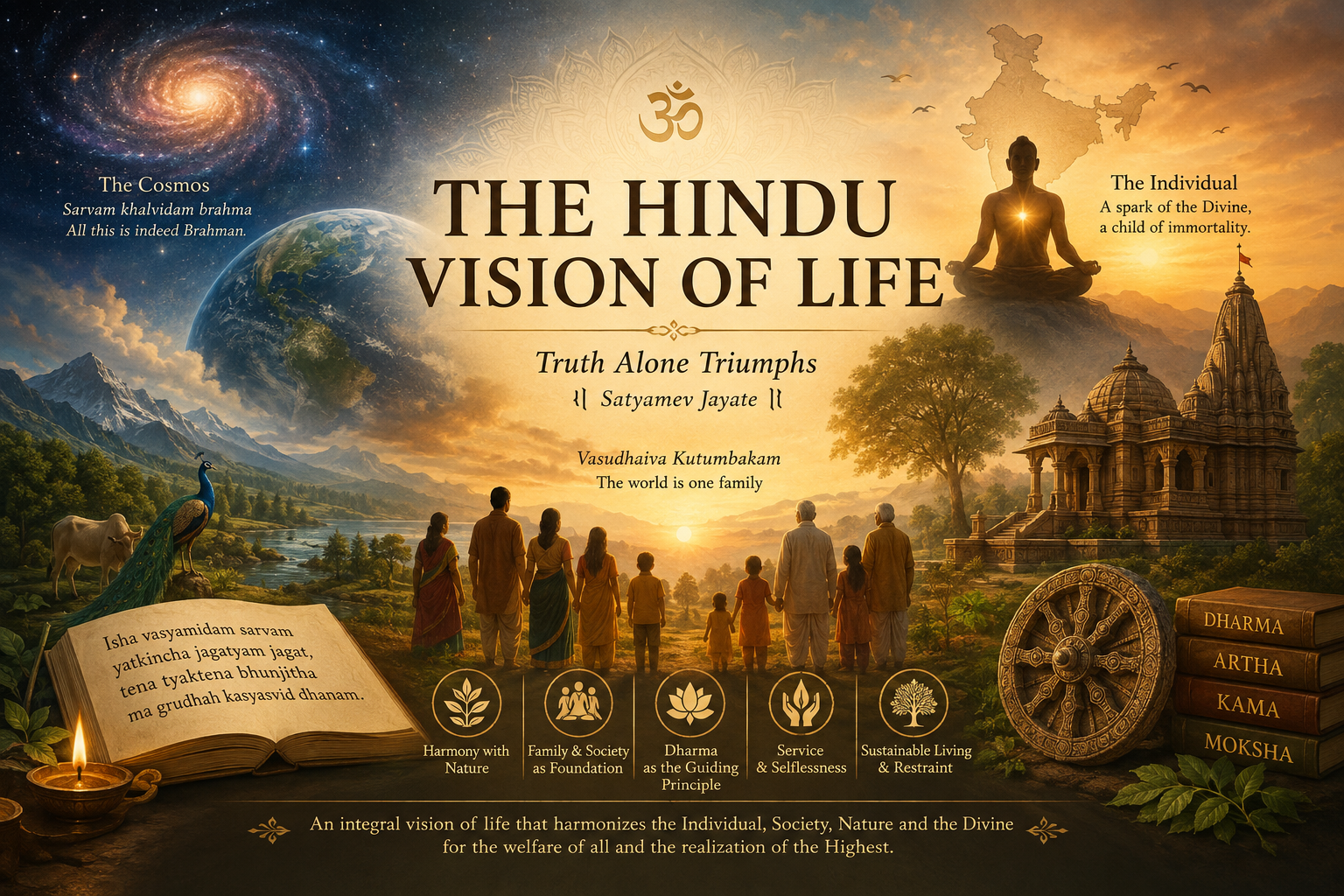
The Rashtriya Swayamsevak Sangh (RSS) is often the subject of global public discourse, academic debate, and curiosity. At the heart of its worldview is the principle Satyamev Jayate, “Truth Alone Triumphs” which reflects a longstanding conviction in the Indian civilisational tradition that truth ultimately prevails by virtue of being true. Ancient Indian seers and thinkers reflected deeply on the nature of truth, human existence, and the universe, and their insights shaped the evolution of Indian society and its way of life. This civilisational development came to be known as Hindu Sanskriti, the Hindu cultural and civilisational tradition. A useful starting point for understanding how these ideas are interpreted within the RSS is Hindu Jivan Drishti (The Hindu Vision of Life), a chapter in Vishay Bindu (Fifth Edition, published on Deepawali, Vikram Samvat 2069 [November 2012], by Sharad Prakashan, Agra). The chapter sets out a philosophical framework for understanding the individual, family, society, economy, nature, and the wider universe, and provides an important lens through which to examine how the RSS connects traditional Indian philosophical thought with contemporary questions of social organisation and national life. The discussion that follows draws on these ideas to explain the broader worldview that informs the RSS and its understanding of India’s civilisational identity.
The Cosmic Vision (Srishti Chintan)
The foundational truth Sarvam khalvidam brahma, meaning all this is indeed Brahman or the Cosmic Reality, represents an experiential realization pioneered by our ancestors. This entire universe has emerged as an expression of a single, unified consciousness, and it is from this absolute truth that our Jivan Drishti, or vision of life, has evolved. Defined in a single phrase, the Hindu vision of life is an Ekatma Jivan Drishti, an integral vision of life.
Because all existence is seen as interconnected, the natural aspiration of the Hindu psyche does not seek narrow victories. Instead, it naturally manifests in universal invocations such as Sarve bhavantu sukhinah, wishing that all beings be happy; Bhavatu mangalam, seeking that well-being prevail for all; Sarbat da bhala, praying that good come to all, Vishwa ka kalyan ho, desiring welfare for the entire world; and Paropakaraya punyaya, papaya parapidanam, affirming that merit lies in serving others while sin lies in inflicting harm.
Within this cosmic framework, all elements including water, air, earth, flora, fauna, and natural resources share an equal, fundamental right to exist. Resource utilization must therefore be strictly limited to necessity. Consequently, self-restraint (Samyam), simplicity, and consumption anchored in sacrifice (Tyag) became core values of life, known as Jivan Moolya.
This ethos is captured in the foundational verse of the Isha Upanishad:
Isha vasyamidam sarvam yatkincha jagatyam jagat, tena tyaktena bhunjitha ma grudhah kasyasvid dhanam,
which translates to: all of this that exists in this changing universe is pervaded by the Divine; enjoy it through renunciation or detachment, and do not covet the wealth of anyone else.
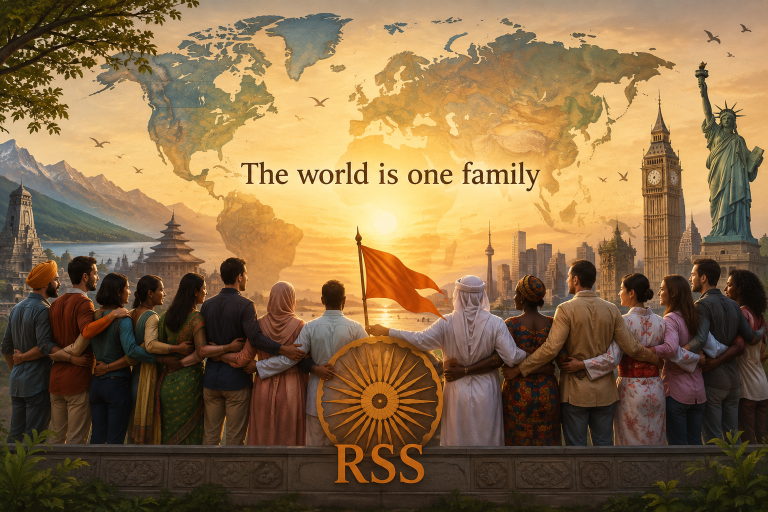
This worldview, encapsulated in Vasudhaiva kutumbakam or the world is one family, reflects a deep sense of reverence and motherhood (Matritva) toward the Earth, viewing nature and creation as a mother rather than an object of ownership. The guiding principle is sustainable replenishment (Dohan) rather than exploitation (Shoshan). Just as every child has a right to the mother’s milk, no single child has the right to bleed the mother dry.
Human existence
Building upon this cosmic understanding, the text outlines the internal dimensions and ultimate goals of human existence. Regarding the divine nature of humanity, man is not merely a material being; every individual is a spark of the Divine,a child of immortality (Amritputra). A human being is an integrated unity of four dimensions: the physical body (Sharir), the mind (Man), the intellect (Buddhi), and the soul (Atma).
Concerning the fourfold harmony, the individual does not exist in isolation. Authentic fulfillment is realized only through the harmonious integration of four expanding spheres of existence: the individual (Vyashti), society (Samashti), creation (Srishti), and the Supreme Reality (Parameshti).
In terms of the immortality of the soul (Atma-Amartva), the soul is eternal; while everything that takes physical birth is destined to perish, the Atma itself is beyond birth and death. As for reincarnation (Punarjanma), a living being’s rebirth is determined by the accumulated impressions, latent tendencies, and moral dispositions (Samskaras) carried from previous lifetimes.
Addressing holistic happiness versus transient pleasure, the intrinsic longing of human life is happiness. However, authentic happiness cannot be reductionist or confined solely to material comforts; sensory pleasure (Indriya Sukh) is inherently transient. The ultimate purpose of human life is the attainment of eternal, unconditioned bliss,liberation (Moksha).
For the four pillars of human endeavor (Purusharthas), balanced and comprehensive development requires individual life to be organized around four cardinal pursuits: ethical order or duty (Dharma), wealth or material well-being (Artha), desire or aesthetic fulfillment (Kama), and spiritual liberation (Moksha).
Finally, in self-realization (Aham Brahmasmi), through conscious inner pursuit, a human being can transcend the limitations of the body, mind, and intellect to directly experience the divine consciousness within, awakening to the cosmic truth: “Aham Brahmasmi” (I am the Infinite Reality).
The Characteristics of Hindu Culture
The geographical landscape bounded by the Himalayas and the oceans, an environment (Nisarga) rich in natural diversity, and the direct realization of an underlying organic oneness (Ekatmata) form the bedrock of Indian civilization.
A life centered on Yajna and sacrifice (Yajnamayi va Tyagamayi) is guided by the ideals of “Idam Na Mama” (“This is not mine”) and “Sarvabhuta-hite-rata” (“Devoted to the welfare of all beings”). This ethos established a continuous lineage of selflessly detached, elevated personalities (Tyagi Mahapurush).
Regarding the imperative of duty (Kartavya Nirvahan), Indian culture is built on selflessness, where practicing Dharma is synonymous with fulfilling one’s responsibilities toward others. Morality is framed through contextual, relational obligations rather than abstract individual rights, including Putra-dharma (filial duty of a child), Pitri-dharma (paternal duty of a parent), Pati-dharma and Patni-dharma (marital obligations), Raja-dharma (governance ethics), and Praja-dharma (civic responsibility). This structural insistence on Dharma extends to institutionalized public welfare and community-wide benevolence, such as establishing free medical dispensaries (Dharmartha Aushadhalaya) and public rest houses (Dharmashala).
Pluralistic acceptance and tolerance reflect a respectful mindset toward all diverse paths of spiritual practice (Upasana Paddhati) and philosophical viewpoints, guided by the foundational realization: “Ekam Sat Viprah Bahudha Vadanti” (“Truth is One, the wise express it in varied ways”).
Similarly, equal respect for all traditions (Sarva-Pantha Samadara) represents an all-inclusive ethos that accords equal reverence to all spiritual traditions and paths (Panths). This worldview transcends sectarian boundaries, regional identities, and dogmatic creeds to contemplate the holistic welfare of humanity as a whole.
The civilization possesses an all-inclusive capacity for absorption and organic assimilation (Atmasatrikaran). Historical precedents include the complete cultural assimilation and integration of external invading groups like the Shakas and the Hunas. This dynamic capacity reflects an open, expansive mindset ready to embrace sublime and progressive thoughts from any quarter, embodied by the Vedic aphorism: “Aano bhadra krtavo yantu vishwatah” (“Let noble thoughts come to us from every side”). It signifies a continuous readiness to harmonize and absorb external elements into the foundational matrix while welcoming beneficial ideas globally while maintaining core values.
The synthesis of strength and devotion (Shastra-Shaastra and Shakti-Bhakti) forms an organic worldview that avoids the dichotomy between spiritual seeking and temporal action. It unites physical strength (Shastra) with intellectual and scriptural wisdom (Shaastra), and dynamic power (Shakti) with selfless devotion (Bhakti). Historically, this balance has been embodied through powerful partnerships where spiritual vision guided righteous action, such as Samarth Guru Ramdas and Chhatrapati Shivaji, Chanakya and Chandragupta Maurya, Guru Gobind Singh and Banda Singh Bahadur, and Sri Ramakrishna Paramahamsa and Swami Vivekananda.
Finally, the cultivation of a reverent attitude presents an expansive worldview that elevates everyday human relations and natural elements into objects of sacred reverence (Pujabhav). Its foundational human imperatives state: Matridevo Bhava (revere the mother as divine), Pitridevo Bhava (revere the father as divine), Acharyadevo Bhava (revere the preceptor as divine), Atithidevo Bhava (revere the guest as divine), and Rashtradevo Bhava (revere the nation as divine).
Ecological and Spatial Consecration
This reverential consciousness extends to environmental stewardship and spatial harmony through practical traditions: Bhumi Puja, which represents sacred reverence for the soil and land; Vastu Puja, the consecration of living spaces; Gau Puja, reverence for cattle as symbols of sustenance; and Jala Puja, the sacred preservation of water sources.
Nurturing the Family and Clan Ecosystem
This reflects a societal structure built on expanding circles of human belonging, recognizing the nuclear family (Parivar) as the primary micro-unit and the extended clan or community (Kutumb) as the macro-building block of society. This ecosystem serves as the principal institution for transmitting ethical values (Samskaras) across generations through structured rites of passage, known as the Shodasha Samskara, the sixteen sacred life-stage sacraments spanning from conception to death, historically enumerated as forty Samskaras in ancient Grihya Sutras.
Absolute Dedication Toward Society and Nation
Individual existence finds its ultimate validation not in isolated self-interest, but through total dedication (Sarvasvarpana) to the collective society (Samashti) and the nation (Rashtra). A life anchored in Dharma is defined by four core practices: Unity in Diversity (Vividhta mein ekta), which is recognizing the underlying oneness beneath external variations; Harmonious Living with Nature (Prakriti ke sath samanvay), which is maintaining ecological balance rather than dominance; Selfless Duty (Nishkama Karma), which is performing one’s obligations dedicated to the greater good without egoistic attachment; and a Restrained Lifestyle (Samyamit Jivan), which is practicing personal simplicity and sensory self-control.
The criterion of the wise is captured in timeless verses. The first states: Matrivat pardareshu pardrayeshu loshtavat, atmavat sarvabhuteshu yah pashyati sah panditah.
Which translates to: he alone is truly wise who views another’s spouse as a mother, regards another’s material wealth as mere clods of earth, and recognizes his own inner self within every living being. The second verse, from the Maha Upanishad (6.71) and Hitopadesha, states:
Ayam nijah paro veti ganana laghuchetasam, udaracharitanam tu vasudhaiva kutumbakam.
Which translating to: the distinction between “this person is my own” and “that person is a stranger” is the mindset of narrow-minded individuals; for those of an expanded, noble character, the entire Earth is but one integrated family.
The Goal of Human Life
The text turns to an analysis of human psychology, motivation, and the hierarchy of human experience. The ultimate objective behind all human actions is the attainment of absolute bliss (Ananda). Even inanimate matter naturally gravitates toward a state of stable equilibrium, energy inherently follows the path of least resistance, and living organisms instinctively avert pain while being drawn toward comfort and well-being, such as moving away from an electric shock or being attracted to food sources. The attraction toward Ananda in a human being is innate, seamless, and entirely natural, unfolding across four distinct levels.
First, physical or sensory pleasure represents the desire and effort to attain physical comfort, which is identical across all living creatures including animals, birds, insects, and human beings. The longing for food, water, a pleasant climate, security, fragrance, and tactile comfort is common to all life forms. However, the satisfaction derived from these is purely transient and fleeting, triggering a repetitive craving where sensory gratification does not extinguish a desire but intensifies it, akin to pouring clarified butter (Ghee) onto a fire, which only causes it to blaze wilder.
Second, mental or psychological joy demonstrates that mental well-being is vastly superior to physical comfort, as no amount of physical luxury can bring true solace in a state of profound grief or mental distress. The pursuit of psychological joy is so compelling that an individual willingly disregards physical hardship, bodily fatigue, or pain, such as enduring arduous travel merely for the joy of reuniting with loved ones. Under conditions of bondage, dependency, or subjugation (Dasata), even the highest material affluence and physical luxury feel equivalent to hell (Naraka). While mental joy is far more enduring and deep-seated than physical pleasure, it too remains transient and subject to change, being frequently swayed by emotional impulses, mental agitation, and fluctuating sentiments.
Third, intellectual pleasure operates at an even higher and more refined plane of consciousness, where the thirst for deeper knowledge drives humanity to undertake perilous and adventurous expeditions into dense forests, treacherous mountains, the depths of the oceans, polar regions, and the farthest reaches of stellar constellations. When cognitive mental processes are integrated with discernment and wisdom (Viveka), the higher intellect manifests, exemplified practically by a student willingly sacrificing worldly entertainment to prepare diligently for examinations.
Fourth, spiritual bliss of the soul represents supreme bliss (Paramananda), which is eternal, unchanging, and transcends the limitations of both the analytical intellect and the shifting modifications of the mind-stuff (Chittavritti). It is not attained through logical argumentation but is anchored entirely in direct internal realization. Spiritual bliss is neither one-sided, self-centred, nor restricted by the boundaries of space and time (Desh-Kaal); grounded in ultimate spiritual altruism (Paramartha), it is harmoniously integrated, boundless, and entirely free from any fetters or limitations.
This organic continuum of happiness is classified as the Purushartha-Chatushtaya, the four foundational pursuits of human life: Dharma (Righteous Conduct), Artha (Material Wealth), Kama (Desire or Sensory Fulfillment), and Moksha (Liberation). Within this framework, material wealth (Artha) secures physical comforts and partially contributes to mental peace, the fulfillment of desires (Kama) yields psychological satisfaction, and spiritual liberation (Moksha) represents the absolute fulfillment and ultimate satiation of the soul (Atma).
The bedrock and underlying matrix of all these pursuits is Dharma, defined as the natural unfolding of one’s inherent virtues, the execution of duty, the application of discernment (Viveka), conduct anchored in values (Samskaras), and an ideal-oriented spiritual discipline (Sadhana). Dharma is also the dynamic arrangement of life structured according to an individual’s virtues, professional duties (Guna-Karma), and inherent nature, adapted to the specific needs of the era (Yuganukul) and geography (Deshanukul), serving as the indispensable foundation of a truly happy life.
Therefore, the timeless maxim holds true: “Dharmo Rakshati Rakshitah” (“Dharma protects those who protect or uphold it”). This is reinforced by the verse:
Ahara-nidra-bhaya-maithunanca samanyam etat pashubhih naranam, dharmo hi tesham adhiko vishesho dharmena hinah pashubhih samanah.
It explains that eating, sleeping, fear, and procreation are instincts shared in common by animals and human beings; it is Dharma alone that constitutes the unique, higher attribute of humans, and those devoid of Dharma are indistinguishable from beasts. Furthermore, the traditional saying “Nara karni karai to Narayana bana jaye” affirms that if a human being aligns their actions with supreme righteousness, they can elevate themselves to the level of the Divine. Hence, the ultimate goal of human life is the attainment of supreme liberation (Moksha) through a life anchored firmly in Dharma.
The Ideal Hindu Home
The identity of any nation is mirrored by its society, social conduct, its actions (Kritis), and its homes. According to Vastu Shastra, a home is not a mere structural frame or just a place of dwelling; rather, it reflects the character and daily conduct of its inhabitants. The continuum of Griha (house), Grihasthi (household), and Grihasthashram (the householder stage of life) constitutes the smallest and most fundamental organic unit of society. The householder stage is a sacred tradition, anchored not in the isolated individual, but in the family, as exemplified by divine householder lineages such as Sitaram, Lakshminarayan, Vitthal-Rakhubai, and Shankar-Parvati.
The very mention of the word ‘Home’ immediately invokes ideals of sanctity, cleanliness, purity, righteousness, deep belonging, cultural values (Samskaras), spiritual company (Satsang), simplicity, social harmony (Samarasata), and a love for truth. A Hindu home is expected to be a living manifestation of Hindutva values, a space for the awakening of civilizational consciousness, mutual affection, profound reverence, and the honoring of guests (Atithi Satkar). This sentiment is articulated in the classic verse:
Avata hiya harashe nahim, nainana nahim sneha, rahiman vahan na jaiye, kanchan barase meha,
which translates to: do not go to a place where people’s hearts do not rejoice upon your arrival, and their eyes show no warmth or affection, even if that place happens to shower down rain of pure gold.
The observable traits of an ideal home manifest across several daily habits and practical lifestyle choices. These include domestic cleanliness, the visible presence of sacred Hindu symbols such as Aum, Swastika, and Omkar, a dedicated prayer space (Upasanagriha), and the nurturing of the Tulsi plant. It encompasses maintaining a well-regulated daily routine with collective family prayer and traditional mealtime practices, alongside a consistent culture of charity (Daan), the daily practice of setting aside a portion of food for cows (Gau-Gras), and offering donations during auspicious family occasions.
Furthermore, an ideal home emphasizes indigenous preferences in food, attire, and language, active use of Swadeshi or locally produced goods in daily life, and celebrating birthdays and other milestones strictly in accordance with traditional Indian customs and rituals. Households ensure the active availability of Hindu sacred texts, national literature, inspiring portraits of great historical figures, and media that articulate civilizational thought. Family members consciously use vocabulary from Indian languages for domestic address, such as Mataji(mother), Pitaji(father), and similar familial terms, while naming the household or residence itself in a manner that reflects civilizational roots and values.
The home acts as a nurturing crucible for the traditional Indian ethos through eco-friendly behavior practiced via the mindful, restrained, and non-wasteful consumption of resources like water and electricity. Civic and cultural pride (Swadeshabhiman) is visually anchored by maps or depictions of Akhand Bharat (Undivided India) and Bharat Mata, supported by a conscious insistence on Swadeshi principles across one’s food choices (Bhojan), spiritual chants (Bhajan), and emotional disposition (Bhavna). Inhabitants demonstrate active respect and an egalitarian attitude of social harmony (Samarasata) toward the poor, the illiterate, the specially abled, and the elderly. Ultimately, the home transforms into a foundational school of learning (Gurukul), hosting regular discussions and reflections on burning social and national contemporary issues, while maintaining deeply affectionate, empathetic, and close-knit relations with immediate neighbors.
The Concept of National Development
Moving from the micro unit of the home to the nation as a whole, the manual details the principles of national development, known as Rashtra Vikas. Any discourse on development must be strictly predicated on available resources, both economic and human. There must be an optimal and balanced utilization of the existing labor force and natural resources.
Core Structural Principles
The core structural principles of this model rely on a decentralized economic architecture that prioritizes ecofriendly, low energy consuming, cottage, and village industries while actively generating local employment. It requires the restrained and mindful consumption of available resources, emphasizing the central importance of, and a deep reverence toward, the cow (Gau) and agriculture. The guiding imperative seeks employment for every hand and water for every field. This reflects a way of life anchored in both Abhyudaya, representing material prosperity and worldly progress, and Nishreyas, representing spiritual emancipation and otherworldly well-being.
The Definition of National Development
National development is defined as a philosophy of sustainable, nourishing, value imbued, universally beneficial, egalitarian, balanced, and all round development, envisioned in the light of our eternal values of life, tailored to the inherent nature, aspirations, needs, and socio economic realities of our nation and society, and driven primarily by our own collective strength, resources, skills, and talents by awakening the active labor and energy of the country. Across all streams of Indian thought and every creative or constructive endeavor, the concept of ultimate well-being (Mangal) remains central, ensuring that at every level, the welfare and auspiciousness of all is wished for.
An Integral World-Vision (Ekatma Vishwa Drishti)
An all encompassing, integral world vision, known as Ekatma Vishwa Drishti, views human beings, nature, and the environment as inseparable parts of a single whole. Therefore, humanity must live in perfect harmony with nature and base the entirety of its technological and economic infrastructure upon this core principle.
Integral Humanism in Practice (Ekatma Manav)
In applying Integral Humanism (Ekatma Manav) in practice, human centric systems imbued with profound empathy must be built in the image of the all pervading, supreme consciousness (Brahman). This system must awaken an individual’s inherent skills and potential while honoring their dignity, helping them secure their rightful place in society, and providing the inspiration to actualize the latent divine heights within their personality.
An Integral and Integrated Economic Approach
Under an integral and integrated economic approach, Indian philosophy firmly believes in a holistic, integrated, and balanced perspective. In alignment with this philosophy, economic progress is considered ideal when it maintains a harmonious equilibrium between the individual and society. This means our economic architecture must be designed such that private enterprise, individual motivation, and personal initiative coexist seamlessly alongside robust systems of social and ethical regulation.
Dharma-Based Structure
This creates a Dharma based structure where national material prosperity (Samriddhi) and moral righteousness (Sadachar) progress hand in hand.
The Hindu Perspective on Environment
Finally, the text outlines the ecological vision necessary to sustain both society and nature. The external environment, manifested as earth, water, air, living beings, and flora, and the internal environment, manifested as the soul (Atma), are both creations of the Supreme Consciousness (Paramatma). Their fundamental, organic oneness (Ekatmata) must be deeply understood. The natural world presenting itself before us in the form of earth, water, air, vegetation, and living beings by which we are enveloped and which exists all around human life is defined as the environment, where Paritah Avaran, or the surrounding envelope, equals environment. These elements, comprising the Panchamahabhutas or five primordial elements of Earth, Water, Fire, Air, and Space, are absolutely essential for our existence and development.
Understanding Pollution and Crisis
The process of the degradation or destruction of these elements is termed pollution, which signifies the creation of an imbalance within the environment. This ecological imbalance is caused by the excessive, beyond permissible presence of physical, chemical, and biological elements that inflict harm upon life within the ecosystem.
The present global ecological crisis manifests through a rise in global temperatures or global warming, depletion of the ozone layer, acid rain, indiscriminate deforestation, marine and ocean pollution, ecological perils arising from nuclear energy generation, and broad climate change.
The primary causes behind rising pollution stem from a fragmented, mechanistic worldview, the exploitation of nature, and a distorted concept of development that equates progress with hyper production and hyper consumption. It is further aggravated by flawed production systems and technologies, modern excesses of transportation, fashion, packaging, and commercial advertising, and a flawed lifestyle rooted in consumerist patterns. Ultimately, a crisis of energy is a crisis of the life force itself.
Hindu Perspective and Role
Humanity is inherently dependent upon nature and constitutes an inseparable part of it. Trees absorb carbon dioxide and bestow life giving oxygen (Pranvayu). We must conduct ourselves with a profound understanding of nature’s cosmic cycle (Srishtichakra), recognizing that one who disrupts this natural cycle commits a transgression against life (Paapi). Sustaining this cosmic cycle constitutes genuine environmental conservation. Celebrating Beejotsav, the festival of seeds and sowing, naturally leads to the protection of nature.
Our daily conduct must ensure the uninterrupted survival of biodiversity. Recognizing Nature as the Divine Mother requires absolute reverence accompanied by a worldview rooted in peaceful coexistence and mutual harmony. The Prithvi Sukta of the Atharva Veda, an ancient Hindu scripture, extensively expounds and discusses the vision of environmental conservation through various traditional actions and practices. This requires adopting a limited, restrained, and morally upright lifestyle and consumption pattern.
The Four Sutras for Environmental Conservation and Enrichment
First, refusing and restricting usage involves limiting the use of pollution inducing amenities such as plastics, fireworks, and air conditioning systems, alongside minimizing the wastage of water and electricity. Second, optimal and conscious utilization ensures the complete and mindful utilization of resources, leaving no wasted leftovers (Jhootan) on one’s food plate while fully utilizing paper, cloth, and solar energy. Third, recycling and composting redirects household vegetable scraps, organic domestic waste, and waste paper back into the ecosystem by converting them into organic manure or compost. Fourth, maintaining a restrained lifestyle requires adopting a limited, morally upright lifestyle and consumption pattern that honors all living beings.
Conclusion
The framework outlined in Vishay-Bindu presents a systematically integrated model where metaphysics, individual ethics, social organization, and ecological policy are treated as interdependent components of a single worldview. Rather than viewing socio economic development and environmental management as isolated policy sectors, the text grounds them in a non dualistic philosophical premise, defining the individual (Vyashti), collective society (Samashti), natural creation (Srishti), and ultimate reality (Parameshti) as expanding, concentric spheres of a unified continuum.
From an analytical standpoint, the manual’s core arguments rest on three primary conceptual pivots:
A Duty Centric Ethical Model substitutes a rights dominated discourse with relational duties (Kartavya Nirvahan) and ethical conduct (Dharma) as the primary mechanism for social stability and public welfare.
Economic Decentralization rejects hyper industrialization and hyper consumption in favor of localized, low energy production systems designed to balance material progress (Abhyudaya) with ecological limits.
Ecological Organicism replaces a mechanistic, exploitative approach to nature (Shoshan) with a model of sustainable replenishment (Dohan), framing environmental conservation not as a modern technical fix, but as an inherent cultural obligation.
Ultimately, the document serves as a foundational primary text illustrating how traditional Bharatiya philosophical concepts are synthesized into a coherent, contemporary ideology aimed at national reconstruction and global engagement.
(The writer is an author and columnist)