India’s main opposition party claims the country’s first census in 16 years is being rigged by RSS volunteers. Its senior leader Jairam Ramesh has stitched a routine RSS meeting, a government committee and a technical rules amendment into a census conspiracy. The facts break every link — and the Congress party’s own history with the Sangh tells a very different story.
Why this census matters
India is preparing for its largest administrative exercise in a generation. Census 2027 will be the country’s first headcount in 16 years: the 2021 round was postponed because of the Covid-19 pandemic, so the last full count dates back to 2011. It will also be the first fully digital census in India’s history. In a country of about 1.4 billion people, the census shapes how public money is shared out, how welfare is targeted and, eventually, how electoral constituencies are drawn. Its credibility matters to every Indian, whatever their politics.
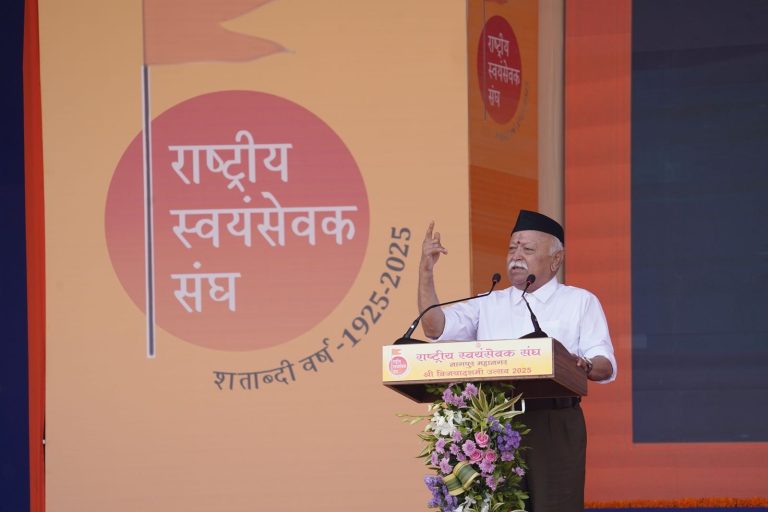
That is the backdrop to a familiar political manoeuvre: create a false bogey and blame the Rashtriya Swayamsevak Sangh (RSS). Founded in 1925, the RSS is often described as the world’s largest volunteer organisation. It works through local units called shakhas — daily neighbourhood gatherings of volunteers, known as swayamsevaks. It is ideological mentor of the Bharatiya Janata Party (BJP), which leads India’s national government.
Jairam Ramesh, general secretary in charge of communications for the Indian National Congress, India’s principal national opposition party, did exactly that on October 17 in an official statement. He was reacting to a notification issued on October 16 by the Registrar General of India — the official under the federal Home Ministry who conducts the census — amending the Census Rules, 1990. Ramesh linked three unconnected things: an RSS meeting in the southern city of Belagavi, a government demographic committee’s call for public inputs, and the amendment to the census rules. Without any evidence, he declared the result a “Rozgar Guarantee Yojana for thousands of RSS/BJP workers” — roughly, a government jobs-guarantee scheme for RSS and BJP activists — that would allegedly leave the Census “dangerously doctored”.
No document, no name and no number was offered as evidence. His claim does not stand up to scrutiny of the facts.
A routine annual meeting, recast as a plot
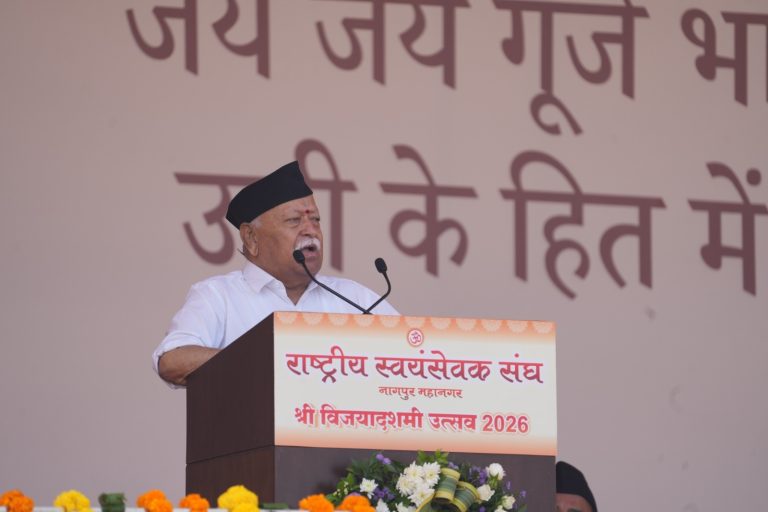
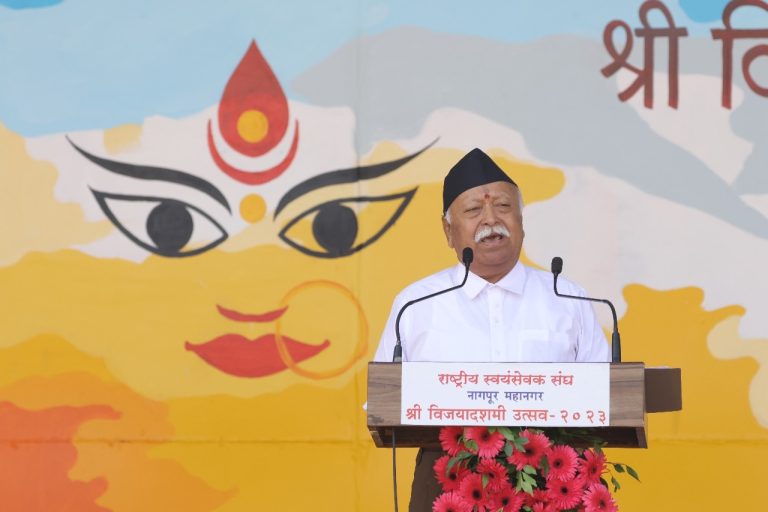
Ramesh speaks of a “big training camp” for cadres “on the single-point agenda of Census 2027”. What actually met in Belagavi from July 10 to 12 was the RSS’s annual Akhil Bharatiya Prant Pracharak Baithak — the all-India meeting of the organisation’s provincial full-time wokers. It is held every July, and took place in Delhi last year. It is one fixed date in the Sangh’s annual calendar of national meetings, much as a party conference or a church synod is a fixed date in the calendars of Western institutions.
Its participants were pracharaks — full-time volunteers who forgo family life to devote themselves to the organisation — who run the Sangh’s 11 kshetras (zones) and 46 prants (provinces). The “big training camp” alleged by Ramesh was merely a routine organisational meeting attended by only 226 RSS functionaries in addition to the organisation’s senior leadership.
In fact, it was not a training camp at all. It was a routine meeting whose agenda was published on rss.org on July 1. That agenda covered the expansion of the shakha network in the RSS’s centenary year; reports from the summer training camps, the organisation has held for its volunteers every year since the late 1920s; the 2026-27 travel schedule of the Sarsanghchalak, the chief mentor of the RSS; and contemporary national subjects such as the census. The concluding statement was also made public, giving details of the discussions at the meeting. Secret conspiracies do not usually publish their agendas in advance and their conclusions afterwards.
The census was one item on an open agenda. Every political party, think tank and media outlet in India is discussing Census 2027 — the first in 16 years. There is also an irony in the venue: Belagavi lies in Karnataka, a state governed by the Congress party itself, whose own administration secured the venue.
This is not the first attempt to create smoke where there is no fire. Public records show that the RSS holds several organisational meetings during the year. At all of them, its functionaries review organisational work, identify gaps and plan ahead. After every major meeting, senior functionaries brief the media. Reading an electoral or administrative conspiracy into a review of shakha expansion says more about the reader than about the Sangh.
A legal fix after court rulings, not a hiring scheme
Readers outside India may find it useful to know how census-takers are chosen. Rule 3 of the Census Rules already allowed teachers, clerks, officials “or any person” to serve as enumerators — the field staff who visit every household and record its details. That clause survived amendments in 1994, in 2009 (under the Congress-led United Progressive Alliance, or UPA, government), in 2018 and in 2022. The new amendment simply names the categories explicitly: teachers of government and private institutions, and officials of governments, public sector undertakings (state-owned companies), banks and similar bodies.
The trigger for this latest notification was a series of court rulings. On October 8, the Punjab and Haryana High Court stayed orders requisitioning teachers from private unaided schools — schools that receive no government funding — after petitioners argued that the law gave the state no such power. The Bombay High Court passed a similar order. With enumeration starting December 1 in four states and some 30 lakh field staff — about three million people — needed nationwide, the government closed a legal gap through this notification. Without it, private-school teachers, a large part of the workforce India has traditionally relied on for census duty, could have declined to serve.
Most importantly, census enumerators are appointed by state governments, not by the central government in New Delhi. India is a federal union, and census fieldwork runs through the administrations of its states. The Registrar General asked states to complete appointments of census functionaries by January 15, 2026. In Karnataka, Telangana and Kerala, Congress-led governments pick them. There is neither any provision nor any scope in the notification for appointment on the basis of political affiliation.
The design of Census 2027 also makes the accusation of “doctoring” impossible to sustain. As India’s first digital census, it will have enumerators record data directly on mobile applications rather than on paper forms. Each enumerator covers 700 to 800 people, and one supervisor oversees every six enumerators. Above them sits the Census Management and Monitoring System (CMMS) Portal, a centralised, web-based digital platform designed to plan, manage, execute and monitor all census-related activities across administrative levels. Through its integrated dashboard, officers at the sub-district, district and state levels can track enumeration progress, field performance and operational readiness in real time. Any irregularity in a single enumerator’s work would be visible to several layers of officials — many of them serving opposition-run state governments. Even the Congress party’s own newspaper, the National Herald, reported these safeguards without a hint of conspiracy.
Smearing a committee of judges and civil servants
Ramesh says the government’s demographic committee is “high level” only in its members’ RSS affiliation. A look at its composition tells a different story. It is chaired by Justice Prakash Prabhakar Naolekar, a retired judge of the Supreme Court of India. Its members are Durga Shanker Mishra, a retired officer of the Indian Administrative Service (IAS), the country’s prestigious civil service; Balaji Srivastava, a retired officer of the Indian Police Service (IPS); and the economist Shamika Ravi.
Calling them an “RSS ecosystem” is a smear on the institutions they served for decades. The Congress party’s real discomfort appears to be the committee’s remit — illegal immigration and abnormal settlement patterns, issues of particular sensitivity in India’s border states. The consultation works only by inviting public input, and no one should object to it: it is standard operating procedure for administrations everywhere, much like a public consultation in Britain or a notice-and-comment process in the United States.
A record of claims that did not hold up
There is a pattern to these accusations. Ramesh had earlier amplified, by reposting on X, a purported British-era Home Department document “signed” by Lord Mountbatten, the last Viceroy of India, which claimed that the RSS shunned India’s freedom movement. Even Alt News, an Indian fact-checking website that is no friend of the Sangh, found the document had been morphed.
This month, N. Chandrababu Naidu, Chief Minister of the southern state of Andhra Pradesh, publicly rebutted him on another claim, and minister Nara Lokesh asked him to verify facts before posting anything on X.
Indian courts have upheld over the decades that the Sangh’s organisational structure and activities are legitimate. Even so, it needs to be reiterated that the RSS has become the Opposition’s convenient culprit. The fact of the matter is that the Opposition keeps fighting the wrong battle. The allegations it makes against the RSS are never backed by evidence.
What the Congress party’s own history shows
Differences in ideology should not descend into slander. And the Congress would do well to read its own history, because its leaders have repeatedly worked alongside the RSS at moments of national crisis.
After India’s 1962 war with China, about 3,000 uniformed swayamsevaks marched in Delhi’s Republic Day parade in 1963 — India’s foremost state ceremony — in recognition of the organisation’s stellar contribution to the war effort. Whether Prime Minister Jawaharlal Nehru formally invited them may be debated; that they marched under his government is not.
In 1965, as Pakistan attacked India, Prime Minister Lal Bahadur Shastri invited Sarsanghchalak MS Golwalkar to an all-party meeting, even though the RSS was not a political party. The Sarsanghchalak pledged full cooperation.
The Vivekananda Rock Memorial — built on a rock off Kanyakumari, at India’s southern tip, where the Hindu monk Swami Vivekananda meditated before travelling to address the 1893 Parliament of the World’s Religions in Chicago — was built under RSS pracharak Eknath Ranade as part of his journey of serving the nation, with contributions from almost every state. Prime Minister Indira Gandhi visited on September 16, 1970, and called it “a moving experience”.
The real threat to India’s census
Census 2027 will shape India’s policy for at least a decade, and it will be run by officials whom state governments appoint — including the Congress party’s own. If there is any evidence that even one enumerator will be appointed for being an RSS swayamsevak or a BJP worker, it should be placed before the Registrar General, the courts or the state governments.
Otherwise, the only thing contaminating the Census is a campaign to discredit it before a single household has been counted.