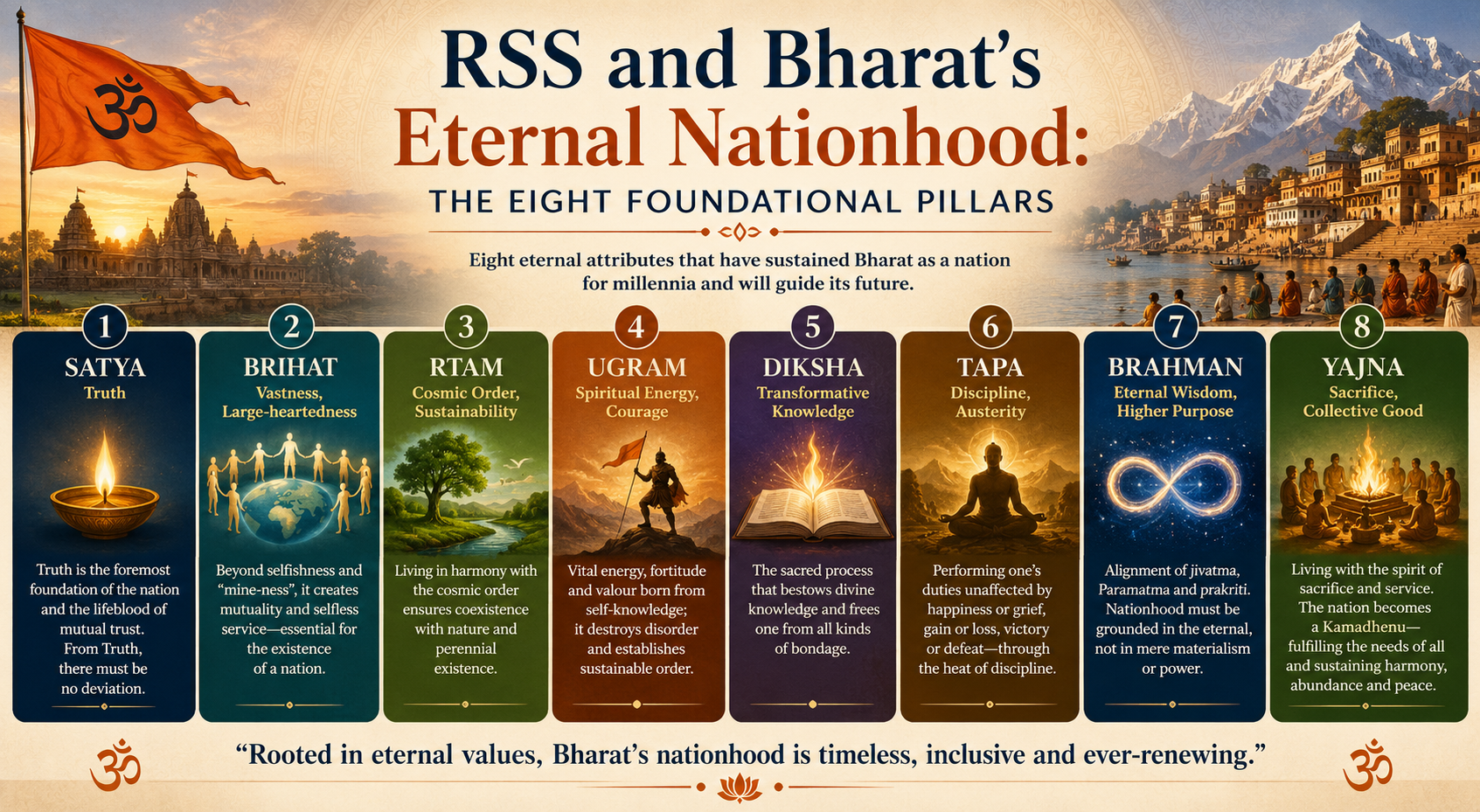
There have been several debates on the concept of nationhood as defined by the Rashtriya Swayamsevak Sangh (RSS). These debates have largely looked at Bharat’s nationhood from the lens of either politics, geography, or culture. From the RSS’ perspective, Bharat as a nation has eight key attributes that sustain it. Ranga Hari, an ideological stalwart of the RSS, has defined these attributes in his seminal work, ‘The Perennial Flow of Bharat’s Nationhood’.
Moral and Cosmic Foundation: Satya, Brihat, and Rtam
The first attribute is Satya or Truth. It is the foremost fundamental and founding base of the nation. Truth is imperative in order to live in the world successfully and purposefully. Truth is the fundamental element of a nation as it is innate in nature, serving as the lifeblood of mutual trust. Truth needs to be treated as an eternal value, unattached to any conditions or circumstances. As mentioned in the Taittiriya Upanishad: “Satyānna pramaditavyam”—which means, “From Truth, there must be no deviation.”
The second attribute that has sustained our nationhood for millennia is Brihat, meaning enormous or vast. All segments of the nation have to adopt this attribute, which implies large-heartedness. The inhabitants of the nation should not be selfish but selfless. In the Bhagavad Gita, Sri Krishna warns that thinking in terms of “this is mine” (mama) binds a person to material anxiety. To break this bondage, He introduces the concept of Nirmama, meaning “without mine-ness” or “free from possessiveness.” The element of Brihat is essential to create mutuality, without which a nation cannot exist.
The third fundamental attribute is Rtam (or Ztam). In Vedic literature, it defines the cosmic order which sustains Creation. Adhering to this attribute ensures that we protect and conserve the environment around us. Rtam has been very often used alongside the term Satyam (Truth) in our Vedic literature. When individuals conduct themselves in accordance with the spirit of Rtam, it ensures peaceful coexistence not only amongst individuals but also with nature. That is the only way to ensure perennial existence. As we are witnessing today, countries and societies that are not living according to this attribute are facing existential challenges in the form of climate change and bloody wars for exploiting and consuming more and more natural resources.
Inner Transformation and Resilience: Ugram, Diksha, and Tapa
The fourth attribute is Ugram. This denotes vital spiritual energy, fortitude, valour, and courage. To act according to this attribute, one requires the consciousness of one’s self. Ugram is a transformative energy that destroys disorder and establishes a sustainable order based on interconnectedness amongst individuals. The fundamental building block of this interconnectedness is knowledge of one’s self.
The fifth attribute is Diksha. Generally, this attribute is associated with worship or ritual, but it goes much beyond this narrow interpretation. Diksha is the process of attaining that knowledge which frees one from all kinds of bondage. As described in the Viṣṇu Yāmala Tantra:
divyaṁ jñānaṁ yato dadyāt kuryāt pāpasya saṅkṣayam | tasmād dīkṣeti sā proktā deśikais tattva-kovidaiḥ ||
“Because it bestows divine knowledge (divya-jñāna) and causes the complete destruction of all sins (pāpasya saṅkṣayam), this sacred process is declared as ‘Dīkṣā’ by the enlightened spiritual teachers who realize the ultimate truth.”
The sixth attribute is Tapa. Normally denoting austerity, tapa here means functioning and performing one’s tasks and duties without getting affected by external circumstances. Tapa in this context means forging ahead, regardless of happiness or grief, gain or loss, victory or defeat. One acquires their desired goals through this heat of discipline, as explained through the expression “Tapadbhiḥ prāpyate ’bhīṣṭam”—by those who engage in Tapas, the ultimate desired goal is inevitably attained.
The Ultimate Synthesis: Brahman and Yajna over Materialism
The seventh attribute is Brahma or Brahman. The holistic wisdom and enlightenment of the jivatma (being), Paramatma (the Supreme Being), and prakriti (nature) is Brahman. It implies that the foundation and institution of the nation cannot be materialism alone; it has to be based on the eternal element. A nation built purely on economic considerations and power dynamics lacks a moral anchor. Grounding national consciousness in the infinite (Brahman) provides a timeless ethical compass, ensuring that laws, justice, and social institutions serve the evolution of human consciousness rather than short-term greed.
The eighth attribute is Yajna. It is also often associated with a ritual, but in a broader context, it implies that one has to make sacrifices to accommodate the less privileged. Sri Krishna explained in the Bhagavad Gita:
saha-yajñāḥ prajāḥ sṛiṣhṭvā purovāca prajāpatiḥ | anena prasaviṣhyadhvam eṣha vo ’stv iṣhṭa-kāma-dhuk ||
“In the beginning of creation, the Creator (Prajapati) brought forth generations of mankind along with the spirit of sacrifice (Yajna). He told them: ‘By this sacrifice may you prosper, and let this be the wish-fulfilling cow (Kamadhenu) to grant you all your desired outcomes.'”
The essence of this attribute, as explained in the above verse, is that raw materialism and selfish hoarding will break the cosmic chain. When a society or nation conducts itself with the spirit of Yajna, everyone contributes their best work for the collective good. In doing so, the nation itself becomes a Kamadhenu—a wish-fulfilling engine that naturally generates sustainable abundance, harmony, and peace.