As the Rashtriya Swayamsevak Sangh (RSS) observes its centenary year, one of the least understood aspects of the organisation remains its unique tradition of Guru Dakshina. Unlike many organisations that rely on membership fees, external fundraising campaigns or institutional grants, the RSS has, since its early years, followed a distinctive model of voluntary contributions made by its own swayamsevaks.
The tradition began in 1928, three years after the RSS was founded by Dr Keshav Baliram Hedgewar. Every year, beginning on Guru Purnima, swayamsevaks across the country voluntarily contribute according to their capacity. These offerings, known as Guru Dakshina, constitute the principal source of resources for the organisation’s activities.
Guru Purnima occupies a special place in the RSS calendar. Along with Vijaya Dashami, Makar Sankranti, Varsha Pratipada, Hindu Samrajya Divas and Raksha Bandhan, it is one of the six major annual observances of the organisation. The Guru Dakshina programme generally starts a few weeks before Guru Purnima, with ceremonies being organised in thousands of shakhas across the country.
A Tradition Rooted in Indian Civilisation
The idea of Guru Dakshina predates the RSS by centuries. In the Indian knowledge tradition, it symbolises gratitude rather than payment. A student expresses reverence towards the teacher by making an offering after receiving knowledge and guidance. The offering is not viewed as a fee but as an expression of respect and commitment.
Guru Purnima itself is associated with Maharshi Ved Vyasa, revered as the compiler of the Vedas and author of the Mahabharata. The day is traditionally dedicated to honouring teachers and the guru-shishya parampara, one of the oldest continuing educational traditions in the world.
The RSS adopted this civilisational practice and gave it an organisational form. Instead of collecting compulsory subscriptions, it encourages every swayamsevak to contribute voluntarily once a year according to his own ability and conviction.
Why the Bhagwa Dhwaj is the Guru
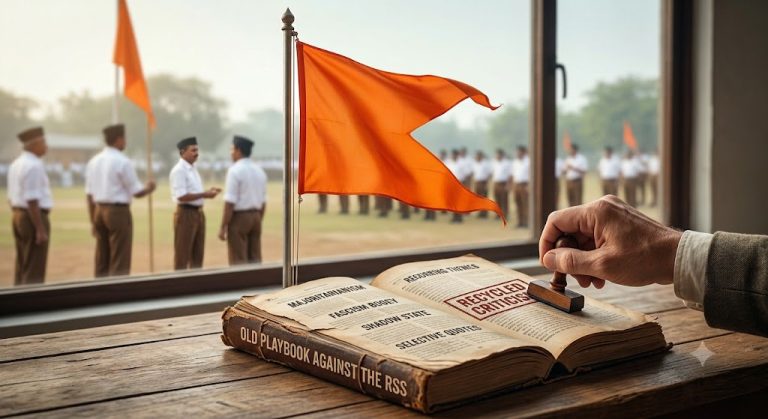
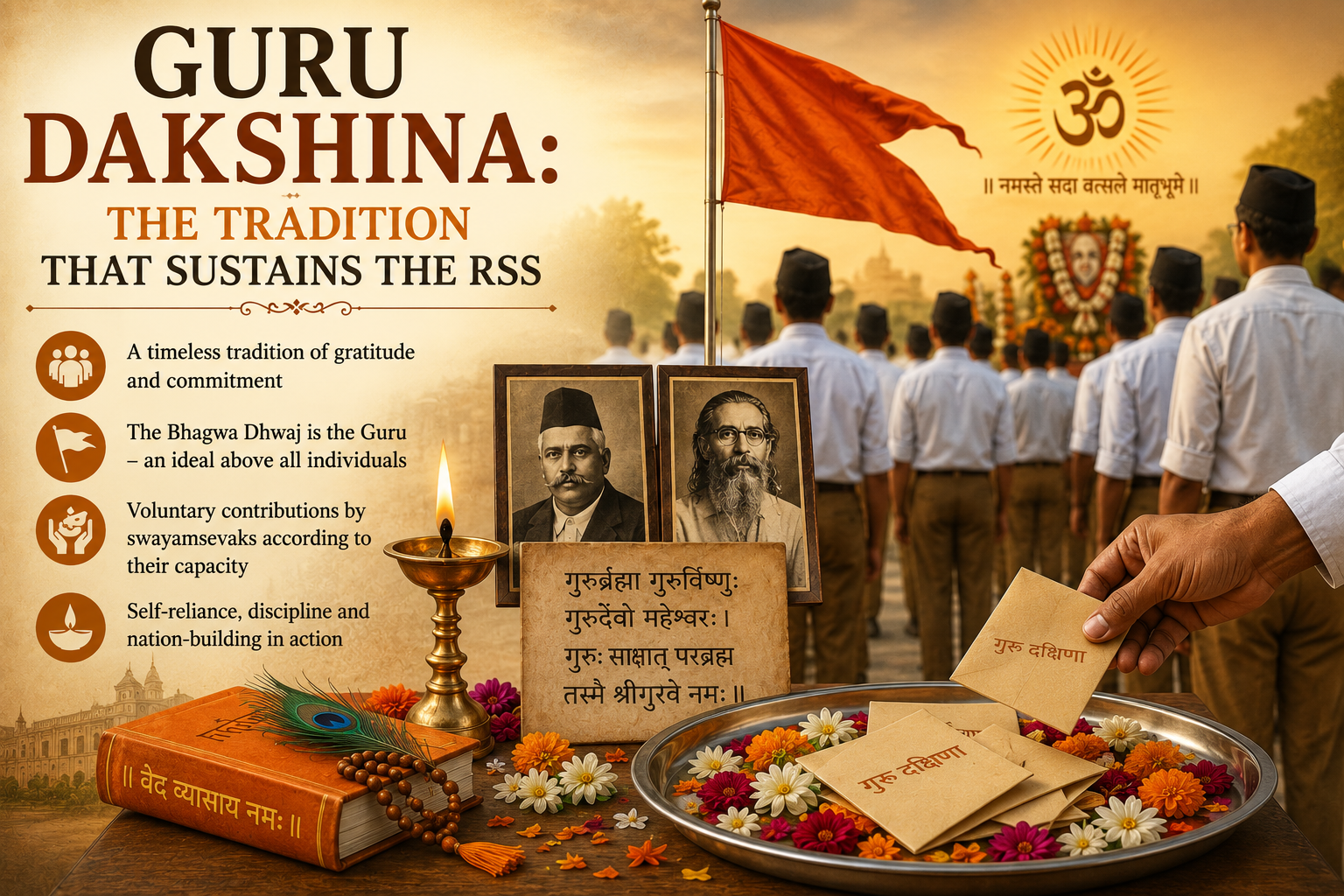
One of the defining features of the RSS Guru Dakshina ceremony is that the offering is not made to an individual but to the Bhagwa Dhwaj (Saffron Flag). This decision was taken by Dr Hedgewar himself.
In the formative years of the organisation, suggestions were reportedly made that the founder should be regarded as the guru. Dr Hedgewar rejected the idea. Instead, he declared the Bhagwa Dhwaj to be the eternal guru of the organisation.
The choice reflected an important institutional principle. By placing the flag above every individual, the RSS consciously sought to avoid personality worship. Individuals may come and go, but ideals remain permanent. The saffron flag, long associated in Indian civilisation with sacrifice, renunciation, courage, knowledge and service, came to represent those enduring values.
For the RSS, therefore, Guru Dakshina is not an offering to a leader. It is an offering made before a symbol that represents the nation’s civilisational ethos and the ideals the organisation seeks to uphold.
How the Ceremony is Conducted
The Guru Dakshina programme is usually organised in a simple and disciplined manner. A hall or shakha ground is prepared with the Bhagwa Dhwaj placed at the centre. An earthen lamp is lit, and portraits of Dr Keshav Baliram Hedgewar and the second Sarsanghchalak, M.S. Golwalkar, are placed nearby.
The ceremony begins with prayers, patriotic songs and recitation of traditional verses. Each swayamsevak then comes forward individually and places a sealed envelope before the Bhagwa Dhwaj. The amount contributed is entirely voluntary, with no prescribed minimum or maximum. The emphasis is on participation and commitment rather than the size of the contribution.
After offering flowers and performing Dhwaj Pranam (salutation to the flag), the volunteers return to their places. The programme generally includes a short address by a senior RSS functionary or an invited speaker, followed by the Sangh prayer and informal interaction among participants.
An important feature of the process is confidentiality. Contributions are made discreetly, and individual amounts are not publicly announced. The emphasis remains on the spirit of offering rather than recognition.
A Model of Self-Reliance
Over nearly a century, Guru Dakshina has become more than an annual ceremony. It reflects the RSS’s emphasis on self-reliance, voluntary participation and organisational discipline.
Since the contributions come from swayamsevaks themselves, the system reinforces a sense of ownership and shared responsibility. Every volunteer, regardless of the amount contributed, participates equally in sustaining the organisation’s activities.
The annual observance also serves as a moment of introspection. It reminds participants that commitment to nation-building is not expressed only through physical participation in the shakha but also through a willingness to contribute according to one’s means.
In many ways, Guru Dakshina embodies a broader principle found throughout India’s civilisational traditions: institutions endure when they are sustained by voluntary commitment, shared values and collective responsibility rather than dependence on individuals. That is why, even after nearly a hundred years, the annual Guru Dakshina ceremony continues to remain one of the most distinctive and enduring traditions of the Rashtriya Swayamsevak Sangh.
(The writer is a senior journalist)