
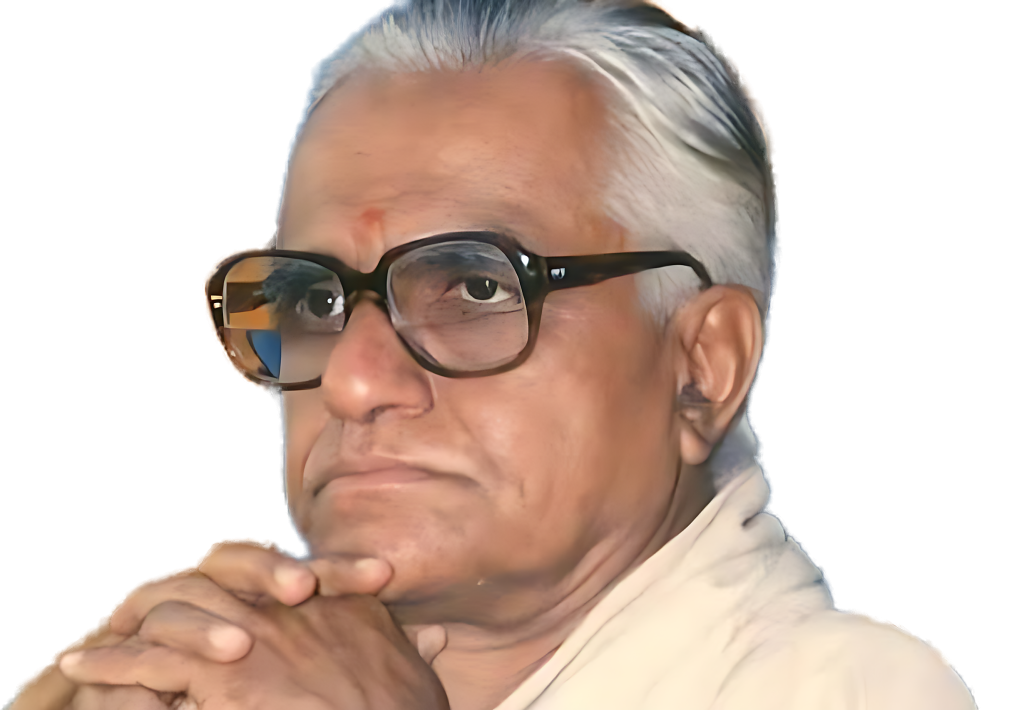
On 13 November, Prime Minister Narendra Modi visited Prashanti Kutiram, the S-VYASA campus on the outskirts of Bengaluru. The occasion marked two events: the 50th anniversary of the yoga institute and the centenary of Hongasandra Venkataramaiah Seshadri, known within the Rashtriya Swayamsevak Sangh (RSS) as Seshadri ji. Sarkaryavah (General Secretary) Dattatreya Hosabale shared the stage with the Prime Minister. The Prime Minister also released six of Seshadri’s books, translated from Kannada into English.
The venue was fitting. Seshadri guided S-VYASA and the yoga movement that grew out of it. When he passed away in 2005, his nephew Dr H.R. Nagendra, who led the movement, performed his last rites. Dr Nagendra, an IISc PhD in mechanical engineering and a former NASA research associate, left his scientific work in 1975 to join Vivekananda Kendra. He went on to found the Swami Vivekananda Yoga Anusandhana Samsthana (S-VYASA), pioneered evidence-based yoga therapy, and helped shape the protocol for the International Day of Yoga.
Paying tribute, the Prime Minister said Seshadri had devoted his entire life to nation-building through character-building. He added a personal note: “The memories of that time with him, the time we spent together, and his words remain with me today.”
From a gold medal in chemistry to the life of a pracharak
Seshadri was born in Bengaluru on 26 May 1926. He earned an MSc in chemistry at the then Mysore University and won a gold medal. In 1946 he became a pracharak (full-time worker) of the Sangh. He worked in Bengaluru and, in the early 1950s, in the Mangalore region. In 1960, he became Prant Pracharak (organiser of the Karnataka prant, the Sangh’s provincial unit).
In 1980 he became Kshetriya Pracharak (zonal organiser) for the southern region, covering Karnataka, Andhra Pradesh, Tamil Nadu and Kerala. He later served as Sah Sarkaryavah (Joint General Secretary). In 1987, he was elected Sarkaryavah and held the responsibility for thirteen years, until 2000. Those years included the Ramjanmabhoomi movement, the turbulence of the 1990s, and a period of large expansion for the Sangh. As his health declined, he handed the responsibility to Mohan Bhagwat, today’s Sarsanghchalak (Chief Mentor), and became Akhil Bharatiya Pracharak Pramukh (All-India head of pracharaks). He passed away at Keshav Kripa, the Sangh office in Bengaluru, on 14 August 2005.
Building Karnataka, brick by brick
His twenty years as Prant Pracharak shaped the Sangh in Karnataka as it stands today. He took shakha (daily neighbourhood gathering) work across the state and carried forward Yadavrao Joshi’s work in organising sewa (service). During the Emergency, he edited Bhugilu (The Flare-up), a record of the excesses of that period and of the resistance to them.
His reach extended abroad. In 1984, he was a special invitee at the World Hindu Conference in New York and at the Hindu Sangam in Bradford, UK.
The writer behind the organisation
Seshadri wrote 32 books, nearly 4,000 pages in all, as well as numerous articles and booklets in Kannada, English, and Hindi. For many years he was the principal writer for Vikrama (weekly), Utthana (monthly), Organiser and Panchajanya.
Yugavatara, his life of Chhatrapati Shivaji, has run into eight editions and has been translated into Hindi and English. Torberalu, a collection of essays on social themes, won the Karnataka Sahitya Akademi Award in 1982. Amma Bagilu Tege gathers his lighter pieces, and Chintanaganga is the Kannada version of second Sarsanghchalak MS Golwalkar’s thought.
His English-language work took the Sangh’s view of history to national and international readers. The Tragic Story of the Partition, first published in 1982 as the English version of Desha Vibhajaneya Duranta Kathe, remains the standard work on the events of 1947. RSS: A Vision in Action was among the first comprehensive accounts of the organisation and its work. He also wrote Warning of Meenakshipuram (1981), Implications of Christian Conversions (1999) and, in Kannada, Aasaamina Aartaswara (The Anguished Cry of Assam, 1980). These books addressed conversions, infiltration and the falsification of India’s history when few in public life were willing to do so.
The man who made men
His letters and his presence shaped people as much as his books shaped thinking. Hosabale recalls that Seshadri wrote more than 10,000 letters to workers on all kinds of matters, including personal ones, and that he would visit small villages and know the names of thousands of karyakartas (workers).
Hosabale, who joined the Sangh in Karnataka in 1968 when Seshadri was Prant Pracharak, said of him: “H.V. Seshadri ji, steeped in patriotism from childhood, gave limitless inspiration for national work in life to countless swayamsevaks like me. His entire life was a living example of the sattvik karma yoga as described in the Bhagavad Gita.”
The grooming was personal and practical. Hosabale cites an instance in which Seshadri tied the laces of a young swayamsevak’s uniform shoes. That swayamsevak later said Seshadri had “bound him to the organisation and to the nation for life”. Even in failing health, Seshadri travelled to meet middle-level workers one by one, asking about their health, studies, and problems. In the 1980s, he sat in the front row of every session of a four-day lecture series in Bengaluru, and the audience learnt to arrive on time.
The Prime Minister recalled an image Seshadri often used: a mother who stays awake all night for her child and asks for nothing in return. Seshadri held that what one gives to society with both hands returns a thousandfold. His own life followed that principle. Hosabale once found him shaving before a broken mirror and suggested a new one. Seshadri said he could see what he needed to see. Told that a broken mirror was inauspicious, he smiled and said: “What more is there to be auspicious about in this life?”
His work today
The Sangh is now in its 102nd year, with work in every district of the country and among the diaspora. It grew through organisers who wrote, writers who organised, and leaders who stayed in the background so that others could come forward.
His books on the Partition and Christian conversions remain essential references for scholars and practitioners. The yoga organisation he inspired has helped establish yoga in scientific and academic settings worldwide. The karyakartas he nurtured carry his work forward, from village shakhas to the Sangh’s top leadership.