When discussions arise about the growth and resilience of the Rashtriya Swayamsevak Sangh (RSS) over the past century, attention often turns to its organisational methods, its network of daily shakhas, or the many social initiatives that have emerged from its work. Yet behind these visible expressions lies something deeper, a culture shaped over decades by individuals whose personal lives reflected extraordinary discipline and commitment.
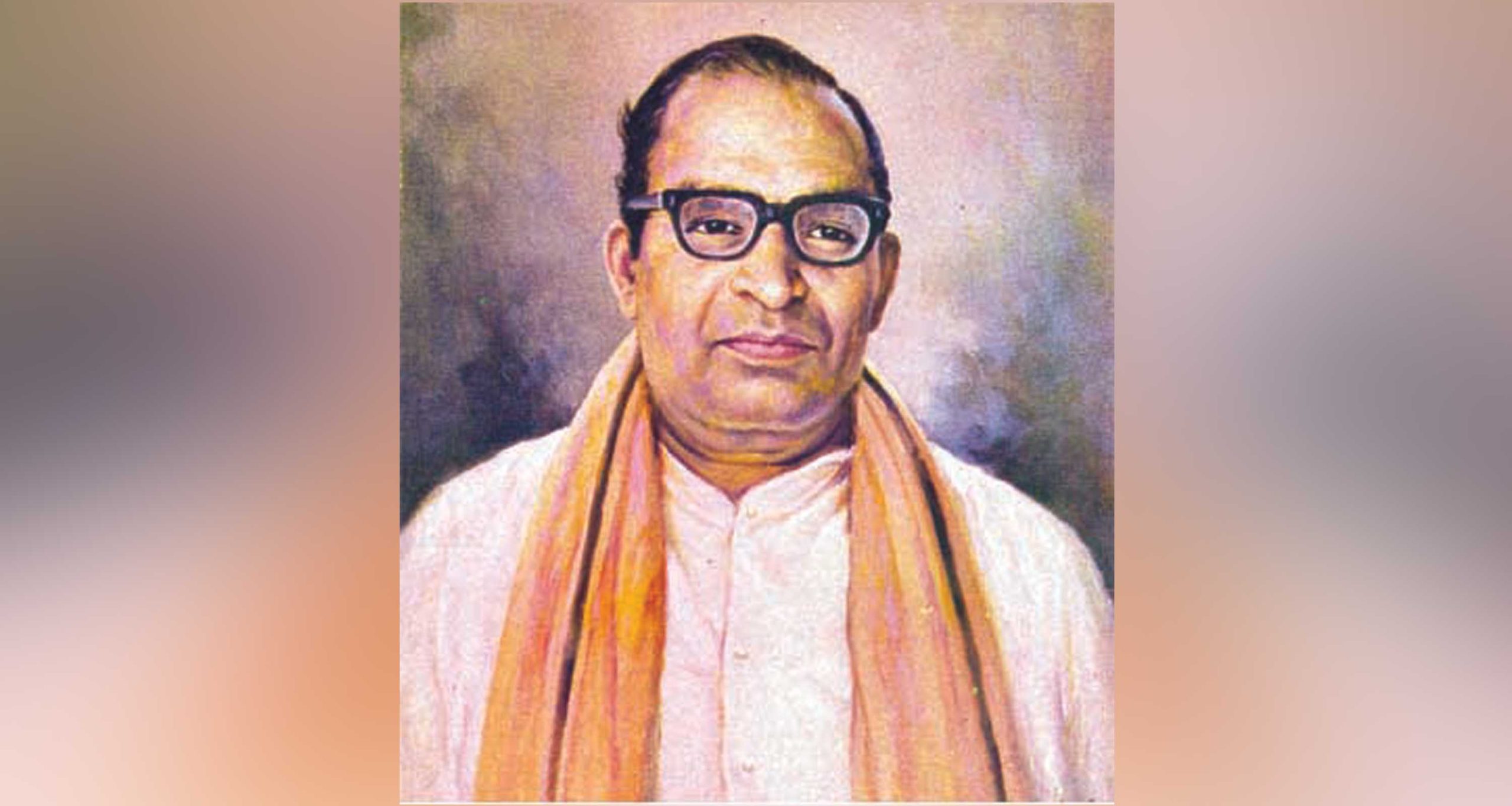
Among those individuals, Eknath Ranade who served as Sarkaryavah (General Secretary from 1955-62)of the RSS occupies a distinctive place. Those who worked closely with him remembered a personality marked by quiet intensity, meticulous habits, and a complete absence of personal display.
His life was defined by constant, methodical work carried out with quiet seriousness. To understand his contribution is therefore to look at the institutions he helped build and the character that guided them. The following incidents and reflections illustrate the discipline and organisational ethos that shaped Eknath Ranade.
A young boy named Eknath Ranade would often sit for nearly an hour on the wall near the Nagpur shakha, quietly observing the activities. When the entry of young boys into the shakha began, he joined the very first group. His dedication and discipline were such that he would later rise to become one of the most distinguished and memorable Sarkaryavahs of the RSS.
Born on 16 November 1914 in Tiltilā in Amravati district of Maharashtra, Eknath Ramakrishna Ranade was from an early age a bright student, gifted orator, and natural organiser. Ranade pursued his early education in Nagpur while living with his elder brother. It was during this period that he came into close contact with the RSS and its founder Dr Keshav Baliram Hedgewar, an interaction that shaped his resolve to dedicate his life to national service.
After passing his Matriculation examination, he approached Hedgewar and offered himself for RSS work anywhere in the country. Hegdewar, however, advised him to continue his studies, explaining that higher education would enable him to serve society more effectively and ensure that people did not assume he had chosen this work only because he lacked other opportunities.
Following this advice, Eknath completed his graduation in 1936. By then, he had already emerged as a deeply studious and committed young man, known for his clarity of thought, inspiring speech, and unwavering dedication to a larger national mission.
Leader of the Historic Satyagraha
In 1948, a ban was imposed on the RSS after the organisation was falsely accused in connection with the assassination of Mahatma Gandhi. The Sarsanghchalak (Chief Mentor) Madhav Sadashiv Golwalkar, along with Sarkaryavah Bhayyaji Dani and several other senior functionaries, were arrested.
In this difficult situation, the responsibility of organising the nationwide Satyagraha fell upon Eknath Ranade. From Delhi he directed the movement, leading what came to be regarded as one of the largest Satyagrahas. Nearly 80,000 Swayamsevaks courted arrest across the country, filling prisons nationwide.
During this period, Eknath worked underground, travelling across the country to maintain morale among Swayamsevaks and facilitate mediation between the RSS and the government.
He also drafted a written constitution for the RSS and submitted it to Venkatarama Shastri (a distinguished jurist from Madras) who was helping mediate with the government. When Shastri raised objections about the inclusion of Bal Swayamsevaks (young volunteers), Eknath argued that even the Congress Seva Dal enrolled young boys, therefore, such participation in the RSS should not be questioned. Shastri accepted this reasoning and successfully conveyed it to the government.
Service to Displaced Hindus
Later, when Eknath was appointed Pracharak (full-time worker)for the Purvanchalregion (eastern belt of Uttar Pradesh) he faced the humanitarian crisis created by the influx of lakhs of Hindu refugees from East Pakistan (now Bangladesh). To organise relief, he established the VastuharaSahayata Samiti.
Through this initiative, thousands of tents and temporary shelters were arranged for displaced families. For months, food, clothing, and medical care were provided. Efforts were also made to help refugees rebuild their lives through basic education and vocational training, enabling them to regain self-reliance and stability.
Organisational Vision and Institutional Foundations
Eknath played a significant role in streamlining the organisational functioning and creating a strong institutional memory that still serves the organisation purposefully.
Systematising the Method of Work
Eknath Ranade brought systematic clarity to several aspects of the functioning of the RSS. Organisational principles such as Lok Sampark (public outreach), Lok Sangrah (social consolidation), Lok Sanskar (cultural shaping of society), and Lok Vyavastha (social organisation) were articulated and institutionalised through his efforts.
Society’s “Centres of Influence”
Eknath emphasised maintaining contact with influential individuals across society like community leaders, local heads, and respected figures, regardless of formal education. What mattered was their social influence and ability to guide their communities.
Beginning the Tradition of Nationwide Organisational Tours
As Sarkaryavah, he initiated extensive tours across the country, travelling district by district. In major cities he would stay for several days, personally training Mukhya Shikshaks (Chief Instructor) in the discipline and procedures of the daily shakha including overall achaar-paddhati (organisation’s established code of conduct). He also ensured correct pronunciation, rhythm, and understanding of the RSS prayer.
Maintaining Detailed Worker Lists
Eknath Ranade introduced the systematic preparation of detailed lists of workers for meetings. Every worker’s name, location, responsibility, training background, and Sangh Ayu (time spent in working in RSS since joining) were to be recorded. If someone was absent, the reason could be understood personally, and they could later be informed about the meeting’s decisionsensuring accountability and personal contact.
The Unwritten Ethos of the Organisation
Eknath Ranade often explained that organisations function not only through written rules but also through an unwritten ethos. He referred to this as “Kul-Reeti”,the living tradition of conduct within the organisational family.
He illustrated this through an incident from April 1944.
A Swayamsevak named Leeladhar Rathore from Khandwa was entrusted with delivering an urgent message to Sarsanghchalak MS Golwalkar, informing him that the venue of a Sangh Shiksha Varg (Training programme) had been changed at the last moment. Golwalkar, known within the organisation as Guruji, was attending a meeting of Pracharaks in Timarni that was scheduled to conclude that afternoon. The message had to reach him before he left.
Rathore reached the railway station carrying the note but accidentally boarded the Calcutta Mail instead of the passenger train that stopped at Timarni. When the train passed the station without halting, he realised the mistake. Returning from the next station would delay the message, and by then Sarsanghchalak would likely have already departed.
Determined to deliver the message in time, he jumped from the moving train. He fell onto the gravel beside the tracks and was severely injured.
Despite his injuries, he made his way to the meeting venue at Timarni. Reaching there, he handed the message to the Sarsanghchalak and collapsed.
He survived the fall, but the incident remained an example often cited by Ranade to illustrate the RSS organisational ethos, where once a responsibility is accepted, it must be fulfilled with complete dedication.
Praise All Around, Criticism Upwards
Eknath Ranade emphasised another aspect of organisational culture. Complaints about a worker or functionary should not be discussed casually; they should be taken to the appropriate authority in the hierarchy. If unresolved, the matter could move upward, even to Sarsanghchalak.
Thus, appreciation should circulate everywhere, while criticism should move upward through responsible channels.
Lighting Lamps of Hope in Difficult Times
Eknath became Sarkaryavah during a discouraging phase in the RSS history after the ban, when finances were strained and morale was low.
To address this, he persuaded Golwalkar, known for his humility to allow a Shraddha Nidhi (voluntary offering out of respect) on the occasion of his 51st birthday in 1956. Each province contributed voluntarily.
The total reached ₹26 lakh, an enormous amount at that time. Through this initiative, the organisation was able to clear its debts and restore financial stability. More importantly, it rekindled enthusiasm and confidence among Swayamsevaks.
Inspiring National Programmes and the Spirit of Collective Participation
In a similar spirit, the All-India training camp held in Indore (in Madhya Pradesh) in 1960 for Vibhag Sanghchalaks, Karyavahs (Heads and Chief Executives of various RSS units), and Pracharaks proved to be highly energising for the organisation.
Later, in 1962, the All-India gathering of swayamsevaks organised on the occasion of the inauguration of the Smriti Mandir at RSS headquarters in Nagpur, dedicated to Dr Hedgewar, also became a landmark moment in the RSS organisational journey.
The planning and construction of the Smriti Mandir owed much to the vision and organisational skill of Eknath. To ensure that every Swayamsevak across the country felt a personal connection with the memorial, he initiated a unique idea where each Swayamsevak contributed one rupee towards its construction.This created a feeling that the memorial belonged to everyone.
Never Satisfied with Less than the Best
A defining trait of Eknath Ranade was his insistence on precision and excellence.
He would often rewrite letters repeatedly until the wording was exact. One of his associates, P. Parameswaran once recalled that while touring South India, Eknath carried a dictionary during English speeches and would pause briefly to find the most appropriate word rather than use an inaccurate one.
Before undertaking any task, he studied it thoroughly. For example, before beginning work related to the Vivekananda Rock Memorial, he personally swam to the rock to understand the site. He also studied engineering concepts to interact effectively with architects and engineers.
Practical Guidance to Workers
Eknath would tell the workers that letters must be replied to immediately. Not doing so, he would say, is like someone speaking to us while we turn our face away and sit silently.
Similarly, he considered the habit of maintaining a diary and systematically recording all necessary information in it as an essential discipline of organisational work. The diary, he would say, should always be kept close at handotherwise, what is its use?
To those who became discouraged by difficulties or adverse circumstances and began to think in a defeatist manner, Eknath would say that workers should be like the high-tension wires of electricity,which are installed above all other lines and are capable of carrying the current despite all kinds of voltages and shocks, while ensuring that the flow of electricity remains orderly and controlled.
He would further declare that if a problem has been created by human beings, then human beings can certainly solve it as well.
“Then You Are the Right Person”
Parameswaran recalled an incident from 1957 when he was a head of the Bharatiya Vichar Kendra (a cultural and intellectual organisation) in Kerala. Eknath asked him to work in the Bharatiya Jana Sangh (predecessor of today’s Bharatiya Janata Party). When he replied that he had no interest in politics, Eknathsaid:
“Precisely because of this detachment, you are fit to work in that difficult field.”
Parameswaran later accepted the responsibility and eventually became National Vice-President of the Bharatiya Janata Party.
Difficult Fields, Diverse Fields
Eknathji advised workers in various organisational fields that shakha attendance must never be neglected, even by those holding important responsibilities.
At a meeting in Lucknow, a senior leader of Bharatiya Jana Sangh once asked whether their work should also be considered RSS work. Eknath replied immediately:
“A person who thinks in this manner should be considered as having already drifted away from the work.”
When Sankat Prasad Singh of the Bharatiya Kisan Sangh (an RSS-inspired organisation of farmers) sought guidance, Eknath explained that workers in different fields should not expect more from the RSS than they themselves contribute. They must establish their own ground while drawing inspiration from the RSS.
The Unconquerable “Commander”
In 1973, after the passing of Sarsanghchalak MS Golwalkar, Balasaheb Deoras became the new Sarsanghchalak. By then Eknath Ranade was fully engaged in the work of the Vivekananda Kendra and the Rock Memorial.
Even so, he continued to participate in programmes across the country.
An Incident Illustrating His Character
In June 1973, Eknath Ranade addressed a Sangh Shiksha Varg (RSS training camp) in Kanpur. By coincidence, the newly appointed Sarsanghchalak Balasaheb Deoras was also present during his session, in which Eknath spoke on the theme “Pujaniya (revered) Sarsanghchalak.”
The following day, a meeting of all teachers and Pracharaksof the camp was held at Sanatan Dharma College. After the initial discussions concluded, Eknath was about to begin another subject when Dr. Kanhaiyalal Singh, the camp karyavah (Head), raised a question that changed the tone of the gathering. Through his remarks he indicated that, in the prevailing circumstances, the organisation might benefit if Eknath himself assumed its responsibility.
Eknath responded immediately:
“As far as my personal position is concerned, my bag is always tied and ready. It would not take even two minutes for me to come here from there. But if you have faith in the extraordinary personality of revered Guruji (Golwalkar), then accept that the arrangement he created for the organisation will prove fully effective.”
This clear and balanced reply satisfied everyone present.
A Legacy of Character
As the RSS reflects on its hundred-year journey, many milestones naturally come to mind like the expansion of its work, the development of institutions, and the influence it has exerted across different fields of national life.
It is also clear that the deeper strength of the organisation lies in the character of individuals who quietly shaped its culture through their conduct.
Eknath Ranade’s life offers a vivid example of this tradition. His discipline in small matters, his seriousness in accepting responsibility, his insistence on clarity in language and thought, and his reluctance to seek personal recognition together formed a personality that inspired those who worked with him.
For younger Swayamsevaks learning about this legacy today, the lessons do not appear in the form of instruction or exhortation. They appear in the habits and decisions of a worker whose life reflected the ideals he or she served.
Eknath Ranade passed away at Chennai on August 22, 1982 at the age of 67.
(The writer is an author and columnist)
(Note: Parts of the text are translated and adapted from the book Sangh Neev Mein Visarjit Pratham Pushpwritten by Vireshwar Diwedi, Lokhit Prakashan (Rashtradharm Prakashan Ltd.), Lucknow, Uttar Pradesh, 5th Edition, January 2016.)