
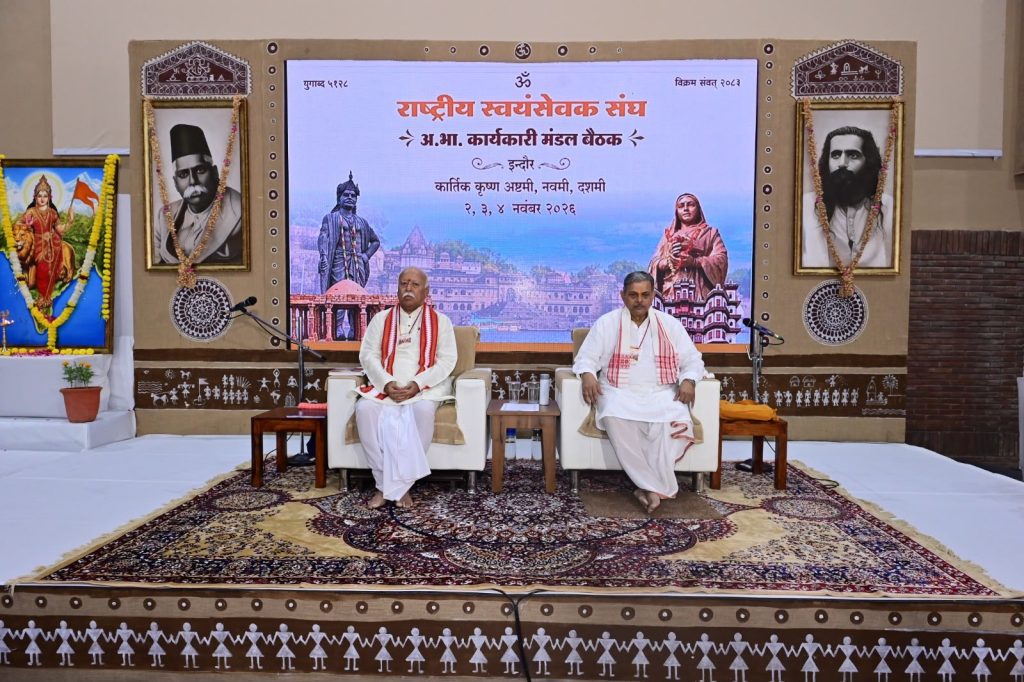
Each year, the Rashtriya Swayamsevak Sangh (RSS) takes stock of the year behind it. The body that carries out this review is the Akhil Bharatiya Karyakari Mandal (ABKM), the All India Executive Council. Its annual sitting shows how the organisation measures its own progress, and how that measurement has changed.
Within the RSS hierarchy, the ABKM holds the second-highest position. At a press briefing at Dharwad in 2021, Arun Kumar, then serving as Sah Sarkaryavah (Joint General Secretary), set out the structure. The Akhil Bharatiya Pratinidhi Sabha (ABPS) is the supreme decision-making body, with nearly 1,500 elected representatives who determine the annual calendar. The ABKM sits immediately below it, and one of its central responsibilities is to review the organisational progress achieved so far.
The ABKM meets every year before Diwali. It reviews the annual plan set at the March ABPS, assesses how the RSS’s work has expanded, and follows up on the address of the Sarsanghchalak (Chief Mentor) on Vijayadashami, the festival on which the RSS was founded in 1925. National issues of the day are also on the table. The cycle is the constant: the plan is set in spring and assessed in autumn.
The participants include the Sarsanghchalak, the Sarkaryavah (General Secretary), all the Sah-Sarkaryavahs, the heads of the All India departments (Akhil Bharatiya Karya Vibhag Pramukhs) and other ABKM members. Each of the 46 prants (provinces) sends its sanghchalak (provincial mentor), karyavah (the de facto head) and pracharak (full-time worker), along with their deputies, and the 11 kshetras (regions) are represented as well. Attendance stood at 381 in 2023 and 393 in 2024. With six seats for each of the 46 prants, the prants could supply up to 276 of the 2024 participants (the writer’s calculation).
The meetings open with routine business. At Mathura in 2024, the proceedings of the previous meeting were approved, and each prant was to present its special initiatives and general situation. At Bhuj in 2023, Akhil Bharatiya Prachar Pramukh (All India Publicity Chief) Sunil Ambekar said the ABKM would take up practical issues from the ground. This included reviewing targets for expanding shakhas, the local daily gatherings that form the RSS’s basic unit. The organisation carries out this review every six months, so the shakha count is the most regular measure of its reach.
The agenda shifts with the calendar but follows a recognisable pattern. At Prayagraj in 2022, the announced items were the annual plan, expansion, and the Sangh Shiksha Varg, the training camps. At Bhuj, the agenda included programmes linked to the Ayodhya temple consecration and a change in the camps’ curriculum. At Mathura, it covered Panch Parivartan, the RSS’s five-point social agenda, and the goals for its centenary year. At Jabalpur in 2025, the focus was on nationwide Hindu conferences.
The ABKM has also adopted resolutions from time to time on matters of national and foreign concern. These include one on the Pak-American pact in 1952, one on Bangladesh in 1971, one on attacks on Hindus in Bangladesh at Dharwad in 2021, and one on Jammu and Kashmir in 2020.
The organisational structure itself is now under discussion. At the Samalkha press conference during the ABPS meeting on 15 March, Sarkaryavah Dattatreya Hosabale said decentralisation had been discussed. The proposal is to create smaller units called sambhags in place of prants by the next ABPS, after which the 46 prants may be replaced by more than 80 sambhags. Hosabale described the aim as efficiency. In August, it was reported that the prant pracharak system, the full-time worker in charge of a prant, would give way to a sambhag pracharak system, and the ABKM’s annual gathering can be read as one stage in that change.
The ABKM is best understood as the RSS’s annual instrument of review. The ABPS sets the direction, and the ABKM checks how faithfully the year’s plan has been carried out on the ground, from shakha numbers and training camps to the organisation’s own structure. The next few cycles will show whether the proposed move from prants to sambhags changes the rhythm of that review or only the map on which it is drawn.
(The writer is an author and columnist)