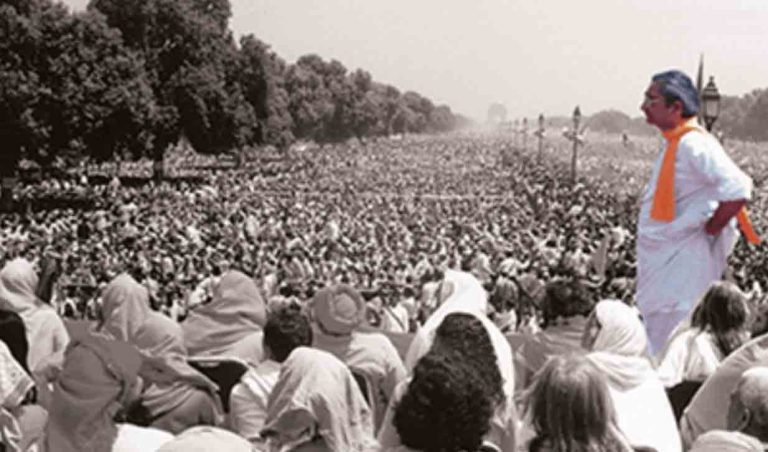
When construction began on the Vivekananda Rock Memorial, a monument rising from the open sea off Kanyakumari in the 1960s, Eknath Ranade made his purpose clear: “To put up a cement and concrete structure is not the work for which I am born.” His real aim was a “living memorial”: the Vivekananda Kendra, a spiritually oriented service mission built around man-making and nation-building.
Early Years in Nagpur
Eknath Ramakrishna Ranade was born on 19 November 1914 at Timtala, in Maharashtra’s Amravati district, the youngest of eight children. His father, Ramakrishnarao Vinayak Ranade, worked for the Great Indian Peninsular Railway in Vidarbha. His mother, Ramabai, came from the Barve family of Pune.
In 1921 he was sent to Nagpur to live with his eldest brother, Baburao. Dr Keshav Baliram Hedgewar had founded the Rashtriya Swayamsevak Sangh (RSS) in Nagpur in 1925. In 1926, at the age of twelve, Eknath attended his first shakha, the RSS’s daily gathering, and it became the turning point of his life. He passed his matriculation in 1932 and wanted to become a full-time RSS worker at once, but Dr Hedgewar insisted that he first finish his education. Ranade went on to take an honours degree in philosophy from Nagpur University.
To answer the arguments of Christian missionaries, he began studying the Upanishads. Finding them hard to interpret on his own, he turned to the works of Swami Vivekananda, which first introduced him to Swamiji’s life and vision.
Pracharak and Underground Organiser
In 1938 Ranade became a pracharak, a full-time worker of the RSS, and was sent to the Mahakoshal region of central India. He completed an LL.B. in first class in the mid-1940s and rose to prant pracharak (provincial organiser) for Mahakoshal and Madhya Bharat, where his organising skill and remarkable memory became widely known.
When the RSS was banned after Mahatma Gandhi’s assassination in 1948, Ranade went underground to keep the organisation functioning. The satyagraha (passive resistance) he directed from Delhi is documented in Discipline, Duty, and Nation: The Life and Work of Eknath Ranade. The ban was suspended on 20 January 1949 after government-initiated negotiations. During that period, Ranade, P.D. Dani and Balasaheb Deoras drafted a formal constitution for the organisation. According to the chronological biography, he was among those who held talks with Sardar Vallabhbhai Patel during the effort to have the ban lifted, and he was imprisoned for about a month in 1949.
Eastern India and the General Secretary’s Office
In 1950 he was sent to eastern India as pracharak for Poorvanchal (the eastern region), covering Bengal, Orissa and Assam. There he learnt Bengali. In Calcutta he organised the Vastuhara Sahayata Samiti, which located, assisted and sheltered refugees arriving from East Pakistan. The North-East he came to know in these years would later become the first field of the Vivekananda Kendra’s work.
From 1955 to 1962 he served as Sarkaryavah (general secretary) of the RSS. In 1962, ahead of Swami Vivekananda’s birth centenary, he compiled the Swamiji’s writings as Rousing Call to Hindu Nation, released on 17 January 1963.
A Rock in the Sea
Swami Vivekananda swam out to a rock off Kanyakumari in December 1892 and meditated there before the journey that would take him to Chicago. A committee formed in 1962 to mark the rock for his birth centenary soon ran into conflict over a cross placed there. Armed police were posted on the rock, and a memorial tablet installed in January 1963 was defaced and then stolen.
At the request of Sarsanghchalak (chief mentor) M.S. Golwalkar, Ranade became Organising Secretary of the Vivekananda Rock Memorial Committee on 11 August 1963. In December that year he collected the first signature on a petition from parliamentarians. It eventually carried the names of 323 Members of Parliament across party lines and was handed to Prime Minister Jawaharlal Nehru.
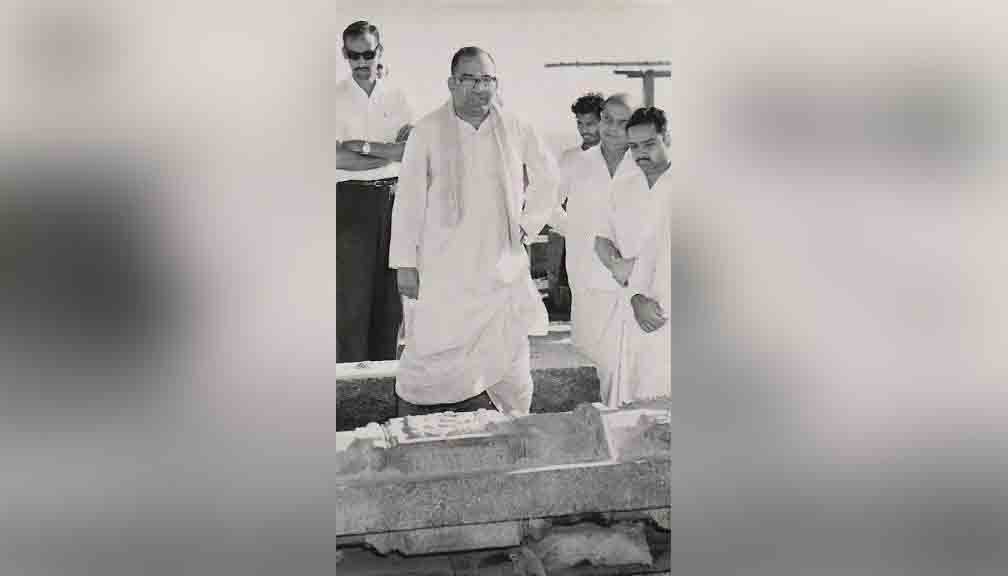
Work began on 6 November 1964, to a design by architect S.K. Achari, prepared with input from the Paramacharya of the Kanchi Kamakoti Peetham and blending the country’s architectural traditions. Building on a rock in the open sea took six years. The memorial cost about ₹1.25 crore. Every state government and the Centre contributed, and much of the money came in one- and two-rupee gifts from ordinary people. Further funding details are available in Vivekananda Rock Memorial: An inspirational tale of grit and determination. President V.V. Giri inaugurated the memorial on 2 September 1970.
Seva as a Living Memorial
Ranade’s dream of a living memorial took shape on 7 January 1972, when the Vivekananda Kendra was established as a spiritually oriented service mission. Its headquarters were set up at Vivekanandapuram, on land Ranade acquired in Kanyakumari. Its aim, man-making and nation-building, drew on Swami Vivekananda’s twin ideals of tyaga (sacrifice) and seva (service).
Ranade drew a clear line between this work and relief. “If we are merely a service-oriented organization,” he told trainee workers in talks later collected as Sadhana of Service, “we will have to pray to God to create cyclones, floods, famines and accidents to provide us opportunities of service.” Feeding the hungry and tending the sick were, in his words, “only a preliminary type of service.” The highest seva imparted “a higher and deeper knowledge,” one that could “equip a person to attain real happiness.” He called the Kendra a thought movement whose purpose was to spread the idea of selfless service.
Service as Sadhana
The work rested on the jeevanvratis, young men and women trained by Ranade himself, who committed their whole lives to service. He taught them to treat seva as sadhana, or disciplined spiritual practice. “That service is the best and the noblest” is, in his formulation, the service performed with total surrender to God, the worker acting “with an attitude of being a tool only.” Work done in that spirit, he said, was itself sadhana: “You don’t have to sit for Sadhana. Life becomes Sadhana.”
Schools in the Northeast
Ranade chose the North-East, a region he had known as a pracharak, as the first field. After studying the area, the Kendra opened seven residential schools in Arunachal Pradesh, staffed by jeevanvratis. These were the beginning of the Vivekananda Kendra Vidyalayas. Branches followed in Guwahati, Dibrugarh, Tinsukia and Imphal, along with a school in Port Blair in the Andamans.
In 1973 he founded Yuva Bharati, Kendra Bharati and the Vivekananda Kendra Patrika. During his tenure he wrote more than 25,000 letters, and he planned a Kendra branch in every district of India.
Final Years and a Second Phase
A stroke in April 1980 left his sight and memory impaired, yet he refused to slow down. He died of a heart attack in Madras on 22 August 1982. He was cremated at Vivekanandapuram the next day, and the pyre was lit as the saffron Om flag was lowered at the Rock Memorial.
The Kendra’s natural resources development project, VK-NARDEP, began in 1986, four years after his death. In Arunachal Pradesh alone, the Kendra now runs 42 Vivekananda Kendra Vidyalayas, besides balwadis and vocational centres. Its wider reach is described in- How Vivekananda Kendra is making difference in the lives of millions. This work makes up the second phase of the memorial Ranade had in mind while the first was still under construction.
Recognition from Within the Ramakrishna Tradition
Swami Ranganathananda of the Ramakrishna Math, Hyderabad, counted him among the “heroic patriots and workers of whom Swami Vivekananda would be proud.” He added that the Swamiji wanted India to produce thousands of such workers.
(The writer is an author and columnist)