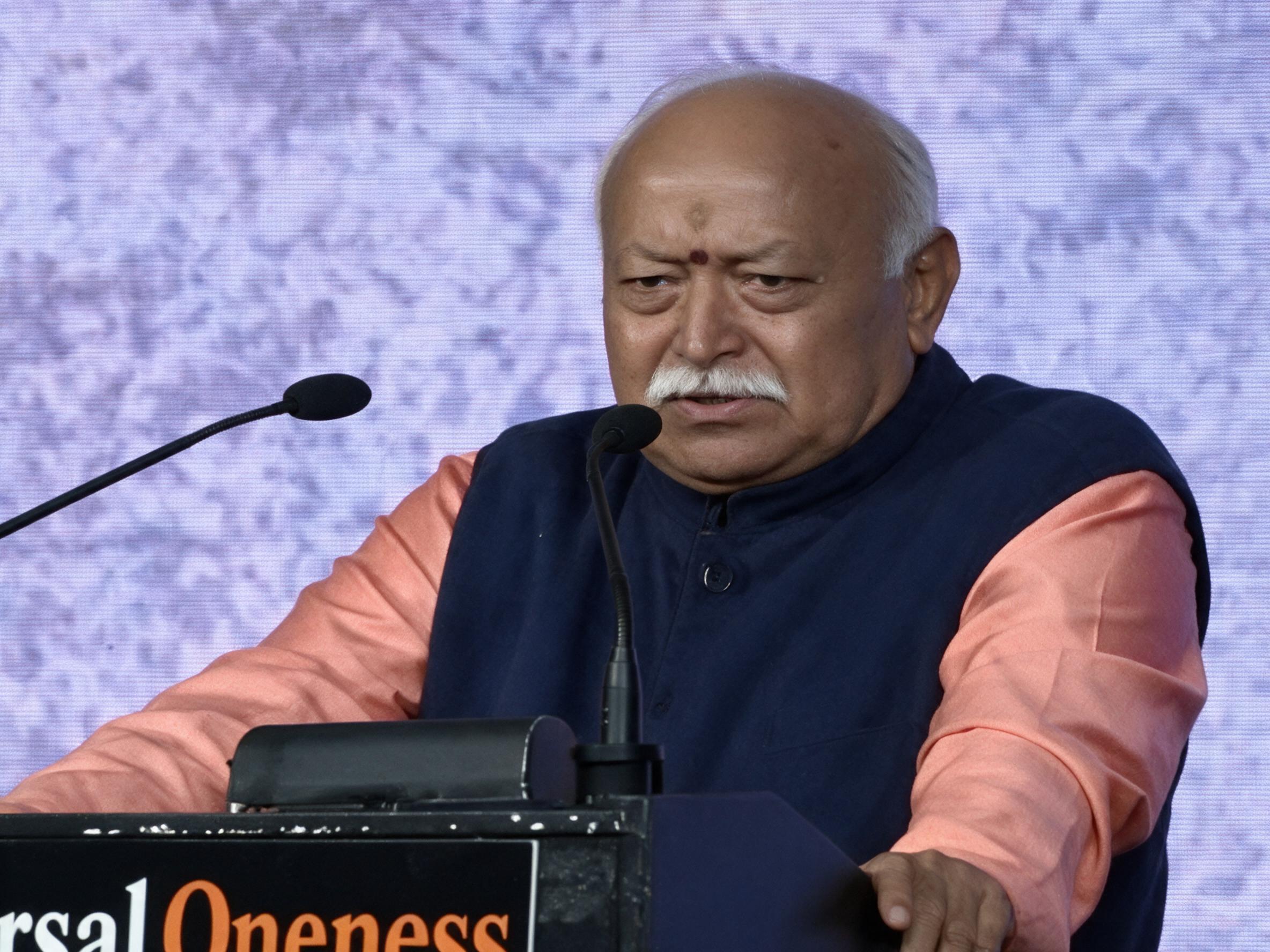
In the contemporary global arena, international relations are almost exclusively defined by hard power, realpolitik, and material transactionalism. Nations interact through the strict machinery of trade pacts, military alliances, energy dependencies, and strategic deterrence. States view one another primarily through economic competition or political defence mechanisms. Yet during an address on August 30, 2026 to a gathering of over 5,000 listeners at New York’s Madison Square Garden, Mohan Bhagwat—speaking as head (Sarsanghchalak) of the Rashtriya Swayamsevak Sangh (RSS), a century-old cultural organization—offered a starkly different framework for how human societies and sovereign states ought to interact.
His message centered on the concept of “spiritual nationalism”—a civilisational paradigm that challenges standard Western frameworks of statecraft, identity, and global governance.
For Western readers, the term “nationalism” carries heavy historical and political baggage. It frequently conjures images of territorial expansionism, ethnic exclusion, isolationist protectionism, or zero-sum ideological rivalries. Bhagwat, however, presented a conceptualization rooted deeply in ancient Indian thought that reframes national identity entirely. In this tradition, a nation is defined not by its capacity for geopolitical dominance or economic extraction, but by its distinct moral and spiritual duty (duty to the world).
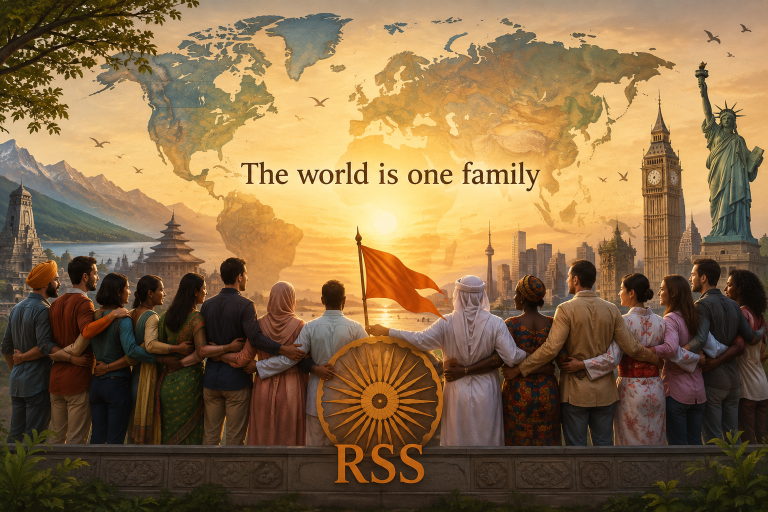
Invoking historic Indian thinkers such as Swami Vivekananda and Sri Aurobindo, Bhagwat argued that every civilization possesses a unique character and a specific mission to contribute to human collective evolution. In this worldview, India’s civilisational destiny is not to project power outwardly through military bases or economic leverage, but to embody and share the principle of “unity in diversity.” This perspective treats the vast spectrum of human cultures, languages, and belief systems not as administrative friction points to be managed or standardized, but as vital manifestations of a single, underlying global oneness. Diversity, in this view, is not a problem requiring resolution, but an expression of life to be celebrated and protected.
Tolerance Versus Acceptance: A Philosophical Divergence
A central element of this civilisational paradigm is the vital distinction between Western notions of “tolerance” and the classic Indian ideal of “acceptance.”
Modern Western secular democracy relies heavily on the concept of tolerance. While tolerance represented a major historical advancement over religious warfare, it remains a passive and somewhat fragile framework. To tolerate someone is to endure their presence, to permit their existence despite fundamental disagreements, and to maintain a polite distance to prevent friction. It acts as an ideological band-aid—useful for preventing immediate conflict, but inherently limited in its ability to build deep social cohesion.
By contrast, the Indian philosophical tradition, as articulated by Vivekananda at the 1893 Parliament of the World’s Religions in Chicago and echoed in Bhagwat’s address, demands active acceptance. Acceptance goes far beyond mere coexistence; it recognizes that different paths, traditions, and ways of life are valid expressions of human experience searching for the same fundamental truths. Where tolerance views differences as something to be endured, acceptance views them as essential components of a rich, interconnected whole. Moving from a mindset of tolerance to one of acceptance changes the nature of cross-cultural diplomacy from defensive containment to genuine engagement.
Understanding Dharma Beyond Modern Terminology
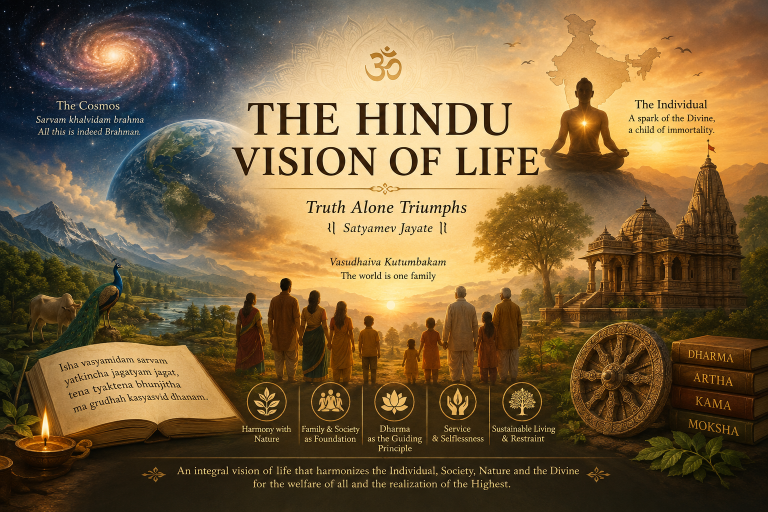
At the core of this worldview lies the concept of Dharma. In Western discourse, Dharma is frequently mistranslated simply as “religion.” However, in Indian thought, religion typically refers to a specific system of faith, worship, and dogma, whereas Dharma encompasses something far broader and more fundamental.
Derived from the Sanskrit root dhri—meaning “to uphold” or “to sustain”—Dharma refers to the intrinsic natural, moral, and cosmic principles that sustain life, maintain social order, and preserve ecological balance. It is not an exclusive creed or a set of rigid doctrines, but an operational framework for living in harmony with one’s environment, community, and inner self.
Bhagwat’s discourse emphasized that the primary challenge facing the modern world is not a scarcity of material resources or technological capability, but a systemic departure from Dharma. When global systems prioritize hyper-individualism, short-term economic consumption, and transactional relationships at the expense of social and ecological balance, fragmentation is the natural result. The civilisational mission of Dharma, therefore, is to restore a framework of sustainability—one that nurtures physical, mental, social, and environmental well-being in equal measure.
The Five Transformations (Panch Parivartan)
To translate these abstract philosophical principles into practical daily practice, the cultural framework presented in New York outlines five actionable pillars of individual and community transformation, known as Panch Parivartan:
- Social Harmony (Samajik Samrasta): The conscious, active effort to eliminate artificial social hierarchies, internal prejudices, and systemic divisions within society. It emphasizes human dignity and shared identity over historical or social fault lines.
- Family Enlightenment (Kutumb Prabodhan): Strengthening the family unit as the primary sanctuary for moral education, emotional resilience, and intergenerational wisdom. In an age of increasing social atomization and loneliness, nurturing multi-generational bonds serves as a fundamental anchor for societal health.
- Environmental Stewardship (Paryavaran Sanrakshan): Shifting the human relationship with nature from one of extraction and exploitation to one of reverence and reciprocity. It calls for living practices that respect natural cycles and protect planetary resources for future generations.
- Civic Duty (Nagrik Kartavya): Rebalancing the modern focus on individual rights with an equal emphasis on personal responsibility toward the broader community. True freedom, within this framework, is maintained through a shared commitment to common duties.
- Self-Reliance (Swadeshi): Encouraging local economic strength, cultural confidence, and sustainable living patterns. Swadeshi does not imply isolationism; rather, it promotes building resilient local communities capable of standing on their own feet while participating constructively in global trade.
Implications for a Globalized World
As Western democracies contend with rising internal polarization, declining trust in institutions, environmental crises, and the limitations of purely economic models of human fulfilment, engaging with alternative civilisational models becomes increasingly relevant.
This Indian paradigm suggests that the deep challenges of the 21st century cannot be solved solely through more sophisticated technology or stronger legal regulations. Instead, they require a shift in underlying assumptions about human purpose and national identity. By moving away from a world defined exclusively by competitive national interests and toward one anchored in shared ethical responsibility, this ancient vision offers a compelling alternative: a world united not by political uniformity, but by a shared commitment to the sustaining principles of Dharma.