
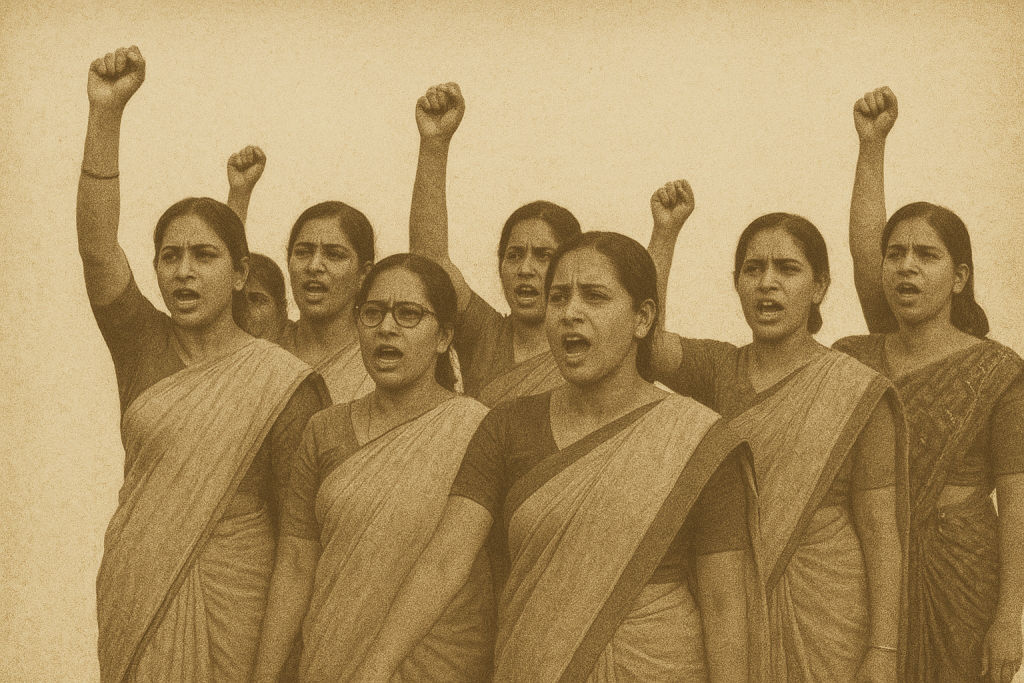
When the Congress government led by Prime Minister Indira Gandhi had imposed internal emergency in India, it is not only the men but a large number of women associated with the RashtraSevika Samiti and the Akhil Bharatiya Vidyarthi Parishad (ABVP), the organisations inspired by the Rashtriya Swayamsevak Sangh (RSS), fought against it. The Emergency was imposed on June 25, 1975 and it lasted for 21 months. It led to censorship, arrests and restrictions on freedom of speech and expression. Women too experienced suppression of their voices and freedom, as the Emergency curtailed democratic rights.
Nagpur-based Sevika Prakashan has come out with an interesting publication‘Apatkal ki Smaran Kanika‘ (Memories of Emergency), highlighting the role of women activists during this darkest chapter in the constitutional history of India. According to this booklet, women from different backgrounds met the challenge by demonstrating remarkable courage. A number of them spent long periods in Indian jails, held secret meetings and distributed pamphlets to create public opinion against the unconstitutional acts of the government.
Documenting the personal accounts and narratives based on the experiences of individuals, the booklet edited by Chirta Joshi and Leena Gahane of Rashtra Sevika Samiti, recounts how actively the women were engaged in organising, and supporting the pro-democracy movement against the Emergency that was primarily led by the RSS.
Narrating her own family’s experience during the Emergency, Alka Inamdar recalls , “On July 4, 1975 at midnight as usual many RSS workers were present at the PrabhatShakha (daily gathering of RSS volunteers for an hour in the morning) . Without any prior notice, the police picked them up from the Shakha itself and put them in jail. Later, everyone came to know that Indira Gandhi had imposed a ban on the RSS. According to the MISA Act, there was no need to prove any crime against them. Or there was no need to present them before the court. People didn’t even know where their own persons were. Nobody knew what to do after Sarsanghchalak (Chief Mentor) BalasahebDeoras and many other senior workers were suddenly imprisoned. My father was also sent to jail from Prabhat Shakha on July 4, 1975”.
At that time there was no ban on the Rashtriya Sevika Samiti as it was not in limelight. Like ABVP and VHP, Rashtra Sevika Samiti too had postponed their programmes and daily activities on the ground. But the Samiti’s shakhas were running from indoors from various houses and andwere still functioning.
“After a few days of confusion, all the Sangh workers who were outside the jail went underground and started to keep the organisation alive. Secret contacts were established with the senior workers imprisoned in the jail. Many of the committee workers helped in this work intelligently and cleverly. Slowly, it was known who was in which jail. The workers whose husbands, sons, fathers or brothers who were in jail could go and meet them once in fifteen days. But other women workers also started going to jails posing as someone’s sister, sister-in-law or mother and meeting the workers there and a mechanism for the exchange of information was established,” wrote Inamdar.
“These women not only provided food and clothing to their husbands and sons who were in jail but also carried messages and information safely despite police surveillance. They organised meetings through the women branches of the organisation, printed propaganda material and created public opinion in the society against the unconstitutional acts of the government,” said Payal Laxmi Soni another Samiti activist.
“..Women from Rashtriya Sevika Samiti, Jan Sangh’s Mahila Morcha and Vidyarthi Parishad and other nationalist organisations kept conducting secret meetings in large numbers. In these meetings, young women were prepared for truth, religion, patriotism, sacrifice and courage. Many of them were sent to jail. In many cities like Lucknow, Banaras, Bhopal, Pune, Jabalpur, Nagpur, Raipur, Delhi, Ajmer, a large number of women were arrested under article 21 for violating the articles because they distributed pamphlets like ‘Save the honour of Parliament’ and ‘Restore Democracy’,” adds Soni.
During the Emergency, “false propaganda in favour of the government was being spread through the government radio and newspapers. At that time, women took the responsibility of providing true information to the society. The workers of Rashtriya Sevika Samiti raised awareness about the policies of the government through mediums like Nari Chetna Shivirs (Women Awareness Camps), religious discourses, cultural education in mohallas (local colonies), temples and schools.”
The booklet mentions various contributions and challenges faced by women, including their participation in protests, resistance movements, and their efforts to uphold democracy.
“In Delhi, Banaras and Pune, many educated women got together, published secret pamphlets, through which the ideas of Loknayak Jaiprakash Narayan, Atal Bihari Vajpayee, Nanaji Deshmukh and Deendayal Upadhyaya were conveyed to public,” wrote Soni. Narayan was a socialist leader while Vajpayee was associated with Bharatiya Jana Sangh and Deshmukh was associated with the RSS. Upadhyaya was an RSS full-timer who later became president of BJS. He propounded the ideological framework of ‘integral humanism’ in 1960s that is the official philosophy of the largest political party of the world- Bharatiya Janata Party- which has been ruling at the Centre in India for more than a decade. It also has governments in many states in India.
“The Emergency”, she said, “generated introspection and many women activists made education, service and self-reliance their life’s goal”.
“After the Emergency got over in 1977 when the Janata Party government came to power, many women activists started schools, hotels, service centres and self-defence training,” she added.
During the challenging period of ‘Emergency,” women activists of Samiti and other RSS-inspired organisations not only kept democracy alive but also Indian culture and religion.
“Many young girls and women became a part of Jai Prakash Narayan-led movement against the Indira’s Gandhi’s government. Girl students took to streets in Delhi, Bihar, Madhya Pradesh, Gujarat and Maharashtra,” says Neelam Yadav.
“Poor women became the biggest victims of exploitation in campaigns like sterilisation,” says Yadav adding that women workers of social organisations showed courage to expose these cases.
The article by Soni mentioned Lilavati Singh from Lucknow was sentenced to six-month imprisonment for distributing pamphlets during the Emergency…”In jail, she continued to teach songs and yoga to the girls in the jail. Savitri Menon from Kerela inspired her students to agitate for democratic values. Many of her students faced suspension for this. Shanta Devi gave shelter to patriotic workers in her house in Lakhimpur by putting her family in danger.”
The resilience and determination of women activists inspired by the RSS played a significant role in the fight for justice and freedom during Emergency. In this context, it is important to highlight the role of women during Emergency as not much is discussed about this in the public discourse in India.
(The writer is a senior journalist)