
About the Source
This article is Part 3 of a three-part series providing a curated translation and analysis of the handbook Vishay-Bindu (Fifth Edition, 2012). While Parts 1 and 2 explored the civilisational definition of the nation and the role of individual character, this final segment focuses on the internal cohesion of society, the economic philosophy of Swadeshi (Self-Reliance), and the critical distinction between Modernisation and Westernisation.
Having examined the role of individual character, patriotism, and the balance between society and the state, the discussion now turns to the social and economic foundations of national strength. These sections focus on the internal cohesion of society, the idea of self-reliant development, and the need to engage with modernity without losing civilisational grounding.
A strong and unified society is the bedrock of any enduring nation.
Social Equality and Harmony are Essential for National Unity
- Defining the Terms: Samata (Equality) is a word for superficial (external) and material equality, whereas Samarasata (Social Harmony) is an indicator of internal intimacy.
- Lessons from History: It was due to the absence of Equality and Social Harmony that we had to face defeat in past history.
- Current Threats: Even today, the great powers of the world are conspiring to divide Hindu society and break the country by taking advantage of this very deficiency.
- Internal Divisions: Specifically, Hindu society is being divided into caste-kinship (jati-biradri), high-low, and regionalism. Differences of forward-backward are being created. To eliminate these differences, social harmony is essential.
- The Organic Requirement: For National Unity, it is necessary that society remains healthy and well-organised.
- The Analogy of the Body: Just as the body stays healthy only when there is harmony and concord among all organs, similarly, for the unity of the Nation, it is essential for the entire society to be well-organised.
- Example of Harmony: The mixing of sugar and milk together.
- Social Reform: The sentiment of untouchability or “un-touching” must be destroyed at the roots.
Beyond social cohesion, economic self-reliance is presented as another pillar of national strength.
The Concept and Practice of Swadeshi
When our country became independent on August 15, 1947, there was hope that we would move rapidly on the path of development and stand in the world as a happy, prosperous, wealthy, self-reliant, and strong nation. But when we look at today’s Bharat, we are met with deep disappointment. The Indian economy has become trapped in deep and serious crises. There are two primary paths for its resolution:
- One path suggests that Bharat can overcome its crises by relying on international institutions, foreign capitalists, and multi-national companies, and by adopting the development models, techniques, and technology of the wealthy Western nations.
- Conversely, the second path suggests that Bharat can gather the strength for national development on its own by adopting a Swadeshi (Indigenous) system and model. According to this path, there is a need to find solutions to our current challenges within our own traditions.
These two approaches represent contrasting models of development, that is, external dependence versus internal self-strengthening.
The concept of Swadeshi Darshan (philosophy) is the realisation of the “Self” (Swa) and the awakening of “Selfhood” (Svatva).
In essence, Swadeshi is framed as a context-sensitive and value-based approach to development.
Swadeshi philosophy implies acting in the light of our eternal life values, considering the nature, temperament, and social and economic conditions of our country and society, primarily utilising our own power, potential, and resources…
This idea is further elaborated as:
“…a philosophy of sustainable, nourishing, value-based (Sanskar-ksham), all-beneficial, balanced, and all-round development through the awakening of the country’s collective energy and labour, based on indigenous skills and talents.”
Swadeshi philosophy is a multi-dimensional, all-encompassing, and universal concept. It is not a narrow or parochial idea. This counters the common perception that Swadeshi implies isolationism. There cannot be a single uniform model of development for the entire world. Diversity is both the truth and the beauty of this world.
Historically, Swadeshi has also played a significant role in India’s freedom movement.
Swadeshi as the Inspiration of the Freedom Movement: Various efforts to promote Swadeshi sentiments and structures provided momentum and energy to the entire independence struggle. Dadabhai Naoroji defined the independence movement itself on the basis of his “Drain of Wealth Theory”.
- In Bharat, Swadeshi has been the concrete expression of economic nationalism.
- As a trend within the independence movement, Swadeshi is mentioned as early as 1849 in the journal Bhaskar published from Pune. This journal urged the public to use Indian products instead of imported foreign goods.
- In 1857, the Kuka movement in Punjab, inspired by Satguru Ram Singh Ji of the Namdhari sect, initiated the building of a Swadeshi system while boycotting British systems.
- In 1867, through the efforts of Navgopal Mitra and Rishi Rajnarayan Ghosh in Bengal, the organisation of Hindu (Swadeshi) Fairs began.
- In 1872, Mahadev Govind Ranade organised a series of public lectures on economic subjects in Pune, making a powerful call for Swadeshi.
- Swami Dayanand, Maharishi Aurobindo, Lokmanya Tilak, Veer Savarkar, Mahatma Gandhi, Babu Genu, etc., are the guiding lights of this Swadeshi movement.
Swadeshi Structure:
According to the Swadeshi viewpoint, the true alternative to both Capitalist and Socialist structures is a Decentralised Economy. In Gandhiji’s vision of ‘Swaraj’ as well, a Swadeshi economy was central.
This reflects a preference for distributed economic power rather than centralised control.
The Swadeshi perspective believes neither in a government-dependent economy (Sarkar-ashrit) nor in a market-dependent economy (Bazaar-ashrit). It believes in a People-dependent economy, one based on public cooperation and community participation.
Swadeshi Behaviour (Economic Aspect):
- To establish and make the Swadeshi economic structure dynamic, Swadeshi behaviour means using only those goods produced (manufactured) by indigenous producers as far as possible. It is expected that the producing entrepreneurs of the country apply their full strength to produce pure and high-quality goods at low prices.
- The country’s scientists, technicians, researchers, and research institutions should develop appropriate technology suited to our conditions while using the talent and skill of the country.
- The government should never allow the dominance of foreign companies; it will have to emerge from the trap of foreign investment. Efforts should be started to get our conditions accepted in the World Trade Organisation with the cooperation of other developing countries. If the fulfilment of the country’s interests is not seen through the World Trade Organisation, then providing leadership to developing nations, we should reconsider its position within global trade frameworks if national interests are not adequately served.
Swadeshi Behaviour (Social Aspect):
Swadeshi is also expressed through everyday social and cultural practices:
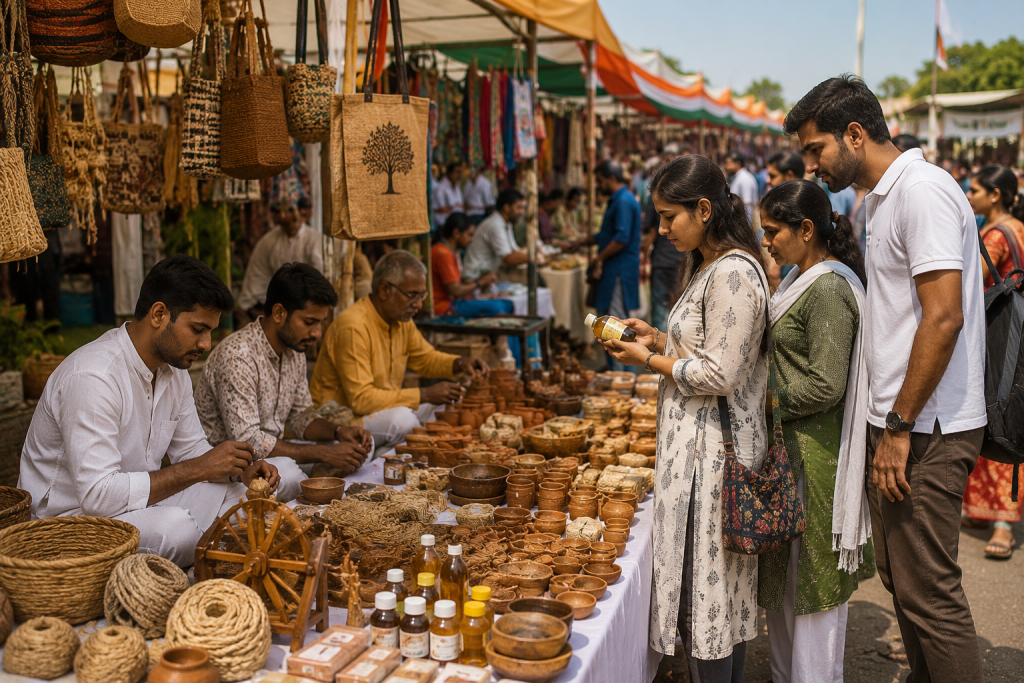
- Pride in own language (Swabhasha), own attire (Swabhoosha), own food (Swabhojan), etc., and the ‘Self’ is the inspiration for Swadeshi behaviour. Therefore, insist on these in the home, family, business, festivals, etc. The use of one’s own language and Indian attire must definitely be done during religious rituals, auspicious tasks, and national days.
- Promote traditional food items and sweets more and more.
- The interior decoration of the house should be Swadeshi.
- Plant traditional fruit-bearing and flowering trees and plants in the house.
- Cattle wealth is a symbol of Swadeshi. Encouragement of cattle-based rural practices, where feasible.
- If cow rearing is not possible, develop a habit of drinking cow’s milk in the family.
- Use Indian medical systems, medicines, and the tradition of home remedies as far as possible.
- Deendayal’s thought – Contemporary (Yugunukul) thought of Swadeshi, indigenous (Swadeshanukul) thought of the foreign.
The discussion on self-reliance leads naturally to the question of how a society engages with modernity.
Modernisation does not mean Westernisation
- Simple meaning of modernisation is leaving behind obsolete things and using new technology in various contexts. Vigilance is needed in this so that fundamental principles are not affected.
- Westernisation means that through the mechanical progress that has happened in the West in the last 200-250 years, their production has increased. They are making efforts to consume (dump) that production and their technology in the world in one form or another.
- They have sufficient means of publicity and abundant materials. If someone considers themselves happy with fewer means, then there will be no consumption of their goods. For them, happiness lies only in consumption (Bhoga), not in sacrifice (Tyaga).
- A conspiracy exists by the West to impose its power and culture on countries called developing. Western consumerist countries constantly try to change the minds of the people of countries called developing.
- Gandhi – Not mass production but production by masses (Not just the insistence on more production, but more people should be engaged in the work of production). Mahatma Gandhi Ji said, “Let machines come, let them reduce the hardness of labour. But they should not snatch away the bread of the labourer’s stomach.”
- In the Indian joint family where its “Not me, but you”. Western families are individualistic, their vision of looking at women, admitting the elderly to old age homes, questioning their utility, etc.blind imitation of these is suicidal.
- Hindu philosophy has been an advocate of continuously embracing novelty while keeping fundamental principles safe according to time, place, and circumstance. Even today, this same criterion is needed for accepting Western ideas.
- Accept every new thing on the basis of merits and demerits. Example – The Sangh’s band (Ghosh) instruments are modern but the compositions are Indian, the broadcast of Ramayana on television, equipment is modern but the program is Indian, Violin instrument is modern but music is Indian, Varanasi railway construction is modern but architectural art is ancient.
- Self-respect should remain protected.
- Gather mechanics and material comforts but remain cautious of their possible ill effects.
- Upon entering a Japanese house, it feels like the house is Japanese, advanced as well as modern.
- Do not run after Western culture. Even while being modern, Indianness can be maintained. Modernity and Indianness are not contradictory.
- Modernity does not mean copying the West in food, clothing, etc. Emerging from dogmas and thinking with an open mind about what is good for the country and society is modernity.
- Consistent with our lifestyle: Modernization but not westernization.
(The writer is an author and columnist)