The Long Shadow of Political Violence Against the RSS in Kerala
Updated: February 7, 2026 6:37
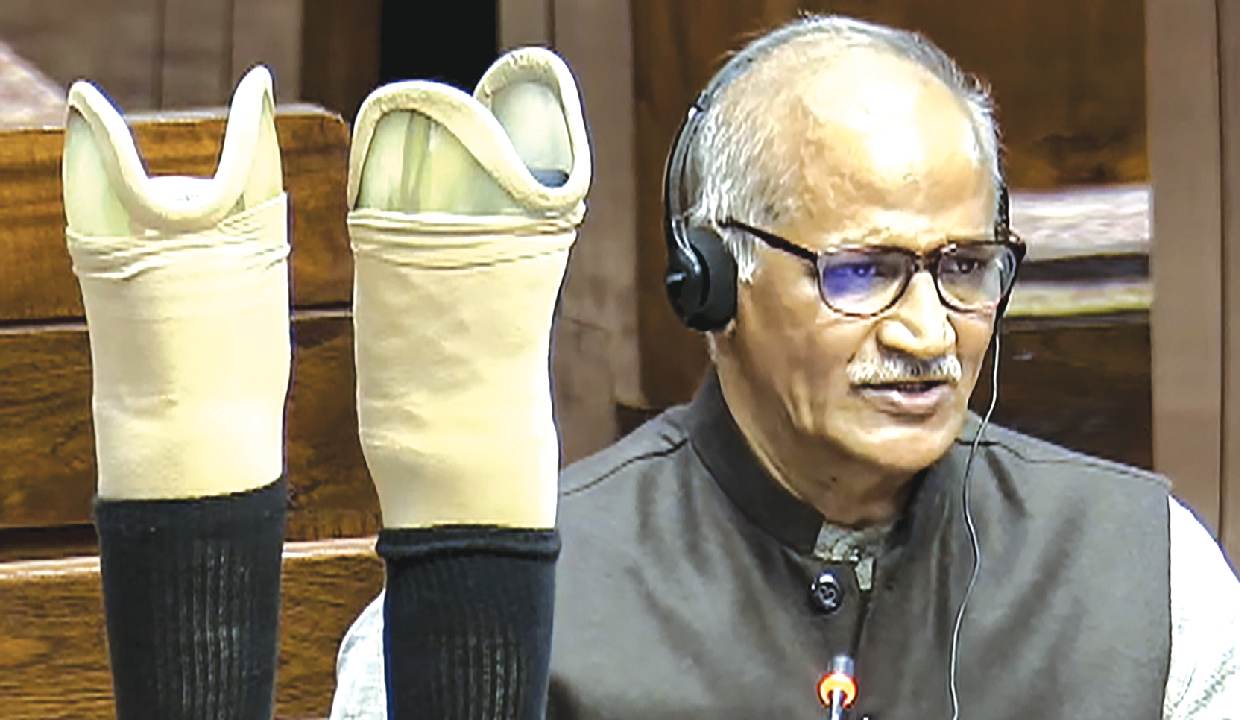
In India’s Upper House of Parliament, Rajya Sabha member C. Sadanandan Master recently delivered an emotional intervention during the Motion of Thanks to the President’s address. In a powerful symbolic gesture, he placed his artificial limbs on the table and recalled a brutal attack that took place more than three decades ago in Kerala.
He argued that many of those who now speak loudly about democracy were associated with the forces that targeted him. Recounting the incident, he said he was ambushed while returning home, dragged to the ground, and had his legs hacked off by assailants. Speaking from his seat due to his disability, the Rashtriya Swayamsevak Sangh (RSS) worker attributed the attack to cadres of the Communist Party of India (Marxist), or CPI(M). His testimony served as a stark reminder of the political violence that has marked parts of Kerala for decades.
Violence against RSS workers
Professor A.K.M. Das, who documented attacks on RSS cadres in his book RSS in Kerala: A Saga of Struggle (Kesari Publications), notes that many victims came from economically modest backgrounds. According to his research, most of those killed belonged to lower-middle-class or poor families, and many were the sole breadwinners of their households.
Das estimates that around 300 workers from the RSS and its ideological mentee, Bharatiya Janata Party (BJP), have been killed in such violence. The book was published in 2020, and incidents have continued since then, suggesting the actual toll may be higher. In addition to those killed, many others have suffered severe injuries or permanent disabilities.
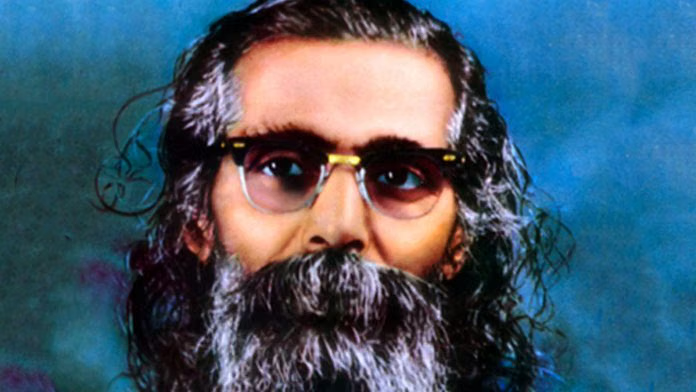
Clashes between Communist groups and RSS workers date back to the late 1940s. In December 1947, Communists reportedly attacked a gathering addressed by M.S. Golwalkar, the second Sarsanghchalak (chief mentor) of the RSS, at Thycaud Stadium in Thiruvananthapuram(Kerala). Another attack on a meeting attended by Golwalkar was reported in 1958. According to Das, these early confrontations soon turned violent, with significant clashes reported in Tellicherry (Kerala) during 1961–62.
The RSS in South India
Founded in Nagpur in 1925, the RSS expanded to southern India in 1939. At the time, present-day Kerala was divided among the princely states of Travancore and Cochin, and the Malabar region, which was part of the Madras Presidency under British rule. These regions were later merged to form the modern state of Kerala.
RSS founder Dr. K.B. Hedgewar sent his associate Dadarao Parmarth, a full-time worker known as a pracharak, to Madras. Another pracharak, Yadavrao Joshi, was sent to Belgaum in present-day Karnataka. Over the next few years, several full-time workers were posted across southern India.
The RSS began its work in Kerala in 1942, when DattopantThengadi was sent to Calicut as a young pracharak, and Baba Telang arrived in Thiruvananthapuram. Later, Purushottam Chincholkar was assigned to the Cochin region.
Growth was slow in the early years, but the organisation gradually expanded. In 1942, three Malayali volunteers from Kerala attended the annual RSS training camp in Nagpur for the first time: Ambali Karunakaran and P. Kumaran from Calicut, and Mannar Gopalan Nair from Thiruvananthapuram.
The first RSS shakha (daily local gathering) in Kerala was started with about a dozen volunteers, with P. Kumaran serving as theMukhyaShikshak (chief instructor). Today, the organisation runs more than 5,000 daily shakhas across the state.
Early clashes and the “Kannur model”
Within a decade of its arrival in Kerala, the RSS had established a presence across the state. At the same time, Communist parties had built strong political bases. The ideological rivalry between the two soon turned violent.
On 28 April 1969, Vadikkal Ramakrishnan, a 36-year-old tailor and RSS worker, was killed in Thalassery. He was the sole breadwinner for his family and is often described as the first RSS worker to be killed in Marxist violence in Kannur district. Over the years, Kannur emerged as the main epicentre of clashes, with a disproportionately high number of casualties among RSS workers.
According to J. Nandakumar, an RSS full-time worker from Kerala, one factor behind the violence has been the movement of cadres from the CPI(M) to the RSS and the BJP. He argues that many RSS workers in northern Kerala come from families with Communist backgrounds.
Nandakumar says the RSS’s refusal to submit to CPI(M) dominance in its strongholds, particularly in Kannur, has intensified tensions. He also adds that violence against RSS and BJP workers can be linked to broader political competition, including efforts to consolidate Muslim vote banks by Communists.
For observers, Sadanandan Master’s testimony in Parliament was not just a personal account. It brought national attention once again to a long and contentious history of political and ideological onslaught by communists in parts of Kerala. This brutal violence against the RSS workers continues to shape local politics and narratives even today.