
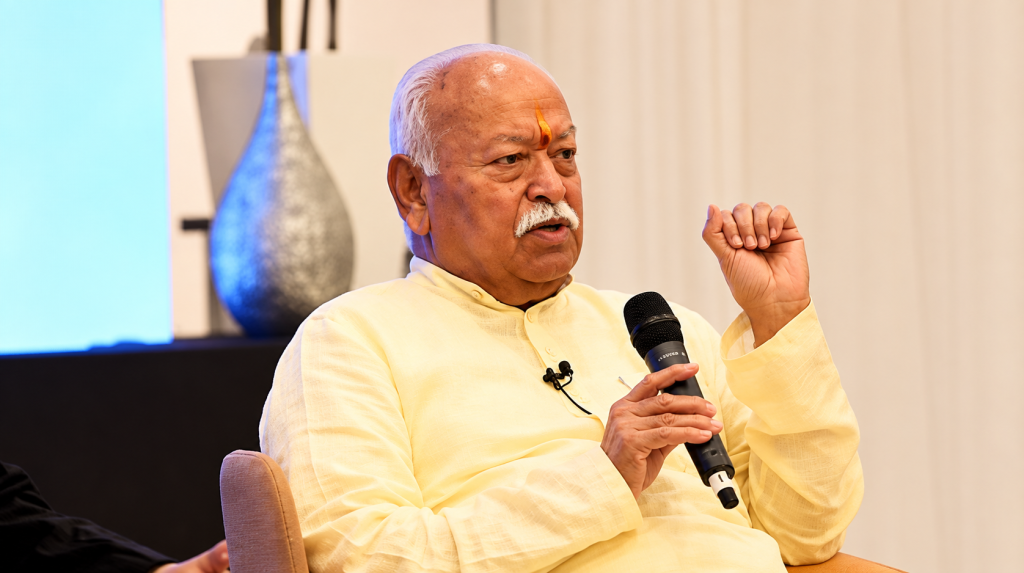
At the “Celebration of Oneness” in London on September 6, 2026, RSS Sarsanghchalak Mohan Bhagwat offered a broad civilisational articulation of some of the ideas that have shaped the Rashtriya Swayamsevak Sangh (RSS) over its first century.
Held at the Oshwal Centre, Potters Bar, Hertfordshire, the community leaders’ reception and civilisational dialogue was initiated by Hindu Swayamsevak Sangh UK (HSS UK), a Hindu social and cultural organisation established in Britain in 1966, with support from Integral, a UK-based organisation that brings together leaders and communities to strengthen dialogue and long-term relationships within the UK and between Britain and Bharat. The gathering brought together around 600 people representing 326 organisations, including community leaders and public figures.
The setting was significant. Bhagwat was speaking not simply to an Indian audience in Britain, but to a diverse diaspora community living in a Western democracy and negotiating questions of identity, belonging, citizenship, heritage and social responsibility.
His central message was that the answer to these questions lies not in uniformity, but in recovering an idea of oneness that accommodates diversity.
From Diversity to Oneness
Asked what single principle had remained constant through the RSS’s hundred-year journey, Bhagwat identified “apnapan”—a sense of belonging rooted in what he described as shuddha sattvik prem, or pure and selfless love.
He connected this idea to the traditional Hindu understanding of society: love for the individual, the family, the community, society, humanity and nature. In this formulation, the foundation of social organisation is not hostility towards an outsider but a widening circle of belonging.
Bhagwat then connected this principle of belonging to a larger philosophical proposition: existence itself is one, even though it appears in many forms.
For him, diversity is not an aberration to be corrected. It is intrinsic to existence. “One has become many,” he explained, and therefore different perspectives, traditions and ways of life naturally emerge.
The practical implication is important. Unity does not require uniformity.
A society can retain differences while recognising an underlying commonality. This, Bhagwat argued, is one of the distinctive contributions of Hindu civilisation to the contemporary world.
What Does “Hindu” Mean?
Perhaps the most consequential part of the London dialogue concerned the meaning of the word Hindu.
Bhagwat argued that Hindu cannot simply be understood as the name of a religious practice, sect or prescribed lifestyle. Rather, he described it as a civilisational disposition that accepts and respects diversity because it recognises that different paths can lead towards the same ultimate goal.
This, he suggested, explains why Indian civilisation historically accommodated multiple schools of thought—from atheistic and agnostic traditions to different forms of theism.
The objective, therefore, is not to convert everyone into one way of thinking.
“We need not convert each other,” was the essence of his argument. One can remain confident in one’s own path while accepting that another person may follow a different path.
This distinction is particularly relevant to Western audiences, where the word “Hindu” is often approached primarily through the category of religion.
Bhagwat’s formulation places greater emphasis on a civilisational ethic: diversity is natural, unity is fundamental, and coexistence is possible without demanding sameness.
Hindu Rashtra: A Civilisational Purpose
The discussion inevitably moved to the concept of Hindu Rashtra, one of the most debated and frequently contested terms associated with the RSS.
Bhagwat made an important distinction between Rashtra and the modern nation-state.
A nation-state, in his explanation, is generally constituted through factors such as common political institutions, governance, language, religion or other forms of similarity. Rashtra, by contrast, begins with a purpose.
In his formulation, the purpose of Hindu Rashtra is not political domination or the creation of a theocratic state. It is to offer the world the proposition that diversity is natural while unity is the underlying truth.
That proposition, he argued, has practical consequences: it can contribute to peace, prosperity, social harmony and a more balanced relationship between humanity and nature.
This is also why Bhagwat’s explanation of Hindu Rashtra is inseparable from his understanding of the human being.
The individual cannot be isolated from society; society cannot be separated from humanity; and humanity cannot be separated from nature.
Beyond the Individual-Society Divide
Bhagwat challenged what he sees as a false choice between individual freedom and social responsibility.
Modern political and economic systems can sometimes frame the individual and society as competing interests. His argument was that they need not be.
The individual can progress while contributing to society, and society can progress while enabling the individual to flourish.
The same principle applies to nature.
Economic and human development, in this framework, should not require the destruction of the natural environment. The underlying connecting principle, Bhagwat argued, is the unity of existence.
This creates a distinctly civilisational approach to contemporary problems. Rather than asking which side should prevail—the individual or society, development or environment, freedom or responsibility—the question becomes how seemingly competing interests can be harmonised.
Seva Without Superiority
Another recurring theme was Seva, or selfless service.
Bhagwat narrated the story of a young man from a poor forest village who encountered an RSS pracharak working without personal remuneration. The young man decided that he too could contribute, eventually dedicating years to social work.
For Bhagwat, the lesson was that service begins not with resources but with willingness.
Seva is also not meant to create a hierarchy between the giver and receiver. The person serving is not doing a favour to someone inferior. Service is an opportunity for personal growth and social connection.
This explains another aspect of the RSS model that Bhagwat emphasised: swayamsevaks working across different spheres of society without claiming exclusive ownership of social progress.
The RSS, he said, works through people involved in sports, education, agriculture, labour, student activities, women’s organisations, politics and social service. The objective is not to become the sole contractor of social change, but to work wherever constructive work is required.
A Different Idea of Diaspora Loyalty
For a London audience, perhaps the most directly relevant question concerned the relationship between British citizenship and Indian civilisational identity.
Bhagwat’s answer was unequivocal: there should be no inherent conflict.
He described Britain as the Karma Bhoomi—the land where British Hindus live, work and discharge their responsibilities. Their Janma Bhoomi or Punya Bhoomi may provide cultural and civilisational values, but that does not diminish their loyalty to the country in which they live.
If interests were ever to come into direct conflict, he said, British Hindus should stand with Britain.
The larger message was that civilisational inheritance does not require political disloyalty. Instead, the values received from one’s heritage can be lived out positively in one’s country of residence.
For diaspora communities, this offers a model of identity that is neither assimilation through cultural erasure nor separation through political isolation.
The Next Generation Must Create Its Own Model
Bhagwat also placed considerable responsibility on younger generations.
He said he was confident about the future because young people have an urge to make the world better and are willing to move beyond petty differences.
But his advice to older generations was equally significant: set the goal, not the method.
Experience should be shared, but younger generations should be allowed to develop their own methods for achieving the larger objective.
This is particularly relevant to an organisation entering its second century.
The principles may remain enduring, Bhagwat suggested, but their application cannot remain frozen in the past. Young people must translate civilisational values into contemporary forms of family life, professional life, technology, social organisation and global engagement.
From Organisation to Social Cooperation
Looking towards the RSS’s next century, Bhagwat’s emphasis shifted from organisational expansion to the broader organisation of society.
He described this as consolidating the benevolent power of society: people retaining their identities and individual ways of life while cooperating rather than becoming harmful to one another.
The objective is not that everyone should become an RSS volunteer. Rather, anyone honestly and selflessly working for society can become part of this larger effort.
Bhagwat presented several possible forms of cooperation—from joining the RSS to supporting its work, cooperating on constructive initiatives, or simply doing honest and selfless social work without even knowing the full form of RSS.
This approach is reflected in the RSS’s emphasis on Panch Parivartan—social harmony, strengthening family values and cultural transmission, environmental responsibility, self-awareness and respect for others, self-reliance and Swadeshi, and civic discipline.
The Essence of Oneness
The London speech ultimately presented a simple proposition with wide implications.
The world does not need to eliminate diversity to achieve unity.
It needs to understand the relationship between the two.
For Bhagwat, the Hindu civilisational idea begins with the recognition that existence is interconnected. From that follows a particular approach to society: respect difference, avoid coercion, serve without superiority, preserve nature, strengthen families and communities, and work towards social cooperation without demanding uniformity.
His message to the diaspora was equally clear: one can remain rooted in civilisational heritage while being fully committed to the country in which one lives.
The significance of the London address, therefore, lies less in any single organisational proposition than in the worldview it attempted to articulate. It was an argument that oneness need not mean sameness, that identity need not require antagonism, and that service can become a bridge between individual responsibility and collective wellbeing.
As the RSS enters its second century, the challenge Bhagwat placed before its younger generation is to translate these principles into new forms suited to a changing world.
The question is ultimately larger than the RSS itself: Can modern societies recover a sense of shared purpose without sacrificing the diversity that makes them human?
Bhagwat’s answer in London was rooted in an old civilisational proposition: diversity is natural, but beneath that diversity lies an essential oneness.