RSS Volunteers in the Hyderabad Satyagraha: The 1938 Unarmed Resistance
Updated: October 17, 2025 9:02

India’s freedom struggle from the British colonial rule was a continuous journey of both armed resistance and nonviolent movements. During this period several princely states remained under autocratic rule, depriving their people of even basic civil rights.Among these, Hyderabad stood out prominently.
In 1938, under the absolute monarchy of the NizamMir Osman Ali Khan,the hereditary Muslim ruler of Hyderabad, civil rights were virtually non-existent. There was no freedom of association, press, or political expression, and dissent was treated as a threat to state authority. The Public Safety Order of 6 September 1938 banned the Hyderabad State Congress and prohibited public meetings, while the Hyderabad City Police Act (1348 Fasli) granted sweeping powers to restrict assemblies, patriotic songs, and cultural gatherings. Even at Osmania University, the singing of Vande Mataram was banned, and Hindu religious celebrations faced curbs and surveillance. Though these laws claimed to preserve order, they overwhelmingly targeted Hindu organisations and nationalist sympathisers. In this atmosphere of repression and religious discrimination, the idea of non-violent resistance emerged as the possible and dignified form of protest.
The growing discontent soon translated into organised action, as several social and nationalist groups began mobilising people through peaceful means to challenge the Nizam’s repressive order.
Nisshastra Pratirodh, meaning unarmed resistance was one such movement. Led primarily by organizations such as the Arya Samaj, Hindu Mahasabha, and Hyderabad State Congress. RSS Swayamsevaks (volunteers) also participated in large numbers.
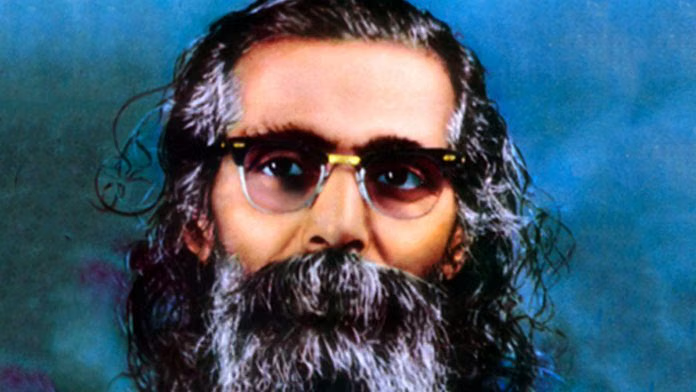
While upholding the RSS’s neutrality and non-political stance aimed at strengthening Hindu society from within, Dr Hedgewar nevertheless ensured that adequate volunteers support the movement. Dr. Hedgewar said, ‘An RSS volunteer, who is a constituent of the Hindu society, does not submit his resignation from the membership of the society when joining the Sangh. For every movement concerning the Hindu society, whatever is necessary and essential, the volunteer is free to do it’…”(RSS Archive, Hedgewar Documents, registers@Register 1 DSC&0056)
Datta Deshpande, who headed the Nagpur division of the Hindu Sabha and was himself an RSS volunteer, wrote that there was no distinction between volunteers of the two organisations, many dedicatedly joined the movement and courted arrest. (R.G. Deshpande, Hyderabad – Vahini Muktisangram, Navbharat Prakashan Sanstha, Mumbai, 1987, pp. 84–85.)
The technique of the proposed resistance was to enter the State limits in contravention of any ban, to hold meetings there and read proscribed literature and newspapers, to perform religious ceremonies and generally oppose every obstacle that is placed in the way of ordinary civil liberties. (Maharashtra Gazetteer Vol. XII, Civil Disobedience Movement (October 1930-December 1941).
The following account of RSS swayamsevaks participation in the Hyderabad Resistance is drawn primarily from Dr. Srirang Godbole’s meticulously researched Book, Hyderabad Nisshastra Pratirodh: RSS, Arya Samaj evam Hindu Mahasabha ki Bhumika(The Hyderabad Unarmed Resistance: The Role of the RSS, Arya Samaj, and Hindu Mahasabha)(Samvit Prakashan, 2022), which remains one of the most comprehensive studies on the subject.
The agitation of 1938 represented a unique example of coordinated yet unarmed resistance against the Nizam’s autocracy, marked by disciplined participation from the Arya Samaj, Hindu Mahasabha, and a significant number of RSS volunteers.
Preparations for the unarmed resistance (nisshastra pratirodh) began in Berar in October 1938. During this period, Dr. Ganesh Martand Pinparkar, a close associate of Dr. Hedgewar and Gopalshastri Dev from Nanded province, toured Berar and the Central Provinces (then a British-administered region comprising parts of present-day Madhya Pradesh and Vidarbha). (Sangh Archives, Hedgewar Papers, Nana Palkar/Hedgewar Notes – 3.3.04, Letter dated 17 November 1938, Nagpur).
On 5 January 1939, a Berar War Council comprising seven members was formed. Its key members, Laxman Vasudev alias Dadasaheb Paranjpe and Yadav Shreehari alias Tatyaji Aane (Dr. Hedgewar’s friend) were both RSS senior functionaries.
On 9 January and again on 27 January 1939, two groups of volunteers from Akola (Berar) set out for Hyderabad. Both groups were intercepted by Nizam’s officials, brutally beaten, and expelled into British India. Subsequently, on 5 February 1939, the first delegation from Central Province of Hindu Mahasabha left Nagpur under the leadership of Dr. L. V. Paranjpe, a member of the Mahasabha’s Working Committee.
It is worth recalling here that Dr. L. V. Paranjpe had earlier been appointed Sarsanghchalak (Chief mentor) when Dr. Hedgewar participated in the Jungle Satyagraha of 1930. During the Hyderabad agitation, he personally led a group of twenty-two volunteers, including twelve RSS swayamsevaks from Berar. All were arrested upon entering Hyderabad.
On 13 February 1939, another group under the leadership of Madhukar Yadavrao Ghui, comprising ten RSS swayamsevaks, entered Hyderabad and were arrested soon after (RSS Archives, Hedgewar Correspondence: Bhaganagar Nishastra Pratikar, C/0001–0002).
The third group, led by Dr. Pavnikkar, departed on 20 February 1939 and was arrested in Hyderabad on 10 March 1939. Dr. Pavnikkar himself was an RSS swayamsevak; his group consisted of thirty individuals, thirteen of whose names are recorded in the RSS archives.
Dr. Godbole notes that records preserved in the Sangh archives reveal that most RSS volunteers were young men of modest means, representing diverse castes and socio-economic backgrounds a reflection of the Sangh’s inclusive social base.
Another prominent swayamsevak who joined the agitation was Prabhakar Balwant alias BhaiyyajiDani, who later served as Sarkaryawah(General secretary) of the RSS from 1945 to 1956 and again in 1962. On 30 March 1939, Dani led a group of nineteen volunteers. All were arrested and sentenced to one year of rigorous imprisonment (Kesari, 28 April 1939).
On 5 April 1939, another contingent under literary scholar and an RSS workerBalshastri Hardas set out from Nagpur and held a satyagraha in Aurangabad on 13 April 1939, after which they too were arrested and sentenced to one year in prison. Among this group were Pandurang Asaram Savarkar and Moreshwar Hedgewar, cousin of Dr. Hedgewar. Both later recounted their experiences in the Nizam’s jail, where they were served meat against their faith and, upon refusal, were confined to dark cells and beaten for declining to sign forms written in Urdu (Kesari, 9 June 1939).
On 10 May 1939, Advocate Vishwanath Kelkar (former Sanghchalak of Nagpur) and NanaSaheb Naik (senior functionary) were given a public send-off along with two hundredvolunteers. They reached Aurangabad on 13 May, and the next day, during an address near Hanuman Mandir, Hyderabad police arrested them. On 16 May, Naik was also arrested along with his group in Sirpur.
On 10 June 1939, another senior RSS functionary, Advocate Narayan Krishnajialias Nanaji Ambhorkar, led a group that was ceremonially sent off by Dr. L. V. Paranjpe. On 17 June 1939, Ambhorkar’s group staged a peaceful demonstration at Supari Maruti Mandir in Aurangabad, where they were subsequently arrested.
The disciplined participation of RSS volunteers exemplified the organisation’s commitment to strengthening Hindu society from within, while supporting broader nationalist and social objectives. Their selfless involvement, marked by courage and adherence to non-violence, reinforced the moral and organisational backbone of the Hyderabad Satyagraha.
The 1938 movement in Hyderabad sought to secure basic civil liberties, including the right to association, expression, and responsible governance, while resisting the growing persecution and discrimination faced by Hindus under the Nizam’s rule. It brought together social and political organisations in a united, peaceful demand for justice, equality, and religious freedom.This unarmed resistance of 1938 laid moral groundwork for the eventual liberation of Hyderabad in 1948.
(The writer is an author and columnist)