
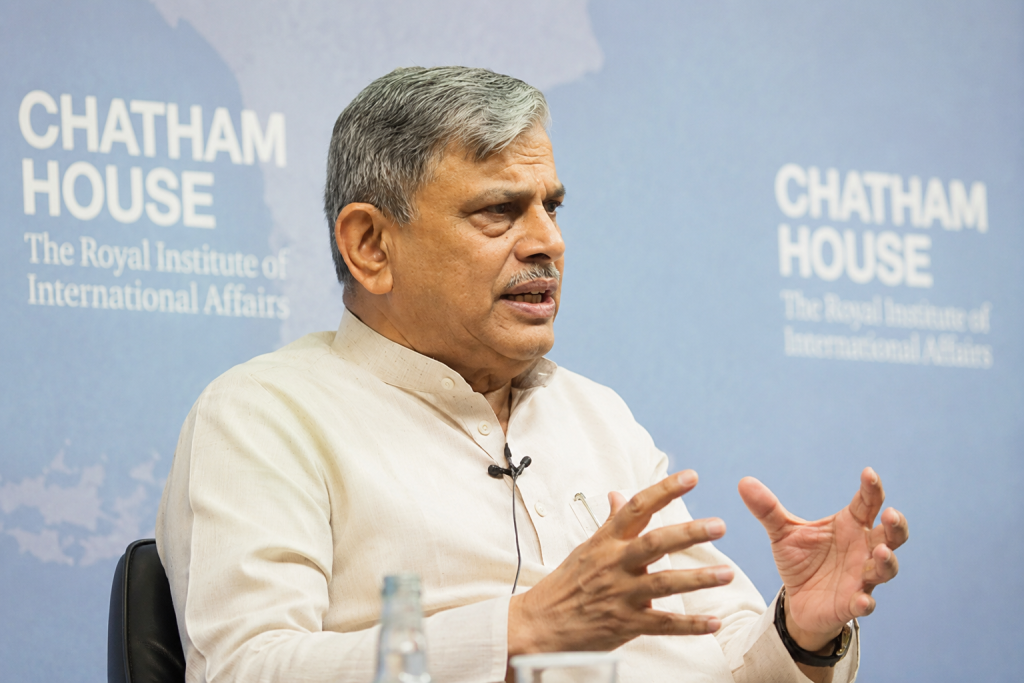
As the Rashtriya Swayamsevak Sangh (RSS) marks its centenary year, the organisation’s engagement beyond Bharat continues to attract significant global attention. During a six-day visit to the United Kingdom from April 10 to 15 this year, RSS Sarkaryavah (General Secretary) Dattatreya Hosabale, accompanied by Akhil Bharatiya Prachar Pramukh (All India Publicity Chief) Sunil Ambekar, engaged with academics, policymakers, parliamentarians, business leaders, and members of the Indian diaspora on themes ranging from civilisational identity to social transformation and India’s evolving global role.
The visit came during the RSS’ centenary year, being observed as a period of renewed commitment to social harmony, service, and nation-building. The interactions in the UK reflected growing international curiosity about the RSS, its organisational model, and the broader idea of Bharat as a civilisational state.
One of the key engagements during the visit was a closed-door interaction at Chatham House, where Hosabale spoke on “RSS View of the World.” Explaining the Sangh’s grassroots nature, he described the RSS as a volunteer-driven civic movement working for social transformation. He highlighted the scale of Sangh-inspired service activities across Bharat, noting that swayamsevaks from diverse social and professional backgrounds contribute to more than 129,000 service initiatives, ranging from educational support programmes to hospitals and tribal welfare projects.
The discussions reportedly covered India’s foreign policy outlook, youth engagement, cultural identity, and the role of community institutions in strengthening social cohesion.
At the International Centre for Sustainability in the City of London, Hosabale elaborated on the distinction between the Bharatiya concept of “Rashtra” and the modern European idea of the nation-state. Describing Bharat as an ancient civilisational entity rooted in shared cultural consciousness, he emphasised that the concept of Rashtra predates modern political frameworks that emerged in Europe after the French Revolution.
The interaction also focused on the Sangh’s approach to social reform, with emphasis on self-correction within Hindu society and the importance of gradual, society-led transformation rather than state-imposed change.
Business leaders and entrepreneurs attending another interaction discussed the role of RSS-inspired organisations in areas such as education, healthcare, rural development, and tribal empowerment. Hosabale underlined the Sangh’s emphasis on character-building and social responsibility through the shakha model, which he described as combining individual discipline with collective social awareness.
The UK visit also saw a significant academic engagement involving scholars from leading institutions including University of Oxford, University of Cambridge, SOAS University of London, University College London, London School of Economics and Political Science, and the University of Sussex. The roundtable focused on the role of civic institutions and voluntarism in shaping social capital and national development.
Hosabale invited scholars to visit Bharat and engage directly with Sangh-inspired service projects to gain first-hand understanding of the organisation’s grassroots work and social initiatives.
In another notable engagement, members of the British Parliament from both the House of Commons and House of Lords participated in a private interaction on the theme “RSS’s Role in Shaping India’s Future.” The discussion included Conservative MP Bob Blackman and representatives from the Labour Party.
The interaction focused on the Sangh’s contribution in fields such as disaster relief, education, healthcare, and tribal welfare, while also exploring the role of the Indian diaspora in strengthening India-UK relations at a time of expanding strategic partnership between the two countries.
Hosabale also met community leaders and attended a Karyakarta Mandal of Hindu Swayamsevak Sangh UK in Rugby, where discussions centred on community engagement, cultural continuity, and the growing role of the diaspora in connecting global Hindu communities.
The visit underscored how, as the RSS enters its centenary year, conversations around Bharat’s civilisational identity, social models, and cultural worldview are increasingly moving beyond India’s borders and into mainstream global discourse.