
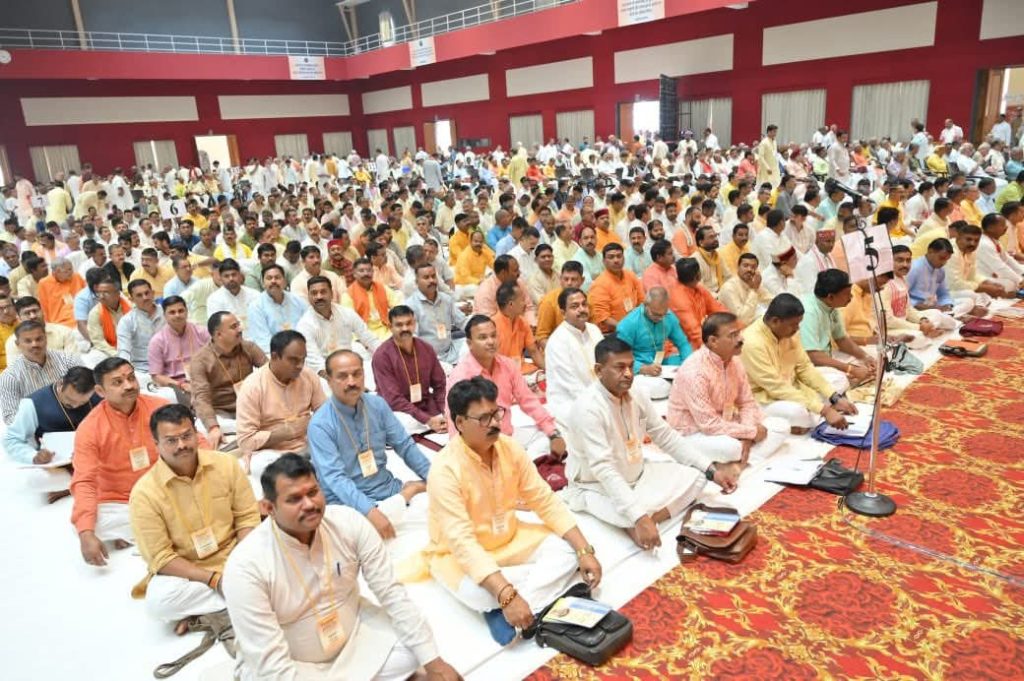
The annual report of the Rashtriya Swayamsevak Sangh (RSS) for 2025–26 was presented at the Akhil Bharatiya Pratinidhi Sabha (ABPS) held in Samalkha, Haryana, from March 13 to 15, 2026. As the highest decision-making body of the RSS, the ABPS has met annually since 1950. During the gathering, which is presided over by the Sarsanghchalak (Chief Mentor), the Sarkaryavah (General Secretary) presents the organization’s annual report.
Currently, the ABPS comprises around 1,500 delegates, including elected representatives from PrantiyaPratinidhi Sabhas (provincial units), members of the Akhil Bharatiya Karyakari Mandal (All India Executive Committee), senior RSS functionaries from the prant(provincial) level and above, and invited representatives from nearly 32 RSS-inspired organisations.
In the middle of the RSS’ centenary year, the report gives a detailed account of engagement across geographical, social, and organisational dimensions.
Statistical Growth and Training Infrastructure
The annual report of 2025–2026 provides empirical data on the organization’s expanding reach through comparative annual data and training metrics:
- Organizational Expansion:
The comparative data for the two-year period reveals a consistent upward trend across all measured organizational categories. Specifically, the Shakha(local unit / daily gathering) segment grew from 83,129 in March 2025 to 88,949 by March 2026, an increase of 5,820. The Sthan (location-based unit / weekly gathering point) category rose from 51,740 to 55,683, while Milan (periodic gathering / meeting) grew from 32,147 to 32,606, and Mandali (small group meeting / informal gathering) increased from 12,091 to 13,211. This data indicates steady growth and a standardization of presence across diverse terrains. Border areas such as Arunachal Pradesh and Leh, alongside island territories like the Andaman and Nicobar Islands, are now integrated into the regular organizational map. - Training Infrastructure and Youth Focus:
The training data from April–June 2025 highlights a strong organizational framework centred on younger participants. The Sangh Shiksha Varg (training camp / training programme) saw its highest engagement during this period, with 63 Samanya (general category, under 40 years) camps training 14,024 individuals from 8,812 locations. Additionally, 29 Vishesh (special category, ages 40–65) camps were conducted for 2,203 trainees. - Leadership Development:
At the leadership development level, Karyakarta Vikas Varg (worker development programme) – 1 (Level 1) conducted 11 camps in each age category, training 2,401 General and 2,067 Special participants, respectively. Additionally, Karyakarta Vikas Varg (worker development programme) – 2 (Level 2) successfully held a General camp for 831 trainees representing 793 locations. These figures reflect an extensive geographical reach and a steady influx of younger personnel into the higher training tiers.
Seva Vibhag
The Seva Vibhag (social service department) activities demonstrate a structured expansion of social welfare through the following consolidated metrics:
- Organizational Infrastructure and Personnel:
Joint planning meetings were conducted in 247 Vibhags (regional divisions), supported by training camps in 932 Nagars (city units) and the appointment of 26,492 Seva Karyakartas (service volunteers) within 15,314 Vyavasayi Shakhas (professional-based shakhas) across 3,007 cities. - Service Scope and Local Outreach:
Nationwide, 96,045 daily or weekly activities—including 45,931 educational, 15,632 health, 17,888 social, and 55,958 other initiatives—are carried out in 12,826 Bastis (localities / settlements), with 15,680 Shakhas directly leading these efforts.
Coming back to the centenary year, many programmes were organised to undertake extensive social outreach, along with national and social awakening activities during the year.
The programmes included the RSS foundation day Vijayadashami Utsav (celebration / event), extensive Griha Sampark (house-to-house contact) and village outreach, Samajik Sadbhav Baithaks (social harmony meetings), prominent citizens’ meets, Hindu Sammelans (conferences / congregations), and Yuva (youth) programmes.
Vijayadashami Utsav
A total of 62,555 Utsavs (celebrations / events) were conducted, in which 2.71 million youth and 536,955 others participated. A total of 22,656 Sanchalans (route marches) were organised, in which 2.16 million youth and 383,663 children participated.
A major highlight of the programme was seen in Madhya Bharat (central region of Bharat), particularly in Bhopal, where a professional category-wise sanchalan (route march) was planned, including key professions such as doctors, advocates, professors, teachers, industrialists, and young entrepreneurs. Out of 2,917 Swayamsevaks (volunteers), 475 were professors, 414 were doctors, 330 were teachers, 305 were advocates, 185 were industrialists, and 180 were young entrepreneurs. At the Maulana Azad National Institute of Technology, a student path sanchalan (march-past / ceremonial route march) was organised in which 232 students and 24 professors participated.
Another notable aspect was observed in the Braj region, where, to ensure active participation, women were involved in planning, execution, and leadership-level responsibilities.
Griha Sampark Abhiyan (Door-to-Door Contact Campaign)
The Griha Sampark Abhiyan (door-to-door contact campaign) represented a major milestone in direct-to-society engagement. This initiative reached over 100 million households across hundreds of thousands of villages and tens of thousands of urban localities, driven by extensive volunteer mobilization and the distribution of printed materials.
- Under this campaign, 389,465 villages were contacted, 31,143 Bastis (localities) were covered, and over 100.21 million houses were visited. A total of around 91.18 million pamphlets were distributed and around 8.41 million books were sold.
- A major highlight of the programme was the targeted outreach to opinion-makers in society, under which 3,478 individuals were contacted in Madhya Bharat. In the Braj region, a specific day was planned to maximise outreach, during which 350,000 families were contacted in a single day.
Hindu Sammelan (Hindu Conferences)
The outreach incorporates a secondary layer of community gatherings and sammelans that engage diverse social groups, including tribal and women’s networks, while adapting to local indigenous traditions to ensure cultural relevance.
- Under this category, 23,143 mandal-level (clusters of 3 to 10 Shakhas) sammelans (conferences / congregations) were organized, alongside 13,905 sammelans at the basti (locality) level. Participation in these programmes included 15.59 million women and 19.34 million men.
- The sammelans featured diverse involvement from women, national personalities, and spiritual leaders, including notable addresses from figures like Padma Shri Tulasi Munda. Outreach focused on indigenous identities, involving over 3,500 Janjati Bandhus (tribal community members) in Dimapur and 17,696 participants in Meghalaya’s 32 gatherings. Strategic presence extended to border regions like Karaigura, while Arunachal Pradesh adopted a community-sourced logistics model utilizing 24,000 “Griha-Siddha” food packets. Youth mobilization was prioritized in Uttar Banga, where Sarsanghchalak Mohan Bhagwat addressed 5,729 young men and 1,053 young women. In Dakshin Assam (Western Assam), Sarkaryavah Dattatreya Hosabale interacted with over 2,000 residents in Hailakandi Nagar.
Samajik Sadbhav Baithak (Meeting for Social Harmony)
These forums bring together representatives from different religious communities, caste groups, and social organisations. The report documents participation from Sikh, Jain, Buddhist, and Muslim representatives in multiple regions, alongside leaders from dozens of caste groups.
- In Malwa, 56 representatives from various spiritual organizations, including ISKCON, Isha Foundation, Art of Living Foundation, and Gayatri Parivar, met in Ujjain. In Madhya Bharat, 224 social leaders along with 38 organizational representatives from eight vibhags(regional divisions) participated in the discussions. The Chittod region saw 178 leaders convene in Udaipur, while 163 sants (spiritual leaders) and katha vachaks (religious narrators / preachers) participated across the Kota and Baran vibhags.
In Haryana, 326 participants from all 27 districts came together, representing 60 castes and 20 spiritual organizations. In the Goraksha region, 582 representatives from various community organizations, including Bouddha Bhikkus (Buddhist monks), gathered in Gorakhpur. Similarly, in Uttar Bihar, 417 leaders representing 53 different castes and communities met in Muzaffarpur.
In Dakshin Bang, the outreach marked a significant milestone with a first-ever visit to the region, where 13,000 people from nine main islands gathered at Netaji Stadium, and 615 social leaders participated in the interaction.
- Historical and Civilizational Connect:
The organization established a historical connection to the independence movement by holding the Virat Hindu Sammelan at the historic site of Subhas Chandra Bose’s 1943 address in Port Blair. - Broad Social and Inter-faith Integration:
Efforts focused on building multi-caste and inter-faith synergy, bringing together a wide spectrum of spiritual traditions and leaders from over sixty different castes to foster social harmony. - Practical Reform and Consultative Leadership:
The initiatives shifted toward addressing modern societal issues, such as drug abuse and mobile addiction, through an interactive leadership model that prioritized grassroots consultation.
Pramukh Jan Goshti (Prominent Citizens Meet)
The Pramukh Jan Goshti (prominent citizens’ meet) series, titled “100 Years of the Sangh’s Journey – New Horizons,” utilized a structured, micro-targeted approach by engaging dignitaries across 132 sub-categories.
- High-level Metropolitan Engagements:
Included sessions in Bengaluru (1,228 attendees), Delhi (1,278 participants, including ambassadors from 40 countries), Kolkata (1,293 personalities, including descendants of 40 revolutionary families), and Mumbai (797 guests). - Regional Outreach:
Further extended to diverse sectors, such as 920 educational heads in North Karnataka, 66 Tollywood personalities in Telangana, 350 advocates in Jammu and Kashmir, and 120 tribal leaders representing 17 tribes in Manipur.
Youth Programmes
Youth programmes under the Shatabdi Varsh (centenary year) initiatives are a core pillar of current outreach. These reflect a structured effort to engage the younger generation across diverse institutions. According to the Prativedan (annual report) 2025–26, these initiatives spanned several formats.
- In Kerala, 870 medical students and researchers attended the “Blooming Bharat” programme in Thiruvananthapuram and Kochi. A Prerana (inspiration) session in Kozhikode targeted the 20–40 age group. In Chennai, a dialogue brought together 1,083 youth.
- In North Karnataka, a Yuva Sadhu-Sant Samvad (dialogue with spiritual leaders) involved 230 sants (spiritual leaders) from various panths (sects / religious traditions). In Navi Mumbai, the Yutthan (upliftment) Youth Conference engaged 910 students from 90 colleges on themes of national security and entrepreneurship. Similarly, in Devgiri, university students and young entrepreneurs gathered in Chhatrapati Sambhajinagar. In Rajkot, 55 youth attended a Yuva Pratibha Milan (talent conclave).
- Madhya Bharat and Chhattisgarh saw significant engagement at national institutions. This included 1,147 participants at AIIMS Raipur, alongside students from IIT Bhilai and IIM. In Punjab and Jammu & Kashmir, sessions were held at AIIMS Bathinda and the IIT/IIM Jammu Nagrota campus. A massive outreach occurred in Odisha Purva (East Odisha), where 25,078 participants, including 10,250 young entrepreneurs, were engaged across 178 Khands (development blocks).
- In Uttar Bengal (North Bengal) and South Assam, a prant-level (state-level) Yuva Sammelan (youth convention) saw thousands of young men and women participate.
- Additionally, 222 individuals from 62 different communities joined Samajik Sadbhav (social harmony) meetings in Haflong and Silchar.
Vishwa Sangh Shivir: The Global Dimension
The centenary year underscored the organization’s international reach through the Vishwa Sangh Shivir (global volunteers’ camp), held in December 2025 in Bhagyanagar (Telangana).
- Bringing together 1,611 Swayamsevaks (volunteers) and their families from 71 countries, the gathering functioned as a strategic bridge between the Indian diaspora and the movement’s domestic vision.
- The shivir (camp) moved beyond routine cultural exchange to focus on the professional and social integration of the global Hindu community. Key sessions addressed the preservation of family values and youth engagement in a globalized context. Notably, the presence of Krishna Ella, Chairman of Bharat Biotech, as a chief guest, alongside the Sarsanghchalak, was part of the programme.
The Annual Report 2025–2026 is more than a record of activities; it is a blueprint for civilizational engagement. By engaging 10% of India’s population and mapping the professional elite into 132 categories, the RSS has demonstrated a sophisticated “Direct-to-Citizen” communication model. Ultimately, these initiatives signify a transition toward a self-sustaining socio-cultural network that integrates youth, professionals, and indigenous communities into a civilisational dialogue.
(The writer is an author and columnist)