POJK Sankalp Diwas: The RSS Legacy in Jammu & Kashmir’s Defence
Updated: February 21, 2026 13:56
Every year on February 22, India observes POJK Sankalp Diwas(day of national resolve for integrating Pakistan-Occupied Jammu & Kashmir with India).It reaffirms Parliament’s unanimous 1994 resolution that Pakistan-occupied Jammu & Kashmir is an integral part of India. The resolution declared Pakistan’s occupation untenable and called for the vacating of territories seized through aggression in 1947-48. It remains a formal expression of India’s resolve to legitimately reclaim these areas.
India became independent in August 1947.In October 1947, despite a standstill agreement signed with Jammu & Kashmir on August 12, 1947, Pakistan launched Operation Gulmarg. Portrayed as a “jihad” to liberate Kashmiri Muslims, the incursion was in fact a coordinated, Pakistan-backed assault marked by widespread looting, killings, and sexual violence as the raiders advanced toward Srinagar.
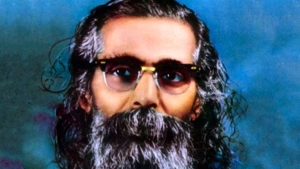
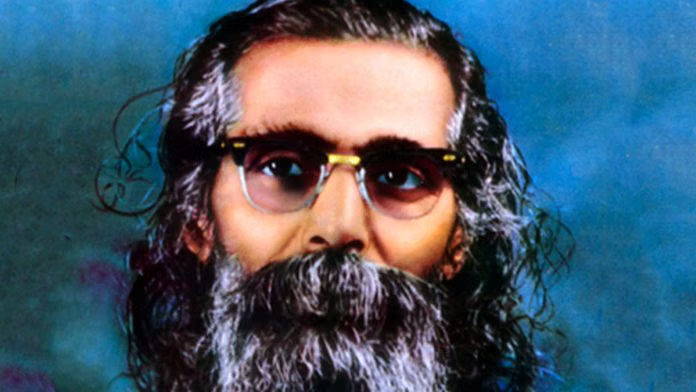
Amidst this instability, a crucial intervention occurred. RSS’ secondSarsanghchalak(Chief mentor)MS Golwalkar met Maharaja Hari Singh(ruler of the state of Jammu & Kashmir) in Srinagar on October 17, 1947, playing a vital role in addressing the Maharaja’s hesitations and urging him to accede to India to ensure the state’s security. Following the Pakistanis onslaught, the Maharaja signed the Instrument of Accession on October 26, 1947. This legally integrated Jammu & Kashmir into the Union of India.
On October 27, Indian troops were airlifted into Srinagar to repel the invasion. Although the Indian Army recovered substantial territory during the conflict, a United Nations arranged ceasefire came into effect on January1, 1949, freezing the positions held by Indian and Pakistani forces at that time. As a result, areas including most of the Muzaffarabad and Mirpur districts and parts of Poonch remained under Pakistani control. These territories are referred to as Pakistan-occupied Jammu & Kashmir (PoJK).
During the Pakistani invasion of Jammu & Kashmir in October 1947, volunteers of the RSS were active there assisting with refugee relief, local organisation, and civil support. Historical accounts and memoirs from the period record that Swayamsevaks(volunteers) helped in evacuation, coordinationand became the backbone of civil defenceWhile their relief work is documented, their role in active resistance and supreme sacrifice remains a largely untold chapter of the conflict.
According to the historical documentation found in the book ‘Partition-Days: The Fiery Saga of RSS(Suruchi Prakashan)’ by Manik Chandra Vajpayee and Sridhar Paradkar, the RSS played a stellar role for India in this conflict.
Defence of the Frontier: Mirpur and Kotli (1947)
The fall of the western districts of Jammu & Kashmir was a result of a massive logistical disadvantage and the overwhelming numbers of the Pakistani-backed lashkars. However, the period between October and November 1947 saw a coordinated effort between the State forces, the Indian Army, and RSS Swayamsevaks to protect the local population.
Resistance at Kotli
Kotli served as a vital link between Mirpur and Poonch. Having established a presence there in 1941, the RSS had a good network in the region. By November 1947, the town was encircled by Islamic marauders who had initiated a campaign of arson and violence in the surrounding villages.
Rescue Mission at Palandri
In an effort to rescue civilians in danger 12 miles away, a joint party was formed consisting of 39 soldiers under Lieutenant Ishwar Singh, police constables under Inspector Hari Singh, and 100 Swayamsevaks(RSS Volunteers). The group was ambushed near a nullah after being misled by local administrative betrayal. Under heavy machine-gun and mortar fire, several swayamsevaks, including Bakshi Durgadas, Chunnilal, Satyapal, son of Nihalchand, Satyapal, son of Khemraj, Jagjit Singh, and Master Manohar Lal were captured.Historical accounts record that when ordered by the Islamist tribal chief to renounce their faith, they refused, leading to their immediate execution.
Ammunition Retrieval
As the Kotli garrison’s supplies dwindled, air-dropped ammunition fell into “no-man’s land.” RSS Nagar Karyavah(RSS in-charge of the town)Ved Prakash led a mission to retrieve these boxes under direct fire. Despite being mortally wounded, he continued to move the supplies until he collapsed. A 22-year-old youth, Somraj, another RSS volunteer, was also martyred after successfully retrieving two boxes. In total, six swayamsevaks lost their lives in this operation, which allowed the garrison to hold.
To secure the city, it became necessary to destroy a Pakistani fortification established in a strategic house just 35 feet from the city limits. Dharmaveer, the son of senior RSS worker Kripa Ram, volunteered for the mission. He successfully demolished the post using grenades and mortars but was killed by enemy fire as the mission concluded.
Despite defending Kotli for 56 days, the town was eventually evacuated on November 27,1947 relocating the residents to Jammu.
Fall of Mirpur and the Final Resistance
Unlike Kotli, Mirpur fell due to a lack of timely reinforcements and a sustained siege. As the city’s defences were breached on November 25, 1947, RSS volunteers remained as a rearguard.
For 20 days, local RSS volunteers and state forces held the perimeter with limited weaponry. Leaders such as Kedar Nath Sahani (Pracharak-a full time RSS worker), Thakur Omkar Singh, and Harbans Lal worked to maintain morale as the city faced mortar fire and massed tribal assaults.
When the defence positions gave way, panic gripped the city. While many state officials and administrative heads reportedly fled, Swayamsevaks(RSS volunteers) remained at their stations to facilitate the exit of refugees.
Purushottam Gupta, a survivor of the Mirpur genocide, noted that the RSS volunteers “stood at their battle stations challenging the enemy. When returned with bullets they fell where they stood, but they did not desert their posts. They were brave martyrs and immortal heroes”
Out of a population of 25,000, only approximately 1,000 survived the massacre. Kedar Nath Sahani and 100 volunteers from Jammu established a relief base at Mangal to provide food and transport for the survivors fleeing toward Jammu.
Infrastructure and Logistics: The Poonch Airstrip
One of the most inspiring examples of the civil-military interface was the construction of the Poonch Airstrip. By late 1947, Poonch was under a prolonged siege, and the Indian Army required a landing strip to bring in reinforcements via Dakota aircraft.
In December 1947, local RSS units, worked alongside the Army’s engineers (led by Lt. Col. Pritam Singh) to clear a rugged stretch of land. Working with basic hand tools under extreme conditions, they levelled the ground for an improvised runway.
This effort allowed the first Indian aircraft to land on December 12,1947, bringing in the 1st Battalion of the Kumaon Regiment. This logistical breakthrough is credited with preventing the fall of Poonch to the invading forces.
RSS Policy and the 1994 Resolution
The RSS’s stance on Jammu & Kashmir is a foundational ideological pillar rather than a contemporary reaction. Between 1953 and 2023, the highest decision-making body of the organisation, the Akhil Bharatiya Pratinidhi Sabha (ABPS) and ABKM (Akhil Bharatiya Karyakari Mandal) have passed several resolutions focusing on:
Reclamation of PoJK: A categorical rejection of Pakistan’s occupation of Mirpur, Muzaffarabad, and Gilgit-Baltistan, urging their full return to Indian sovereignty.
National Integration: Sustained advocacy for the removal of Article 370 and 35A, a position realized in August 2019, ensuring the state’s full constitutional parity with the Union of India.
Rights of Displaced Persons: Consistent support for the rehabilitation and rights of the thousands of refugees forced to escape the Mirpur, Muzaffarabad, and Kotli regions during the 1947 aggression.
The Rashtriya Swayamsevak Sangh had always maintained that Jammu & Kashmir in its entirety including POJK is an inseparable part of Bharat.
(The writer is an author and columnist)