MS Golwalkar’s Final Years: A Masterclass in Purpose-Driven Leadership
Updated: February 20, 2026 15:16
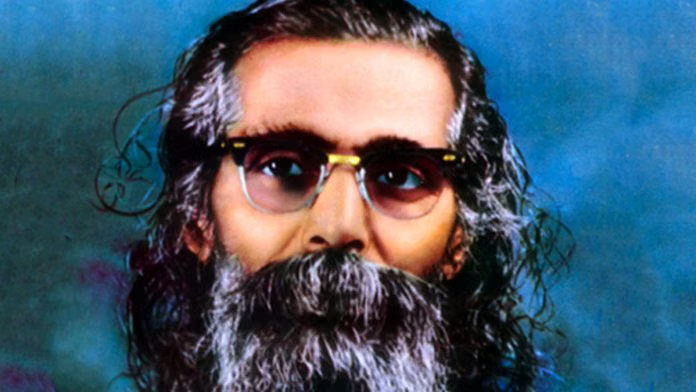
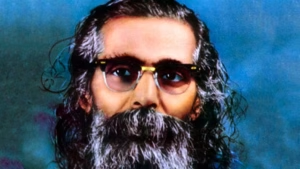
The second Sarsanghchalak of the Rashtriya Swayamsevak Sangh (RSS) Madhav Sadashiv Golwalkar was born on 19 February 1906 and passed away on 5 June 1973. He guided the organisation through its most critical phase from 1940 to 1973, building its core structure on the foundation laid by the founder and first Sarsanghchalak, Dr Keshav Baliram Hedgewar.
Popularly known as ‘Guruji’ the last three years of Golwalkar’s life stand as a lesson in selfless leadership and service to the nation. Even while facing serious illness, he continued to lead from the front, demonstrating commitment not through words but through consistent action-an example for leaders across fields.
Diagnosis and Relentless Duty
In May 1970, Dr. Prafull Desai at the Tata Memorial Hospital, confirmed after various tests that Guruji had cancer. Guruji asked Dr. Desai, “How much has the cancer spread, and can it be cured?” Dr. Desai replied, “That can be known only after an operation. Not to operate would be to invite danger. I sincerely wish that you agree to the operation.”
Guruji agreed to this on the condition that it would be done after he was finished with visiting the RSS training camps according to his pre-decided schedule. He travelled and interacted with swayamsevaks at the training camps without letting them know that he was suffering from cancer. In fact, he also held a press conference in Delhi on June 11, 1970, during the course of the tour, to respond to the RSS’ detractors who had been trying to malign the organisation.
After the press conference in Delhi, he went to Kolkata to address the swayamsevaks at a training camp. From there, he went to Mumbai and was admitted on June 30 at Tata Memorial Hospital for surgery.
On July 1, he underwent a three-hour surgery. While being at the hospital, he started visiting a nearby RSS shakha. He also attended the annual meeting of the RSS’ Central Executive Committee in Mumbai from July 10 to 12. On July 26, he left the hospital, and on August 3, he left for Nagpur by train.
On August 13, Guruji addressed an RSS programme on the occasion of Raksha Bandhan. He stood for 45 minutes while delivering the address.
He returned to Nagpur on September 26 and resumed his old routine. Addressing the Vijaya Dashami function in 1970, where V. Shankar, retired Secretary to Sardar Vallabhbhai Patel, was the chief guest, Guruji warned against possible foreign aggression and emphasised the need to build up the internal strength of the nation.
Guruji had told Dr. Desai, “Mortal that man is, he should not worry too much about his physical well-being. Every living being has to depart at some time or the other. So, what is important is not how long a man lives, but how he lives. I have a mission to live for before me, and I have to fulfill it. So, I only pray to the Almighty to keep me fit till the end.”
A Leader at Work
The final phase of Guruji’s life had begun. He knew he was not well, and yet he continued with a schedule that didn’t give him time to rest. Immediately after his surgery, he toured extensively from October 23 to December 7. He travelled and addressed a series of programmes, organisational meetings, and training camps in Mumbai, Bengaluru, Nasik, and Pune, followed by a short halt in Nagpur, then Delhi and Mumbai, en route to Karnataka for a provincial Sangh conference. From there, he went to Pandharpur, then to Solapur, again Mumbai, and back to Nagpur. At all these places, the schedule used to be crowded and the pace hectic—meetings for guidance to workers, public speeches, and planning for the future.
Dr. Desai had given Guruji around three years. So, till 1973, he immersed himself in organisational work. The RSS’ Central Executive met in Nagpur from July 8 to 10, 1971, and passed a resolution on the situation in Bangladesh, calling upon the Government to keep its solemn promise given to the Hindus of Pakistan at the time of Partition, assuring them of safety and security. On December 3, 1971, Pakistan attacked India. In his statement, issued on December 4, 1971, Guruji appealed to the countrymen, “The unity inspired by genuine love for the motherland alone can lead us to victory.”
“Pakistan is openly at war with us. Our government and the army are quite capable of meeting the challenge, but it is essential to keep the morale of the people high and maintain the highest levels of production in fields and factories. Besides, our jawans on the front must feel that the entire nation is behind them. Civil defence, blood donations, nursing of wounded personnel, etc., are some of the essential services to be organised forthwith.”
The RSS, as desired by Guruji, lent its full support to the defence efforts. Bangladesh was liberated after an emphatic victory of Indian defence forces in December 1971.
He sent a letter to the then Prime Minister, Indira Gandhi, on December 22, saying, “May the unity of the country, a realistic assessment of the situation, and the determination to preserve the honour and prestige of the country continue like this.”
The Final Days
In 1972, Guruji’s health deteriorated very fast. From October 28 to November 3, a brainstorming session was organised at Thane (Maharashtra). It was attended by key RSS functionaries. On his return to Nagpur, medical treatment was resumed afresh. In 1973, he spoke at the concluding session of the RSS’ highest decision-making body, known as the Akhil Bharatiya Pratinidhi Sabha (ABPS), which was arranged in Nagpur.
It was clear there that he was unwell, as he had to make a herculean effort to speak.
In March 1973, his health deteriorated further, and he was confined to the RSS headquarters in Nagpur. From March 26 onwards, he could not even bathe with his own hands. Dr. Sujit Dhar of Calcutta used to visit him once a fortnight to examine him.
Guruji asked him, “Why are you trying to sustain this body? For how many more days would you be able to save it?”
On the night of June 4, 1973, Murlidhar (Baburao) Chauthaiwale arrived to give him an oil massage as he did every day, carrying his familiar bottle of oil. But when he tilted it, not a single drop came out—the bottle had run dry. Guruji saw this, smiled, and said, “The oil is finished? That is all right. Anyway, who’s going to need it tomorrow?” The agonising significance of the words was not lost. The whole day, Guruji sat in his chair facing north. He looked like a yogi, his eyes half-closed, probably contemplating the Divine. That night, he did not lie in bed also but kept sitting in the chair in the same posture. He knew the day of departure had finally arrived.
On June 5, 1973, he passed away.