
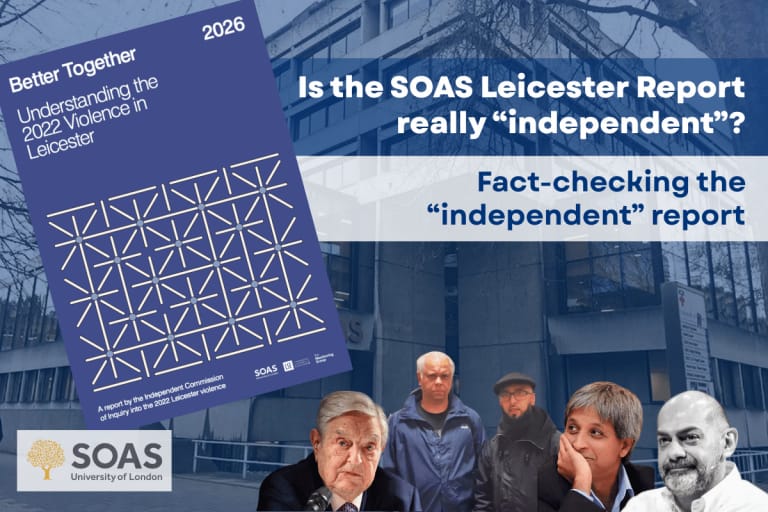
A joint study by three United Kingdom-based groups has made wide allegations against the Rashtriya Swayamsevak Sangh (RSS) and its ideology of Hindutva in the context of the 2022 anti-Hindu riots in Leicester. Radical Muslim mobs had targeted Hindus in these riots, which were reportedly triggered by tensions following an India-Pakistan cricket match.
The origin of the report itself casts doubt over its authenticity. Titled “Understanding the 2022 Violence in Leicester,” the study has been funded by known Hindu and India baiter George Soros through his notorious Open Society Foundation. It was conducted by the School of Oriental and African Studies, the London School of Economics and Political Science, and The Monitoring Group. The report hides the actions of fundamentalist Muslim mobs by concluding that no specific community can be blamed for it.
There is a full chapter in the report on RSS and Hindutva. The facts cited in this report are incorrect, reflecting the bias that emerges either out of a lack of understanding about the Indian civilisational lens or a deliberate attempt to promote Western stereotypes about the largest voluntary organisation in the world.
Fact vs Fiction
To begin with, the report makes a wildly false allegation:
“The RSS and all its major affiliates have been involved in instigating large-scale communal violence and hatred in India since Independence, especially from the 1980s onwards.”
First, the RSS doesn’t have any affiliates. There are dozens of organisations which are run by RSS volunteers along with other members of society, but they can be more appropriately defined as RSS-inspired organisations. They are independently registered autonomous civil organisations.
Second, no RSS-inspired organisation or the RSS has been found guilty of participating in communal violence. In fact, a large number of RSS cadres have sacrificed their lives to protect Hindu society during riots.
The report makes another factual blunder by asserting:
“The RSS typically uses the word ‘Bharat’, a Hinduised rendering of the republic, to refer to India.”
The word ‘Bharat’ has not been created by the RSS; in fact, it is the ancient and original name of India that has been found in literature dating back more than 3,000 years. Even the Government of India since Independence is also known as ‘Bharat Sarkar (Government of Bharat)’.
Hindutva and Spiritual Nationalism
According to this report:
“Hindutva is a political ideology developed in the 1920s in the English language by Vinayak Damodar Savarkar of the Hindu Mahasabha organisation. It is an ideology of aggressive Hindu supremacism based on racial-religious, ethnonationalist and territorial criteria.”
It further adds:
“The RSS in India is an organisation whose founding ideology and methods were inspired by a combination of Savarkar’s ideology, Italian Fascism, and German National Socialism (Nazism). Since its formation, the RSS has attempted to displace the religion of Hinduism with Hindutva, a racial political ideology of Hindu supremacy and anti-Muslim, anti-Christian hatred. The goal of Hindutva movements in India is to create what they call ‘Hindu Rashtra’, a Hindu nation-state based on Hindu supremacy.”
The fact of the matter is that Hindutva is not a political ideology. While Savarkar did contribute to the articulation of Hindutva in a treatise in 1923 in the contemporary context, the concept of Hindutva and Hindu nationalism dates back to ancient India. The concept of ‘Hindutva’ that is pursued by the RSS is not rooted in political nationalism but it is a reflection of ‘spiritual nationalism’ that has been explained quite well in the writings of Indian intellectual giants like Bankim Chandra Chatterjee, Radha Kumud Mukherjee, Bipin Chandra Pal and many others who wrote about it in their works. Sri Aurobindo’s writings also dwelt upon it in detail. None of them had anything to do with the RSS, and most of their writings pre-date Vinayak Damodar Savarkar’s seminal work ‘Hindutva’. It is a common folly that most of the commentators and rapporteurs ignore the originof ‘spiritual nationalism’ in India dating back to several millennia.
Another premise expounded by this report is:
“Hindutva or Hindu nationalism is fundamentally distinct from Hinduism. Hinduism is a world religion encompassing numerous and diverse religious traditions and practices. The literal translation of Hindutva as ‘Hinduness’ allows the RSS and its followers to deliberately confuse it with Hinduism, claiming that the ‘essence’ of the Hindu religion is Hindutva. For those unfamiliar with its history and ideological meaning, Hindutva may seem simply to be a word that means ‘being a Hindu’ rather than a recent far-right political ideology of racial-religious supremacy and anti-minority hatred.”
This sweeping and clichéd statement is an outcome of using a Western lens that cannot differentiate between religion and Dharma and hence equates the Hindu faith as equivalent to other Abrahamic religions.
Hindutva, or Hinduness, is a manifestation of the civilisational values that were imbibed in the concept of Dharma. There is no direct equivalent for the term ‘dharma’ in the English language dictionary. The closest term might be ‘righteousness’. In the early years of the twentieth century, religion was used interchangeably with the word dharma due to the impact of British colonialism on Indian public discourse. Similarly, many philosophers used the word ‘Hinduism’, including Swami Vivekananda. However, ‘ism’ also denotes a dogma such as ‘capitalism’, ‘socialism’, etc. When we use any ‘ism’, that would lead to a certain set of rigid rules. But ‘Hindu’ Dharma isn’t a dogmatic framework, as it believes in “ekam sat viprahbahudhavadanti,” which means “Truth is one, the wise call it by various names.” This is the guiding spirit of Hindutva, and it dates back to the Rig Veda, the most ancient text of Indian civilization.