
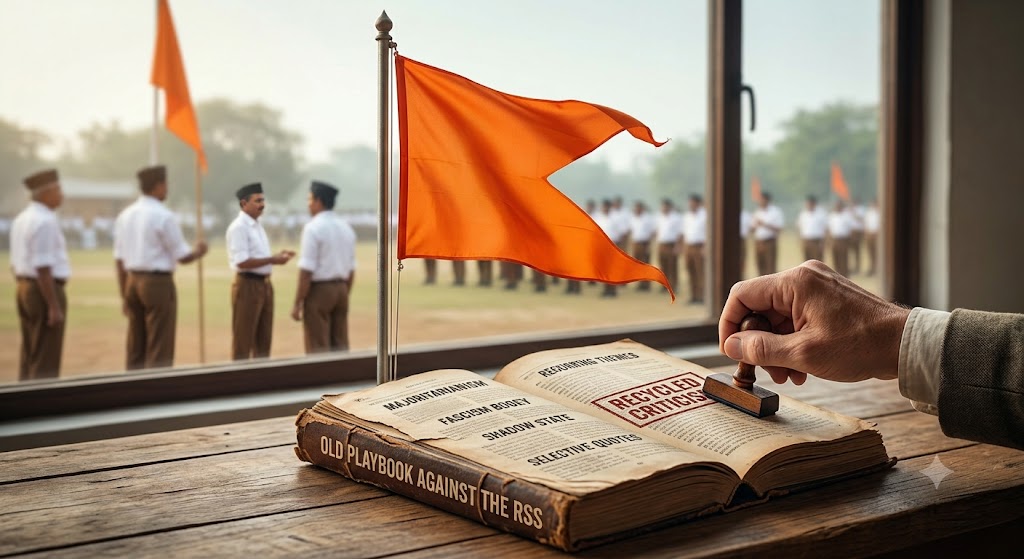
The recent visit (Aug 25-Sept 7) of RSS Sarsanghchalak Mohan Bhagwat to the USA, Canada, and the UK has predictably triggered a familiar offensive against the organisation. In what appears to be a calibrated campaign to undermine the success of this tour, a number of commentaries, interviews, and op-eds are being published in sections of the Indian as well as foreign media. A common thread running through this latest anti-RSS campaign is the projection of a civilisational engagement as a red flag. It would be pertinent to look at some of the recurring themes used by the RSS’s critics for a long time, themes that are being used in this campaign as well.
The charge of “majoritarianism” and threat to minorities
The most frequent allegation is that the RSS represents a majoritarian, exclusionary vision of India that endangers religious minorities. This charge often rests on selective quotes from RSS literature without providing context. The organisation’s clearly articulated, permanent position is that all those who trace their ancestry to Indian soil, regardless of the faith they practice, are part of the same civilisational family.
To use an age-old cliché, actions speak louder than words: the RSS has millions of members cutting across boundaries of religion. Its volunteers run around two lakh welfare projects for the upliftment of marginalised sections of society. Beneficiaries are not discriminated against based on caste or religion. It is a well-known fact, acknowledged even by the RSS’s most bitter critics, that its volunteers are the first to reach out for relief work during any natural calamity, disaster, or major accident. This helping hand is extended to all those who need it, irrespective of religion.
It is important to point out that instead of engaging with the officially articulated position of the RSS — reflected in the speeches of Bhagwat and other senior functionaries — anti-RSS campaigners selectively use quotes from fringe elements to label it majoritarian.
The bogey of “Fascism”
A second recurring theme, especially popular in Western op-eds and often cited by Western and Marxist political scientists, is to term the RSS “fascist.” This is done by drawing on European interwar analogies to compare the Sangh’s discipline, uniforms, and cadre-based structure to fascist paramilitaries. This is a mischievous and intellectually dishonest comparison. The fundamental requirement of a fascist movement or organisation is the presence of a cult of a supreme leader. In the RSS, no individual holds this supreme position — it is instead accorded to the Saffron Flag, whom RSS volunteers call their “Guru.”
N.H. Palkar, a senior RSS functionary who worked with the organisation’s founder, Dr. Keshav Baliram Hedgewar, wrote in a short treatise, Bhagwa Dhwaj: “Hindu nation, Hindu society, Hindu Dharma, Hindu culture, Hindu way of life, and Hindu philosophy are all integrally related to the Saffron Flag. The Saffron Flag is capable of inspiring qualities like renunciation, sacrifice, valour, and patriotism.” The saffron flag flutters atop innumerable temples across India.
A fascist organisation, by definition, has an expansionist military doctrine. The RSS has no such doctrine. Its concept of “Akhand Bharat” is a civilisational concept, not a geographical one. India’s own courts and laws have defined the RSS as a body of individuals that collects resources from its volunteers and uses them for social work.
It is clear that applying a European vocabulary to an Indian socio-cultural organisation tells us more about the analytical laziness of the commentator than about the organisation itself.
The “secrecy” and “shadow state” narrative
Another persistent claim is that the RSS operates as an opaque, unaccountable shadow government, pulling strings behind elected institutions. In fact, all RSS shakhas — its key instrument for connecting with volunteers — are held in public places. There is no scrutiny, membership fee, or formal procedure involved. Anyone can attend a shakha and become a volunteer of the organisation; there is no restriction on entry or exit. All organisations run by RSS volunteers file annual reports, and their structures are published on their websites. The RSS also maintains an official website where all information about the organisation is available. Its senior functionaries address press conferences and give interviews routinely. Resolutions passed by the organisation are made publicly available, articulating the RSS’s stand on various issues. An organisation genuinely committed to functioning in the shadows would not hold a public, televised annual address (on Vijaydashami) outlining its positions on current affairs, nor invite scrutiny by hosting international dignitaries and diplomats at its events, as it has increasingly done in recent years.
Conclusion
It is notable that criticisms against the RSS resurface with particular intensity precisely when the organisation steps into greater public visibility — visits by foreign dignitaries to engage with the RSS, visits by RSS functionaries to foreign countries, and the Sangh’s engagement with major domestic or global institutions. This anxiety among the RSS’s critics appears to stem from discomfort with an indigenous, non-Western socio-cultural formation acquiring legitimacy and confidence on its own terms, defying the frameworks that Western commentary is accustomed to applying to non-Western civilisations.