
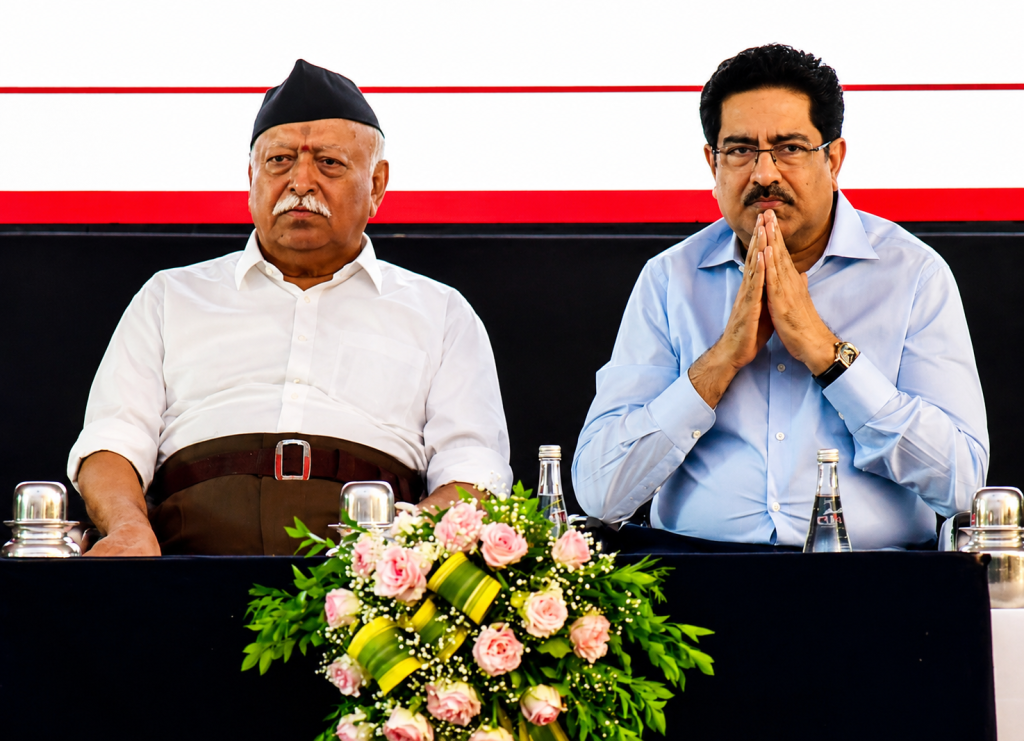
At the public valedictory function of the Karyakarta Vikas Varg (Second Level) of the Rashtriya Swayamsevak Sangh on 4 June 2026, RSS Sarsanghchalak Dr Mohan Bhagwat delivered a wide-ranging address that combined civilisational reflection, national preparedness and the Sangh’s organisational vision.
It is important to decode this speech as, after Vijaydashami — the RSS’ foundation day — this is arguably the second most important occasion on which the Sarsanghchalak indicates the direction and world vision of the Sangh. As the RSS does not believe in any dogmatic framework or static worldview, its direction as well as perspective is perpetually evolving. In this dynamic process, occasions like the valedictory speech at the Karyakarta Vikas Varg (Second Level) become crucial.
Importance of Training Programme
Before moving further to decode Bhagwat’s speech, it is pertinent to explain why the Karyakarta Vikas Varg (Second Level) is so important that its valedictory function is addressed by the Sarsanghchalak himself.
There are three levels of residential training programmes, and the Karyakarta Vikas Varg (Second Level) is the third and highest training programme. The best of the best volunteers are selected to attend this programme at Nagpur. The other two training programmes are held at the state and district levels, but the Karyakarta Vikas Varg (Second Level) is conducted at the central level at the RSS headquarters in Nagpur.
The level of motivation after attending this programme is so high that a large number of participants become full-time RSS workers, known as Pracharaks, dedicating their lives to the organisation by sacrificing careers, family bonds and worldly attractions. Pracharaks form the backbone of the Sangh’s organisational work. Thousands of such full-time workers have quietly helped build the organisation as its eternal backroom force. Almost all of them crossed this threshold after attending the third-year training programme at Nagpur, which was renamed a few years ago as the Karyakarta Vikas Varg (Second Level).
Substantive Civilisational Message
There are certain key takeaways from Bhagwat’s speech that help us understand the way the RSS is looking at challenges and the way forward for India and the world.
Bhagwat argued that the world today is trapped in conflict, excessive self-interest and models of development that often lead to ecological and social destruction. While the modern world speaks separately of individual freedom, social freedom and environmental protection, it lacks a framework that can harmonise all three together. Bharat possesses that civilisational framework through its philosophical understanding of Dharma and the balance between Artha, Kama and Moksha. The world, he suggested, increasingly requires Bharat’s guidance because India alone can think of development that carries everyone together.
Bhagwat emphasised that this knowledge cannot remain confined to scriptures or speeches. It must become part of national character and social conduct. Reflecting on India’s long history of foreign invasions and a thousand years of slavery, he remarked that those who ruled over Bharat were neither superior in numbers nor civilisation, but succeeded because Indian society lost certain intrinsic qualities and preparedness over time. Rebuilding that preparedness, therefore, is essential for the future.
He repeatedly stressed the need for an organised and awakened Hindu society, arguing that the future of Bharat rests upon its shoulders. In this context, it needs to be emphasised that the Sangh has evolved a unique method of social organisation capable of bringing together the diversity of Hindu society into a united national force. As a society, we need to remember that Hindu civilisational ethos are rooted in harmony with creation and universal brotherhood. It is in this context that the ideals of Vasudhaiva Kutumbakam and Vishwa Bandhutva acquire renewed relevance as foundational principles for Bharat’s future rise.
Geopolitical Vision and Organisational Mission
In a significant observation, Bhagwat contrasted Bharat’s potential rise with the conduct of major powers in the contemporary world order. Powerful nations today often behave high-handedly by invading countries, bombing others or controlling critical global supplies. Bharat, however, must emerge differently. The world should come to believe that when Bharat becomes powerful, it will not dominate others but will carry everyone along.
The Sarsanghchalak made it clear that the RSS’ objective is to create such an environment that can help fulfil this larger vision, and that this would be achieved by preparing a cadre of Karyakartas driven by self-awareness, free from selfishness and social divisions, and dedicated to national reconstruction.
Bhagwat also called upon people not to remain mere spectators but to come, observe and understand the Sangh’s work directly. Whether through participation in a Shakha, support for Swayamsevaks or independent efforts for social and national causes, all such efforts, according to him, would contribute towards the same larger mission.
Bhagwat’s speech also indicated that the RSS is increasingly confident about realising the vision articulated by Swami Vivekananda — a vision that envisaged Bharat rising to even greater glory while occupying a position of moral leadership in the world.
( The article was originally published in moneycontrol.com. Link: https://www.moneycontrol.com/news/opinion/rss-outlines-civilisational-vision-and-global-role-for-bharat-1The 3943605.html)