
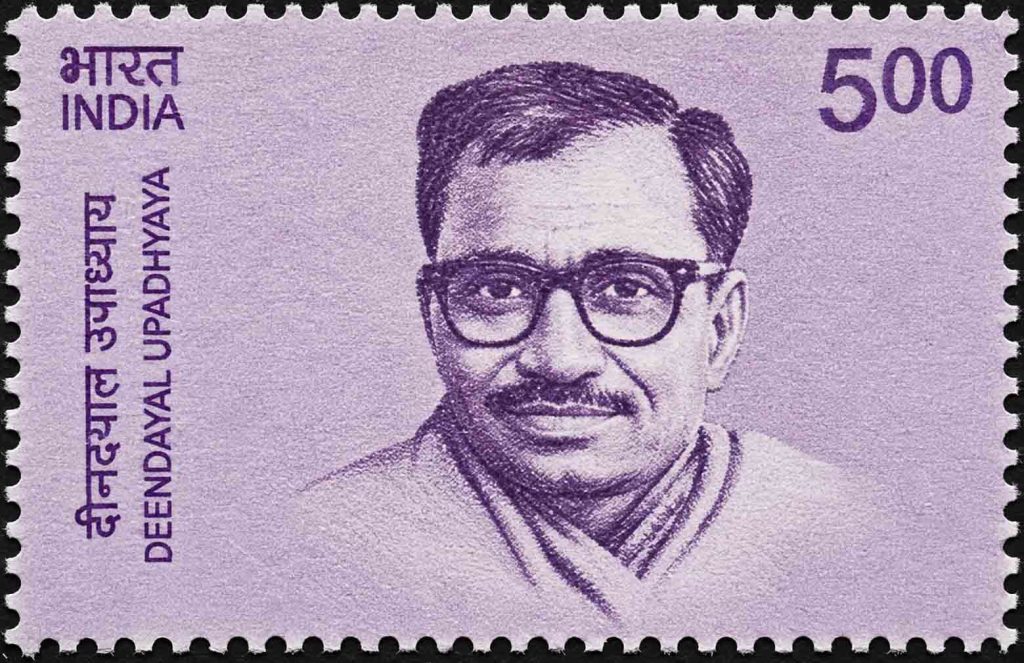
There are few ideologues and philosophers whose thoughts shape a country’s polity decades after their death. Pandit Deendayal Upadhyaya, whose 110th birth anniversary falls on September 25, 2026, is someone whose phulosophy continues to guide India’s polity 58 years after his death.
At the core of his philosophy was Integral Humanism, or Ekatma Manav Darshan, which goes beyond political or ideological confines. It is the philosophy that India’s ruling BJP has adopted as the guiding principle in its constitution.
An full-time worker of Rashtriya Swayamsevak Sangh (RSS), Upadhyaya was the Bharatiya Jana Sangh’s first general secretary from October 1951 until December 1967. He was then elected president of the party, serving until his death on February 11, 1968.
‘Integral Humanism‘ was formulated by Upadhyaya in 1965 as a blueprint for governance and socio-economic development for the country.
“His philosophy of Integral Humanism aims at the overall development – social, political, economic and spiritual – of man. Integral Humanism is also important as it seeks to harmonise the interests of the individual, society and the entire universe. Therefore, his ideas are of great significance for man and mankind as a whole,” wrote Suresh Kumar Soni, former joint general secretary of RSS in his book ‘Deendayal Upadhyaya: A Vibrant Humanist’.
The doctrine, as detailed in the book, insists that India must look to its own cultural ethos rather than adopting imported paradigms.
Integral Humanism asserts that every nation has a cultural and societal central idea, termed as Chiti (cultural roots). Soni highlights this, explaining that Upadhyaya saw India’s civilisational soul as the unifying core.
Upadhyaya’s vision of a revival of the inner cultural spirit of India, its Chiti, still reverberates today. Thus, as envisioned in the philosophy of Integral Humanism, pride in heritage, such as language, tradition and spirituality, is essential. Without them, political freedom lacks meaning.
“The notion of nation occupies an important position in Deendayal’s philosophy of Integral Humanism… The country is conceived as the mother. The notion represents the highest level of love and devotion to the land as mother by its inhabitants… The concept of motherland also conceives and reflects the Hindu ideal of patriotism,” said Soni.
Upadhyaya is of the view that a nation becomes strong, stable, acquires vitality and grows energetically only if the principles which constitute the Chiti (unified consciousness) of a nation are followed and upheld. He believes that Chiti is the soul of the nation, which provides power and energy called Virat to the nation. He emphasises the need to awaken the Virat of the nation by acting in accordance with the Chiti or ethos of the nation.
Integral Humanism centres on the inherent worth of each person, stressing the need to maintain a balance and harmony between the body, mind, intellect and soul of each human being. In other words, society must nurture wholesome development and not treat people as mere economic units. According to Upadhyaya, economic prosperity alone does not ensure a quality life. True progress combines material welfare with inner growth.
Antyodaya, or the rise of the last man, is Upadhyaya’s ethical motto. Ensuring basic rights – food, work, education – for every citizen, particularly villagers, workers and orphans, as well as empowering women, farmers and tribal people, is an imperative in the society envisioned by Upadhyaya. In today’s context, it is known as inclusive growth, which the government focuses on while making policies for the people.
On governance, Soni echoes Upadhyaya’s idea that democracy must be rooted in values. Otherwise, it degenerates into an instrument of individual, class and party interest. Upadhyaya envisioned a Dharma-Rajya or “righteous state”, led by upright, selfless leaders.
Swadeshi and Decentralisation are the two words which can summarise the economic policy suitable for the current times. Soni emphasises Upadhyaya’s motto – Swadeshi (use of indigenous resources) together with decentralisation are the twin keys to India’s economy. Swadeshi means encouraging village industries and home-based enterprises rather than a metro-centric approach. Decentralisation means empowering panchayats, small enterprises and worker cooperatives.
Upadhyaya also favoured a unitary political structure with power devolved downwards. Integral Humanism demands cooperative federalism, a central plan oriented by national dharma, and decentralised execution through panchayats, local cooperatives and joint ventures.
Both Capitalism and Socialism are rejected as one-sided by Integral Humanism, as both lead to centralisation of wealth, power and monopolisation. The unchecked materialism of Capitalism creates inequality and loss of human values, while the enforced uniformity of state-controlled Socialism stifles freedom. Integral Humanism is seen as a third way – a mixed but moral economy. He envisioned a Dharma-Rajya where rulers follow moral law and excessive consumerism is checked.
Like Mahatma Gandhi, Upadhyaya was against the thoughtless imitation of Western ideas. He wanted freedom from the slavery of foreign ideas and asserted that the original culture of the country must remain intact and protected as the core reality.
The ideas of Deendayal Upadhyaya are largely rooted in Indian culture. The economic and social model presented by Upadhyaya is one that replaces exploitation and cultivates a system where wealth creation serves human dignity rather than unchecked profit. It offers a timeless, sustainable vision for building a self-reliant and morally grounded world order.
(The writer is a New-Delhi based senior journalist)