
Qatar-backed Al Jazeera is running a sustained “Hinduphobic” campaign targeting both the Bharatiya Janata Party (BJP) as well as its ideological mentor, the Rashtriya Swayamsevak Sangh (RSS). A number of op-eds published in recent months are devoid of facts and perpetuate a fake narrative aimed at portraying the RSS in a poor light. This Doha-based media group is known for its ties with Islamic radicalists and has been accused by Israel, Saudi Arabia, Egypt, and a host of other nations for its dubious propaganda tactics in a bid to create instability in other countries.
To give an example, in one of its recent articles titled “What is Hindutva and what are the roots of this political movement?”, it got the basic facts wrong. First, Hindutva is deeply rooted in India’s civilisational journey, long before Islam and Christianity were born. It is not a political movement.
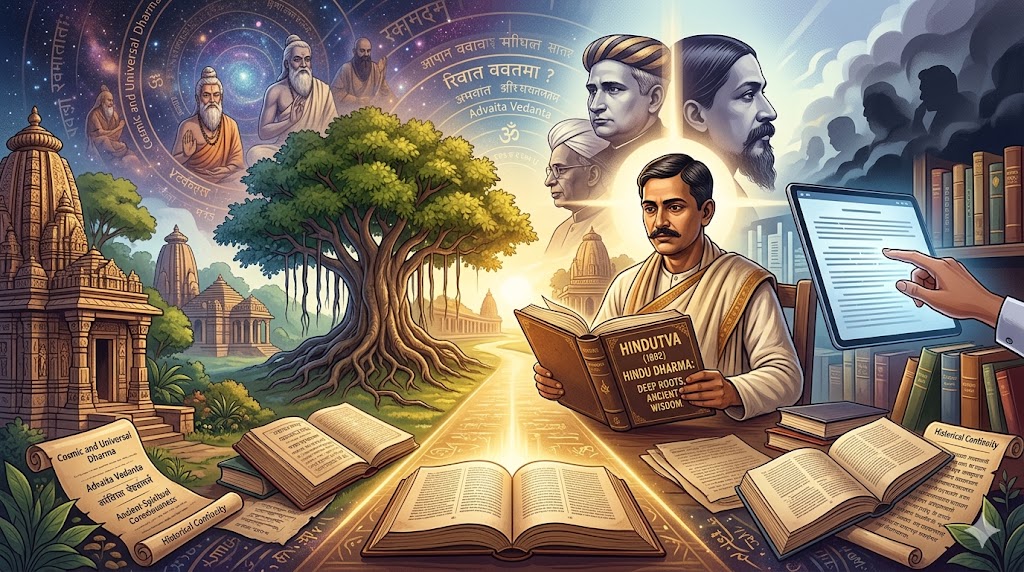
The argument built against “Hindutva” is based on the fundamental premise that the term was coined by Vinayak Damodar Savarkar in 1923. The fact is that the term “Hindutva” was coined by Chandranath Basu, an intellectual from Bengal, when he published a book titled Hindutva in 1892. The book was written in the Bengali language.
Not much research has been done on Basu’s treatise on Hindutva. However, Ankur Barua, a lecturer in Hindu Studies at the Faculty of Divinity, University of Cambridge, conducted some research and published an interesting paper in 2017 titled Vedantic Variations in the Presence of Europe: Establishing the Hindu Dharma in Late Nineteenth Century Bengal, where he discusses Basu’s work in detail.
According to Barua, “Chandranath Basu begins his Hindutva by noting that he is following in the footsteps of Bankim Chandra Chatterjee and Bhudeb Mukhopadhyay in writing about the dharma of the Hindus. While, as we will see, Basu echoes some of the themes of Chatterjee and Mukhopadhyay, the distinctiveness of Hindutva lies in its attempt to present diverse aspects of Hindu life and practice as conceptual unfoldings of Advaitic non-distinction between the finite and the eternal.”
Thus, Basu’s basic conceptual framework is that Hindutva is a manifestation of “Hindu Dharma”. Its key tenet is the philosophy of Advaita Vedanta, which is millennia old. It is not a 20th-century phenomenon, as the Hinduphobic campaign of Al Jazeera and many other similar campaigns have tried to portray.
Leading proponents of “Hindutva” in the 19th and early 20th centuries, such as Bankim Chandra, Sri Aurobindo, Bipin Chandra Pal, Dr Radha Kumud Mookerji, and Dr S. Radhakrishnan, defined the term not through the lens of the state or polity, but through the lens of spirituality.
The fact of the matter is that the concepts of “Hindutva” and “Hindu nationalism” date back to ancient times, and their core is spiritual consciousness, not political ideology.
Even Savarkar, whose Hindutva has been over-analysed through a political lens, defined it more in a civilisational context. He also traced the ancient roots of Hindutva, busting the common myth that it was an outcome of the British colonial era. Savarkar wrote in his treatise Hindutva in 1923:
“It must not be forgotten that we have all along referred to the progress of the Hindu movement as a whole and not to that of any particular creed or religious section thereof—of Hindutva and not Hinduism only. Sanatanists, Satnamis, Sikhs, Aryas, Anaryas, Marathas and Madrasis, Brahmins and Panchamas—all suffered as Hindus and triumphed as Hindus. Both friends and foes contributed equally to enable the words Hindu and Hindusthan to supersede all other designations of our land and our people.”
He further adds:
“This one word, Hindutva, ran like a vital spinal cord through our whole body politic and made the Nayars of Malabar weep over the sufferings of the Brahmins of Kashmir. Our bards bewailed the fall of Hindus, our seers roused the feelings of Hindus, our heroes fought the battles of Hindus, our saints blessed the efforts of Hindus, our statesmen moulded the fate of Hindus, our mothers wept over the wounds and gloried over the triumphs of Hindus.”
It is time to reiterate that the common fallacy underlying most arguments against “Hindutva” is the lack of basic understanding that “Hindu” is a “Dharma” and not a religion like Islam, Christianity, or Judaism.
Bipin Chandra Pal, an Indian freedom fighter well known for playing a stellar role in India’s freedom struggle as well as the cultural renaissance in the early decades of the twentieth century, explained this in his monumental work The Soul of India, published in 1911 — 12 years before Savarkar wrote about Hindutva and 14 years before the RSS was founded:
“Two fundamental characteristics of our culture, detachment and idealism, have been combined into an organic whole in our conception of Dharma, loosely rendered by the English word ‘Religion’. Strictly speaking, the concept is untranslatable. There is, no doubt, some slight affinity between the radical meanings of the two words: Dharma, being derived from the Sanskrit dhri (to hold), and Religion from the Latin ligare (to bind). Dharma is that which holds together the different elements of a thing and thus combines them into one organic whole. Religion is that which binds men together. The conception of religion is, thus, exclusively human and social; that of Dharma is cosmic and universal.”