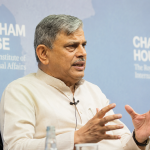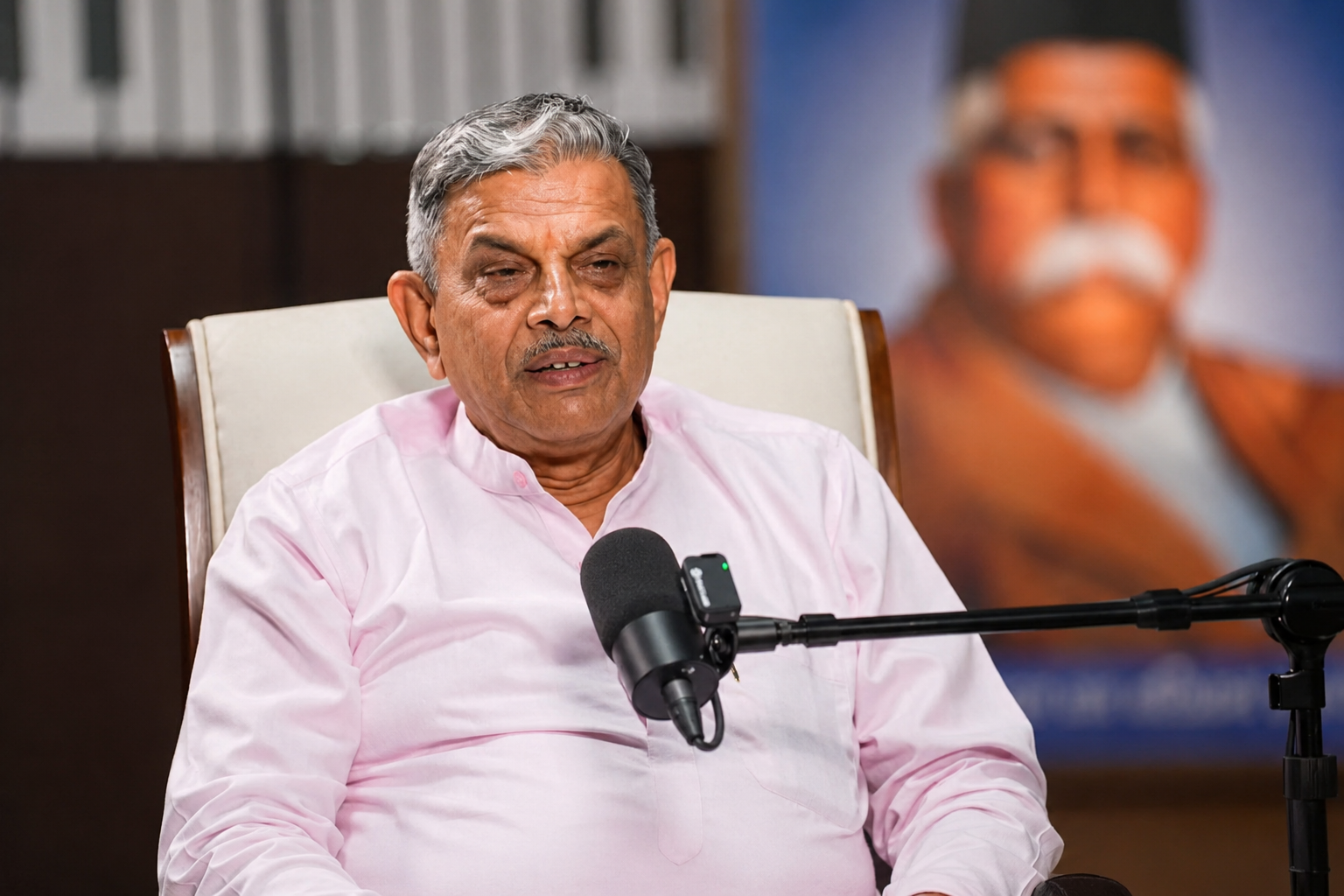
Dattatreya Hosabale, the General Secretary (Sarkaryavah) of the Rashtriya Swayamsevak Sangh (RSS), recently spoke extensively, in a podcast with a news agency, on the long standing debate on “Hindu Rashtra(nation)” and the apprehensions of religious minorities in this regard, especially Muslims.
Bharat is a Hindu Nation
One of the arguments repeatedly made against the RSS is that it is trying to convert Bharat into a “Hindu Nation”. The RSS, on the other hand, has categorically maintained over the last 100 years that it does not need to convert because Bharat already exists as a Hindu nation.
First, let us look at how Hosabale explained this issue before going into further detail. The question posed to him was that while the Sangh’s idea of Hindutva is rooted in India’s cultural and civilisational identity rather than religion alone, many minorities still feel uneasy or apprehensive when terms like “Hindu Rashtra” are used. How does the Sangh reassure them that they are equal and secure in India, and that the idea of a Hindu nation is cultural in nature, not religious or exclusionary?
Hosabale’s reply is worth pondering over for those who have either deliberately or unintentionally misinterpreted the concept of “Hindu Rashtra.”
Explaining the idea of a “Hindu Rashtra”, Hosabale emphasised that the RSS does not believe it is “creating” a Hindu Rashtra. Rather, it sees Bharat as an ancient civilisational entity that has historically existed as a Hindu nation in a cultural sense.
Even during British rule, India was politically governed by the British state, yet it did not become a “British nation”. In the same way, the nation and the state are not identical concepts. Drawing comparisons with East and West Germany before reunification, the RSS General Secretary maintained that political divisions can create different states, but not necessarily different nations.
Hosabale also contended that India’s experience of nationhood differs fundamentally from the European nation-state model that emerged after the French Revolution. For the RSS, nationhood is rooted in shared civilisation, collective memory and cultural continuity rather than merely political borders or religious identity.
As far as apprehensions related to the status of religious minorities in a “Hindu Nation” are concerned, Hosabale made the argument that they have never experienced institutional discrimination as second-class citizens. There are many individuals from minority communities who actively work within the RSS.
But as Hosabale said, “They are not showpieces for us (RSS),” it is clear that the RSS looks at religious minorities not as symbolic figures but as part of the organisation’s broader national outlook. It does not flaunt their presence unlike many other organisations, especially in the political sphere, which use religious minorities as a “trophy” to project their alleged secular credentials to get some additional votes.
Consistent Stand
What Hosabale said reflects consistency in the RSS’ stand on the issue of “Hindu Rashtra”.
The second RSS Sarsanghchalak, M.S. Golwalkar’s exchange of letters with several Muslim intellectuals and luminaries (Shri Guruji Samagra, Volume 7, Prabhat Prakashan, pp. 154–158) clearly indicates that the Sangh’s engagement with minorities is not a new process. In several interviews, speeches and Q&A sessions with people from different sections of society (Shri Guruji Samagra, Volume 9), he clearly stated that being a Muslim or Christian does not come in the way of being part of a “Hindu Rashtra”. They are as much a part of the Hindu Rashtra as any other Hindu.
RSS Sarsanghchalak Mohan Bhagwat had earlier elaborated the Sangh’s viewpoint on this in his annual Vijaydashami address at Nagpur in October 2022: “Since ancient times, irrespective of differences in geography, language, religion, lifestyle, diversities in social and political systems, as a society, culture and nation our way of living has continued in an unbroken manner. In this, there is acceptance, respect, security and progress for all diversities. Other than narrow-mindedness, fundamentalism, aggression and ego, no one needs to forego anything.
Nothing is compulsory other than Truth, compassion, physical and inner purity and the dedicated practice of these three. Devotion to Bharat, the shining ideals of our ancestors and the great Sanskriti (culture) of our country — these are the three pillars which light up and pave our path on which we have to travel together with love and affection. This is our selfhood and Rashtra Dharma.”
Ironically, despite making a logical argument, the RSS has remained under scrutiny for the last 100 years on the same issue. It is clear that “Hindu Rashtra” is neither a geographical nor a religious concept. Unlike political Islam, there is no political “Hindutva”. ‘Hindu Rashtra’ is essentially a cultural and civilisational concept and it has existed on ground for several Millennia.