From AI to Agriculture: The Economic Grammar of RSS at 100
Updated: February 18, 2026 3:18
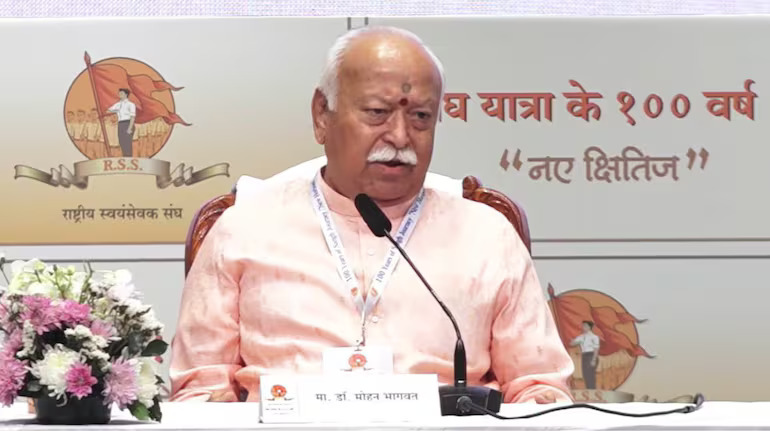
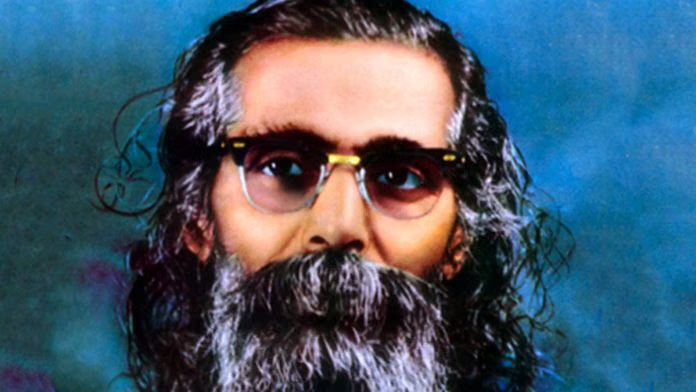
In an outreach programme organised by the Rashtriya Swayamsevak Sangh (RSS) recently as a part of its centenary celebrations, its Sarsanghchalak(Chief Mentor) Mohan Bhagwat spoke extensively and candidly on a host of issues. Many of them are useful indicators to understand the RSS’ economic worldview especially in the context of volatile geopolitics and the disruptive technologies.
What Bhagwat said at this two-day event in Mumbai(Maharashtra) on 7–8 February this year presents an economic outlook rooted in decentralisation and technological adaptation.
We have summed up for our readers what the Sarsanghchalak said on various economic and allied issues presenting a thought-provoking intellectual and ideological matrix where ancient wisdom co-exists with modern innovation ensuring social harmony. It is important to underline the fact that these observations were made by Sarsaghchalak while replying to various questions that were fielded by prominent members of society from various walks of life who attended this event.
Technology, Employment, and Decentralised Economy
Even with new technologies like AI coming in, we will not let job opportunities reduce. In this spirit, we must think and act on this issue. Saying that we will not allow technology to come at all is not the right approach.
We have many hands here; they need work. An empty mind becomes the devil’s home. That’s why Naxalism—left-wing extremism arises, violence grows, and atrocities against women increase. There is a need for decentralisation of the economy.
The dignity of those who work with their hands must increase.
Our focus should not be on ‘Mass Production’, but on ‘Production by the Masses’. For this, we need to change our mindset. In Bharat, we have more working hands than machines. We must build such an economic system where these empty hands get meaningful work.
Agriculture, Rural Development, and Local Enterprise
When we practise farming on the organic/natural basis, the cost goes down. Using your own seeds and your own fertilizers means you are the real owner of your entire farming. There are many such examples across Bharat. We must reduce the cost of farming.
When there is proper storage and processing of the farming produce, the farmer gets better prices for his crop. This work should be done by the government. When the cost of farming goes down, the farmer does not have to take any loan.
Through the dedicated efforts of RSS volunteers, a spirit of development has begun to rise in nearly 5,000 villages across Bharat. Around 350 of these villages have now become inspiring examples for others. Here, people came together, set aside their differences, and lifted their villages through their own determination and hard work. In many areas such as economic progress, agriculture, values and Sanskars (cultural ethics), freedom from addictions, and social harmony, there are visible remarkable changes.
Meanwhile, campaigns like ‘One District One Product’ are proving effective in promoting traditional businesses and in women empowerment across Bharat.
Rethinking GDP, Wealth, and Dharmic Economics
GDP is not an appropriate measure for growth; it is incomplete. It does not count the hard work or production done by our women. This way of measurement must be corrected.
In the old times, one’s income was divided into six parts. Keep one-sixth of the income for yourself, one-sixth for family, one-sixth for Bhagwan (God), one-sixth for savings, one-sixth for Dharma and society, and one-sixth to give to the Raja (the governing authority). These six parts make a balanced and Dharmic way to manage one’s income.
Wealth has three destinies—donation, enjoyment, or destruction. For one who neither donates nor enjoys it, the third fate, destruction, awaits.
Knowledge and Global Engagement
Knowledge should come from all over the world, but we must take it only after testing and understanding it well. Without knowing the aspirations of our own Bharat, our traditions, and the welfare of our farmers, it is not right to accept something just because it is new. That is why it is good for us to remain sensitive and thoughtful.
Geopolitics, Environment, and Global Commitments
On the India-US trade deal, Bhagwat said, “No country can live in isolation today. In any deal, you gain something and you give up something. The goal is just to ensure that Bharat doesn’t suffer any real loss. We too will have to act in the same way. This government is one that stands firm and does not bow down.”
On the question of environment protection, the Sarsanghchalak emphasised, “Bharat is the first country to fulfill the promises of the Paris Agreement.” (To tackle climate change and its negative impacts, world leaders at the UN Climate Change Conference (COP21) in Paris reached a breakthrough on 12 December 2015: the historic Paris Agreement. The Agreement sets long-term goals to guide all nations to substantially reduce global greenhouse gas emissions to hold global temperature increase to well below 2°C above pre-industrial levels and pursue efforts to limit it to 1.5°C above pre-industrial levels, recognizing that this would significantly reduce the risks and impacts of climate change.). He added, “Environment is not just the Sangh’s concern and only Sangh shouldn’t be thinking about it. The entire society should think about it. He also mentioned that environmental protection is one of the key activities of RSS now.