
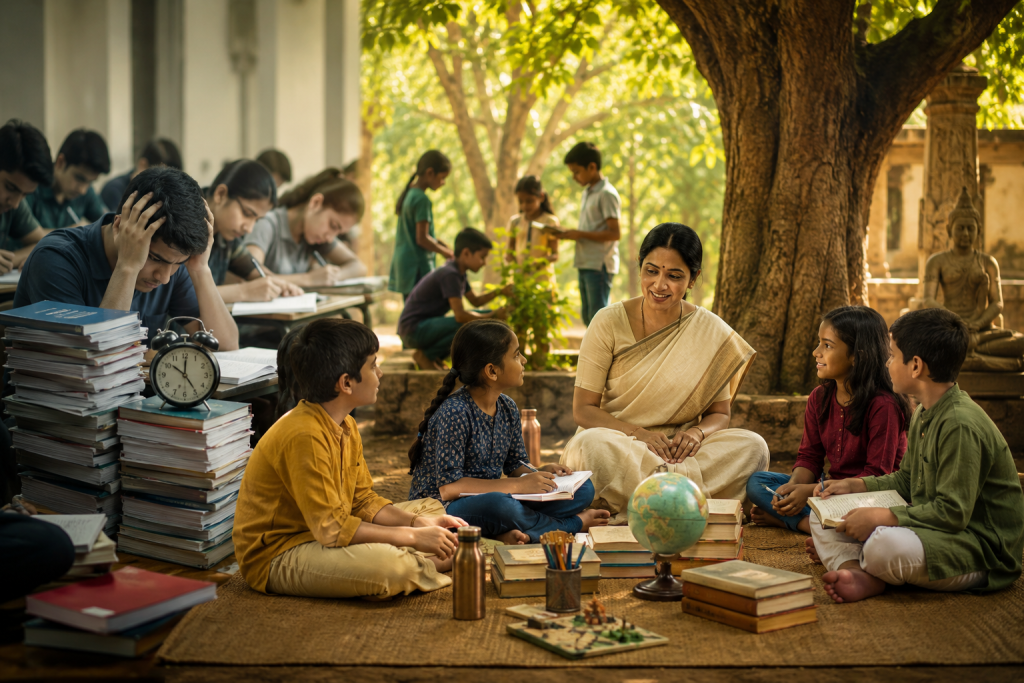
India is undergoing an important conversation about the future of its education system. While considerable attention has been devoted to improving assessment methods, expanding access and strengthening institutional standards, a deeper question is increasingly entering public discourse: should India’s education system continue to be organised primarily around examinations, or should it recover a broader understanding of learning rooted in its own civilizational traditions?
Within the intellectual tradition of the Rashtriya Swayamsevak Sangh (RSS), this debate is closely linked to the wider issue of decolonising Indian institutions. The argument is not that examinations have no place in modern education, but that they have come to dominate an educational framework originally shaped by colonial priorities rather than India’s indigenous conception of shiksha. This perspective draws significantly on the scholarship of Gandhian thinker Dharampal (1922–2006), whose pioneering archival research challenged long-held assumptions about pre-colonial Indian education.
As India commemorates the centenary of his birth in 2026, Dharampal’s work provides an opportunity to reconsider how education can move beyond credentialism towards the holistic development of knowledge, character, skills and entrepreneurship.
The Colonial Trap
Dharampal dispelled the myth that the Indian education system was ‘broken’ before British rule. In fact, the British deliberately created a colonial trap for the young minds of India where education was linked only to employment.
Dharampal’s findings on the Indian education system emerged in the 1960s and were subsequently elaborated through his seminal work, The Beautiful Tree. The British records reproduced by him show that there was hardly a village without a school, and many villages had multiple schools. More importantly, education was closely linked to knowledge and economic opportunity by imparting both theoretical knowledge and vocational skills. The curriculum, and indeed the entire system, was designed to produce responsible citizens interested in creating jobs and becoming producers, entrepreneurs and employers, rather than seeking jobs by attaining degrees through a rigid examination system that doesn’t test real-world knowledge compelling students and young people to live in a world of uncertainty.
According to Dharampal, “It is important to emphasize that indigenous education was carried out through pathshalas, madrassas and gurukulas. Education in these traditional institutions—which were actually kept alive by revenue contributions by the community including illiterate peasants—was called shiksha (and included the ideas of prajna, sheel and samadhi). These institutions were, in fact, the watering holes of the culture of traditional communities. Therefore, the term ‘school’ is a weak translation of the roles these institutions really played in Indian society.”
He further adds, “According to this hard data (primarily collected in the late 18th and early 19th century by the British), in terms of the content and proportion of those attending institutional school education, the situation in India in 1800 is certainly not inferior to what obtained in England then; and in many respects Indian schooling seems to have been much more extensive (and, it should be remembered, that it is a greatly damaged and disorganised India that one is referring to). The content of studies was better than what was then studied in England. The duration of study was more prolonged. The method of school teaching was superior and it is this very method which is said to have greatly helped the introduction of popular education in England but which had prevailed in India for centuries. School attendance, especially in the districts of the Madras Presidency, even in the decayed state of the period 1822–25, was proportionately far higher than the numbers in all varieties of schools in England in 1800. The conditions under which teaching took place in the Indian schools were less dingy and more natural; and, it was observed, the teachers in the Indian schools were generally more dedicated and sober than in the English versions.”
Vicious Circle
What we are witnessing today is a vicious circle where students spend years preparing for entrance examinations whose principal objective is securing admission into another examination system. Eventually, this culminates in recruitment examinations for a shrinking number of desirable jobs, primarily in the government sector.
The problem is that this vicious circle has given birth to another industry—private coaching institutes—that is now aiding and abetting this ‘colonial trap’ for its own sustenance. In fact, private coaching now starts at the pre-primary level itself. According to the Nation Sample Survey’s 75th Round (July 2017 – June 2018) that analysed ‘Household Social Consumption on Education in India’, 11.6 per cent of Indian students take private coaching at the pre-primary level. At the primary level, this rises to 16.4 per cent; at the upper primary or middle level, the figure further increases to 21.9 per cent. At the secondary level, a staggering 30.2 percent of students take private coaching, while at the higher secondary level the figure stands at 27.1 per cent. Overall, at the pre-primary level and above, around one-fifth of Indian students take private coaching.
According to an IMARC report, “The India coaching institutes’ market size reached USD 7.2 Billion in 2025.” It further adds that the market is expected to reach USD 17.8 Billion by 2034, exhibiting a growth rate (CAGR) of 10.29% during 2026–2034.
In fact, dozens of cities across India have emerged as ‘coaching hubs’ where ‘coaching factories’ produce more unsuccessful aspirants than successful ones. This has turned the original concept of Shiksha upside down. The definition of a successful student is to become someone who has cracked a highly competitive examination or scored the highest marks in the classroom or board examinations. Education is thus becoming increasingly delinked from skills, compassion, empathy and responsibility towards nation-building or service to society. It is all about individual achievements with no social commitment. Add to this the growing addiction to social media, which further perpetuates the craving for validation through a large number of views subsequently encouraging the use of abusive language, fostering apathy and disrespect for peers and elders, and finally creating serious mental health issues.
Speaking at a national education conference in July 2025, RSS Sarsanghchalak Mohan Bhagwat had aptly observed that, in the Bharatiya tradition, the fundamental purpose of education is the holistic development of an individual’s personality, not merely the pursuit of employment. Securing a livelihood, he emphasised, is only one limited outcome of education rather than its ultimate objective.
Conclusion
What India faces is a deeper systemic challenge, and reforming the examination system alone can offer only a temporary remedy. More importantly, building a Bharat-centric, holistic education system cannot be the responsibility of the government alone. It requires communities to take the lead and shape the process, much as they did successfully before India’s indigenous educational traditions were disrupted under colonial rule.