
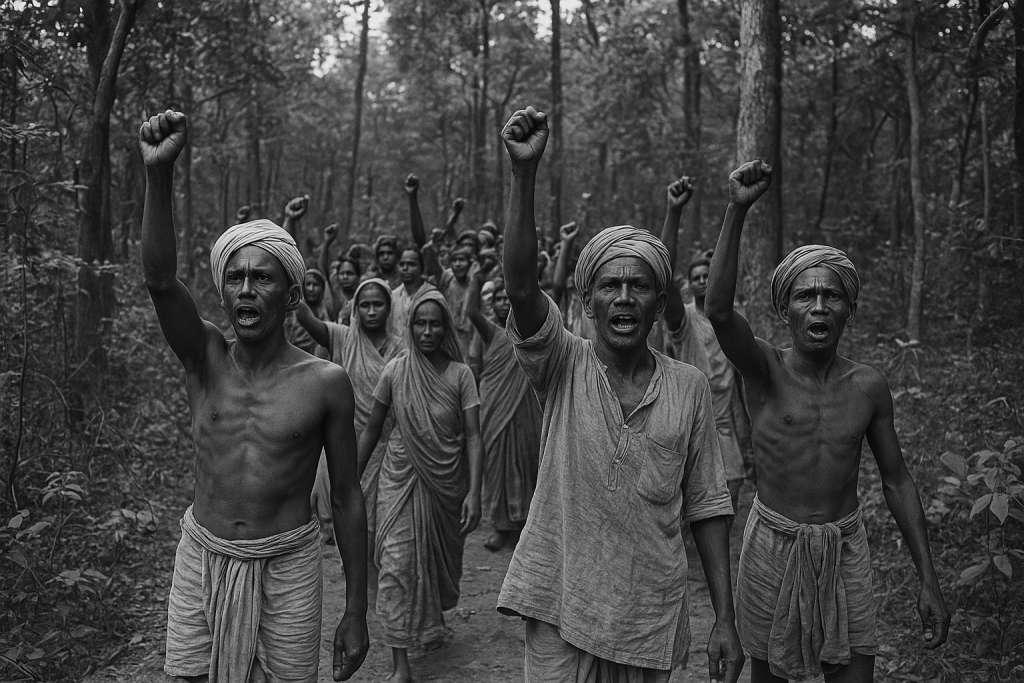
When Mahatma Gandhi launched the Civil Disobedience Movement in 1930, the Salt March symbolized India’s defiance of British rule. But there was another struggle that unfolded in villages and forests, the JungleSatyagraha(non-violent resistance in forests) in the year 1930–31. For rural and tribal communities, forests were their source of fuel, fodder, and food, yet colonial laws had turned them into “Reserved Forests,” barring access to age-old rights. Defying these restrictions, thousands entered forests, grazed cattle, and collected wood in acts of peaceful protest, facing arrests and confiscations. At this stage, the Rashtriya Swayamsevak Sangh (RSS), then barely five years old and still confined to a few districts, saw many of its swayamsevaks(volunteers) join the satyagraha, inspired by the example of its founder Dr Keshav Baliram Hedgewar.
Leadership Vision
Dr Hedgewar had founded the RSS with the objective of dedicated service to the nation.His commitment to Poorna Swaraj (Complete Independence) made participation in the Jungle Satyagraha a natural step in that direction. He believed that every agitation that advances this goal should be supported. This arguably explains his decision to join the movement and face imprisonment. The role of a leader, however, is not limited to personal action, it also lies in inspiring others to act in the same way, in his absence.
Before joining the Satyagraha, Dr. Hedgewar addressed the swayamsevakson 12 July on Guru Puja(worship)Day, outlining the Sangh’s position and responsibilities. His words are documented in the book ‘Jungle Satyagrah Aur Rashtriya Swayamsevak Sangh’(Non-violent resistance in forests and RSS)by Dr. Sreerang Godbole,
According to Godbole(pp22-23), “After arranging for the organisational responsibilities in his absence and clarifying the role regarding participation in the Satyagraha, Dr. Hedgewar said:
Once I sit down after expressing my gratitude, I shall no longer remain the leader of the Sangh. Dr. Paranjpe has accepted to take charge as the Sanghachalak.Allthose participating in this movement are doing so of their own personal will. There has been no change in the ideology or method of the Sangh, nor has our reverence diminished. Every movement in the country must be studied in depth and used, to strengthen ourselves, this is the duty of any institution striving for India’s freedom. Those from the Sangh who have joined this agitation or gone to jail have done so out of their devotion to the nation. Going to jail has become a symbol of sacrifice for patriots willing to endure hardship for the nation’s cause. However, one must understand that India’s freedom cannot be secured by working for just six months or a year, but only through continuous and year-round organisation. Unless we give up this seasonal patriotism and dedicate our entire lives to disciplined, sustained work for the nation’s freedom, the destiny of the country will not change. Instilling this spirit in the youth and organizing them is the true mission of the Sangh.”
Resistance on the ground
Dr Hedgewar and a group of swayamsevaks(volunteers) left Nagpur (in the Indian state of Maharashtra) on 14 July 1930 for Satyagraha. Theywere welcomed by huge crowd at Wardha and other places before reaching Pusad, and were later asked to lead the agitation at Yavatmal(Maharashtra). On 21 July, in presence of of over 10,000 people, Dr Hedgewar and the group of volunteers accompanying him defied the draconian forest laws imposed by the British. They were arrested and sent to Akola Jail in Maharashtra. Dr Hedgewar was sentenced to six months’ rigorous and three months’ simple imprisonment. During his stint in the jail, Dr Hedgewar started an RSS shakha in the prion itself. This marked the birth of Vidarbhaunit of the RSS (Vidarbha is a region in eastern part of Maharashtra). Released on 14 February 1931, Dr Hedgewar was felicitated at Akola, Wardha, and given a grand welcome in Nagpur before resuming charge as Sarsanghchalak(chief mentor).
Participation of Sangh senior functionaries
It is worth noting that before Dr Hedgewar’s decision to participate there were many swayamsevaks(RSS volunteers)who had already participated in the civil disobedience movement.
The Jungle Satyagraha witnessed active involvement of several senior RSS functionaries. At the Nagpur Salt Satyagraha meeting on 1 May 1930, prominent figures such as Dr BS Moonje, Dr MR Cholkar, and first Sarkaryavah(General secretary) of the RSS BalajiHuddar prepared salt and read proscribed texts(of Savarkar’s book ‘1857 ka Swatantrata Samar.’)in open defiance of colonial law. Martandrao Jog, the only Sarsenapati(used to be a post of Chief Commanderduring early years of RSS)of theRSS, played a notable role in the Civil Disobedience Movement as Assistant Commander and later Captain of Volunteers in the War Council of Central Provinces(a British administrative region with Nagpur as its capital, covering much of present-day Madhya Pradesh, Maharashtra, and Chhattisgarh). Jog was imprisoned by the British. Other RSS senior functionaries from Wardha in Maharashtra including Appaji Joshi,SalodfakirTryambak Deshpande and Narayan Deshpande also joined Hedgewar’s satyagraha team. All of them were imprisoned by the British.
Though still in its infancy, the RSS contributed significantly, with hundreds of its volunteers from around 40 shakhasjoining the movement. These ‘shakhas’ were mostly concentrated in Nagpur and Wardha districts.
Apart from the 125 volunteers who participated during Hedgewar’ssatyagraha, Dr Godbole mention the names of 188 swayamsevaks who took part in the Jungle Satyagraha in his book (pp47).
Other anti-British activities
On 2 August 1930, sixty uniformed swayamsevaks of the ambulance corps, raised under Dr. Paranjpe’s guidance, served protestors in Nagpur (Sangh archives, Hedgewar papers, register 7, DSC_0247). Later, on 9 September, thirty-two uniformed swayamsevaks joined a massive procession of 35,000 people protesting the flogging of satyagrahis (Chaudhary, K K, Editor, Civil Disobedience Movement April- September1930, part 9, Gazzetteer Department, Maharashtra Government, 1990, p.1036). They also took part in ‘Abhyankar Day’ demonstrations, reinforcing their role in the wider anti-British movement (Sangh archives, Hedgewar papers, register 7, DSC_0249–0250).
Akola SanghchalakGopal Krishna alias Babasaheb Chitale was senior to Hedgewar in age and had boundless affection for him. The following reminiscence written by Chitale is significant, “On learning that Doctor has gone for Satyagraha, 125 responsible Sangh individuals offered Satyagraha. All were awarded punishment and interred in Akola Jail” (Kesari, 2 July, 1940).
Continuity in RSS work
Even after Hedgewar’s arrest, organisation’swork in Nagpur carried on without disruption. In July itself, the Karyakari Mandal met three times along with a session of instructors, while regular lathiclasses(physical training with bamboo staves, symbolising discipline and self-defence) resumed after college vacations. Plans for collecting donations were drawn up, and physical drills were shifted outside the Sanghasthan(the local ground where swayamsevaks gathered for daily activities). The day-to-day functioning was managed by Anna Sohoni, Bapurao Ballal, Krishna Nilkanth Moharir, Hedgewar’s uncle Abaji, and others, under the overall supervision of Dr. L.V. Paranjpe and Vishwanathrao Kelkar. Paranjpe also met Hedgewar in jail regularly, keeping RSS volunteers informed of his condition (Sangh archives, Hedgewar papers).
Integration with Nationalist Movement
During Hedgewar’s imprisonment, swayamsevaks not only continued organizational work but also engaged in wider nationalist activities. In October 1930, during the Vijayadashamimarchpast, the RSS volunteers offered a salute in front of the Nagpur Jail to honour the imprisoned leaders.The organisation also managed arrangements for Lokmanya Bal GangadharTilak’s death anniversaryheld at Sahastra Chandi Mandir, Nagpur, on 1 August 1930. It paid tributes to Bhagat Singh, Rajguru, Sukhdev, and other martyrs, and suspended routine activities on national occasions such as Independence Day, Motilal Nehru’s death, and major executions. These gestures reflected the Sangh’s integration with the larger freedom movement while maintaining its own organizational discipline (Sangh archives, Hedgewar papers, register 7).
(The writer is an author and columnist)