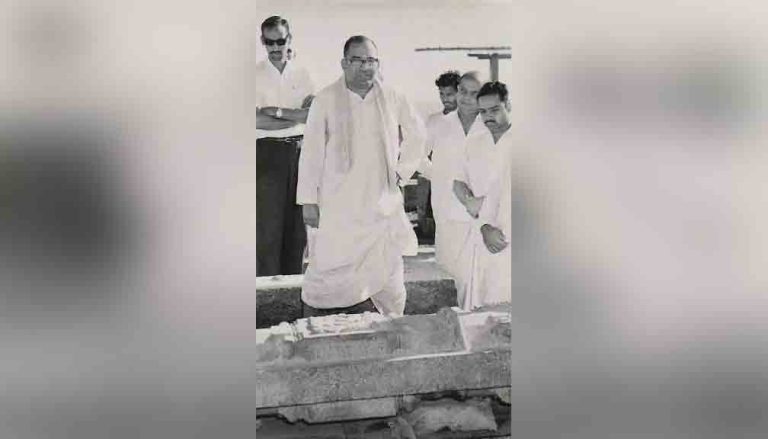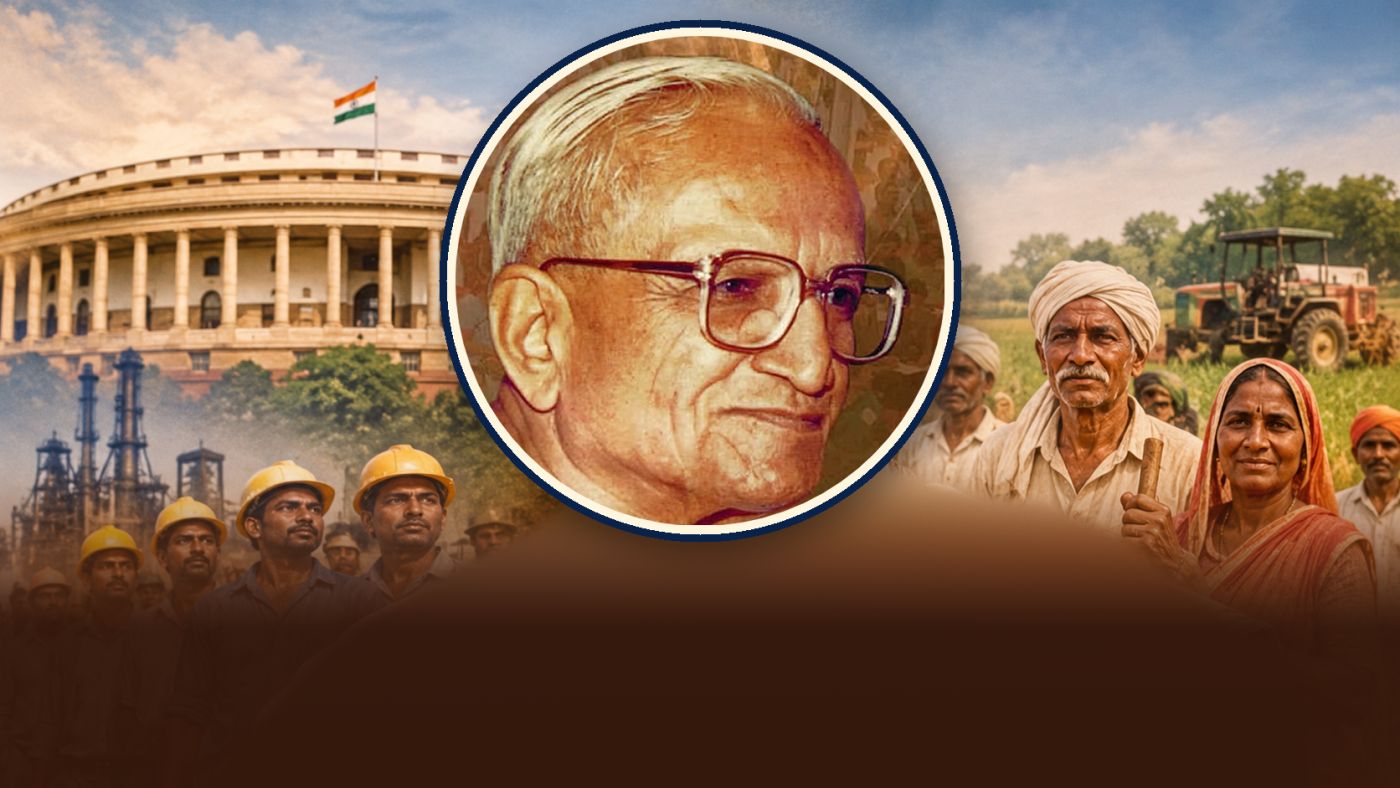
A Pracharak (full-time worker) of the Rashtriya Swayamsevak Sangh (RSS), Dattopant Thengadi was an ideologue and a trade union leader who built India’s largest labour union, the Bharatiya Mazdoor Sangh (BMS), and the farmers’ union, the Bharatiya Kisan Sangh (BKS).
He also gave India the idea of Atmanirbhar Bharat (Self-Reliant India) 30 years before it became a slogan of the BJP government. Swadeshi (self-reliance) stood at the centre of his economic thought.
He was also a co-founder of the Akhil Bharatiya Vidyarthi Parishad (ABVP) and a two-term Member of Parliament in the Rajya Sabha from 1964 to 1976.
One of his biggest contributions was advocating the Third Way, an alternative to both Communism and Capitalism. Thengadi questioned both systems. Capitalism, he said, represented the ownership of capital by a few. Communism represented control by the State. He advocated a philosophy that kept the dignity of labour at its centre. According to him, the economy existed to serve human beings, and not the other way around.
C.K. Saji Narayanan, former National President of the BMS, wrote: “Bharatiya Mazdoor Sangh was a late arrival in the labour movement, born at a time when big central trade unions like INTUC, CITU, AITUC were dominating it. Born in 1955, BMS became the biggest cadre-based organisation of workers in just 34 years because of the extraordinary organising capability and guidance provided by Shri Dattopant Thengadi.”
The Pracharak
Thengadi was a full-time Sangh Pracharak from 1942 until his death on 14 October 2004.
Dattatreya Bapurao Thengadi was born on 10 November 1920 at Arvi in Wardha district, Maharashtra, to advocate Bapurao Dajiba Thengadi. He came to Nagpur in 1936 for higher education, earning an MA from Morris College and an LLB from Law College. There he was introduced to the Sangh. Impressed by RSS founder Dr K.B. Hedgewar and M.S. Golwalkar, he decided to become a full-time Pracharak.
In 1940, when M.S. Golwalkar became the second Sarsanghchalak (Chief), he called for Pracharaks to help expand the organisation. Thengadi was in the first batch that came out in 1942.
He was sent to Kerala to start Sangh work from scratch and stayed there till 1944. During this period, he became President of the Bhasha Prachar Samiti, Kerala, and of the Kerala Rashtra Bhasha Prachar Conference at Kozhikode. He then worked in Bengal from 1944 to 1947, and in Assam from 1948 to 1949.
He was Organising Secretary of the Bharatiya Jana Sangh in Madhya Pradesh (1951–53) and in South India (1956–57).
He was also a co-founder of the Akhil Bharatiya Adhivakta Parishad, Grahak Panchayat, Sahkar Bharati, Pragya Bharati and Bharatiya Vichara Kendra.
Saji Narayanan wrote: “It was at the instance of Shri Guruji Golwalkar that Thengadiji, working as a Pracharak of RSS in 1949, turned his attention towards creating a labour organisation based on Bharatiya values and tradition. Instead of immediately starting an organisation, Thengadiji decided to undertake a deep study of the labour movement, and for this purpose he joined a few organisations. First, he joined Indian National Trade Union Congress (INTUC). In a short time, he became an office-bearer of around 10 unions working under INTUC. In October 1950, he became a member of INTUC’s National Executive. He also became Secretary of INTUC in the erstwhile Madhya Pradesh State. He also used the opportunity to learn more about Communism and gained sufficient knowledge of how communist organisations functioned. In Shri Guruji’s words, Thengadiji ‘single-handedly’ completed the task assigned to him. Though he was the Secretary of the Lok Sangharsh Samiti during the Emergency, he refused the demand that BMS should be made an affiliated organisation of the Janata Party, which came to power immediately after the elections.”
Thengadi declined the Padma Bhushan offered by the Vajpayee government, saying many seniors deserved higher awards.
Saji Narayanan wrote: “It was Thengadiji who taught trade unions to react on the basis of the policies of the government and not on the basis of the colour of the government. He called this ‘Responsive Cooperation’. In 1984, at the Hyderabad meeting, he declared war against multinationals and foreign agents. Thus, he conceived the Swadeshi Jagaran Manch that was formed later in 1991. Since 1991, when the Narasimha Rao government came to power, the labour policy and economic policies of all governments, irrespective of the political affiliation that ruled at the Centre and in different states, were almost the same. Both in the 1999 Nagpur meeting and in the 16 April 2001 rally, as well as in the subsequent agitations, Thengadiji came down heavily on the policies of the NDA government, which became a rare event in the history of modern politics and the trade union movement.”
- Gurumurthy, former co-convenor of the Swadeshi Jagaran Manch (SJM) (Swadeshi Awakening Forum), wrote: “When globalisation challenged India in the early nineties and everyone helplessly just opposed it or blindly welcomed it, he recalled the spirit of the freedom movement, the Swadeshi idea. He formed the Swadeshi Jagaran Manch, which articulated an alternative indigenous economic model. Not just opposition to globalisation. It emerged as the bulwark against mindless globalisation and succeeded in creating a vision for India as a global power. His creations — the BMS, the Kisan Sangh, and the SJM — are known and powerful in thought and action, but he, the creator himself, is not much known.”
Thengadi wrote about his days with Dr B.R. Ambedkar, having worked full-time with Babasaheb during the last four years of his life. His last book, completed in July 2004, just months before his death, was on Ambedkar. It is considered one of the most authentic biographies of Ambedkar. From Ambedkar, he took the idea of Samajik Samrasta (Social Harmony); from Deendayal Upadhyaya, Integral Humanism; and from Golwalkar, the spiritual view of the nation.
Gurumurthy wrote: “Thengadi authored innumerable books of originality and high intellectual content — some 50 books in all, 27 in Hindi, 12 in English and 10 in Marathi. He presented innumerable papers on profound subjects in national and international conferences. He learnt five languages apart from Marathi and English.”
Among his well-known books are Prachar Tantra, Dr Ambedkar, Vichar Sutre, Karyakarta, Sanketrekha, Ekatma Manav, Ek Adhyayan, Pragatipath Kisan, Saptakram and Lakshya Aur Karya.
The Parliamentarian
Thengadi entered the Rajya Sabha from the Bharatiya Jana Sangh for two terms, from 1964 to 1976. He also served as its Vice-Chairman during 1968–70. His parliamentary style, as noted in Dattopant Thengadi: The Activist Parliamentarian, was marked by meticulous presentation of facts, highly referenced propositions, and dignified responses to counter-viewpoints.
During every Budget debate, he would ask the same question: how many hands got work? He demanded an income ratio of 1:10, with the highest salary no more than ten times the lowest wage.
“You are building a palace on a foundation of sand. Without employment, without Swadeshi, without decentralisation, your Budget is a document of dependence.”
He called bonus a deferred wage and a right of every wage-earner, while rejecting “Bonus by Strike”. He gave the slogan “Desh ke hit mein karenge kaam, kaam ke lenge pure daam” (We will work in national interest, and we will claim full remuneration). This debate led to India’s first Bonus Act.
After the march of Sadhus (saints) on Parliament on 7 November 1966 and the police firing that followed, Thengadi reframed the cow slaughter debate: “If you want to protect the farmer, you must protect the cow. If you want to destroy the farmer, kill the cow.” He demanded a central law in this regard.
When Indira Gandhi nationalised 14 banks, he supported it. He demanded 50% credit to agriculture, small industry, village industry and the self-employed, branches in villages, and workers’ participation in management. This was his stand during a debate: “Nationalisation is a means, not an end. The end is economic democracy. If nationalisation does not lead to decentralisation of credit, to employment, to Swadeshi, then it is a fraud on the people.”
The Philosopher
Golwalkar called him “our thought giver”. In his book Third Way, he rejected both Communism and Capitalism, saying both are centralised, exploitative, and foreign. His alternative was Deendayal Upadhyaya’s Integral Humanism.
He replaced the Communists’ slogan, “Workers of the world, unite”, with “Workers unite the world”.
He believed Swadeshi went beyond goods. RSS Sarsanghchalak Mohan Bhagwat later quoted him: “Swadeshi cuts beyond goods and services and stands for attaining a position of international cooperation by achieving national self-reliance, sovereignty and parity.”
Thengadi said, “Swadeshi is the practical manifestation of patriotism. Westernisation is not modernisation. Western paradigms are not universal paradigms.”
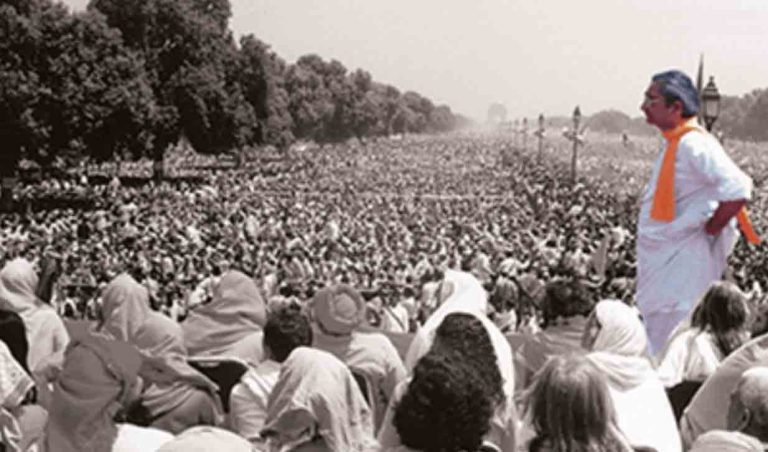
In 1991, he declared war against liberalisation under the World Trade Organisation (WTO) and the World Bank. He addressed rallies at the Red Fort and Ramlila Maidan.
(The writer is a senior journalist)