
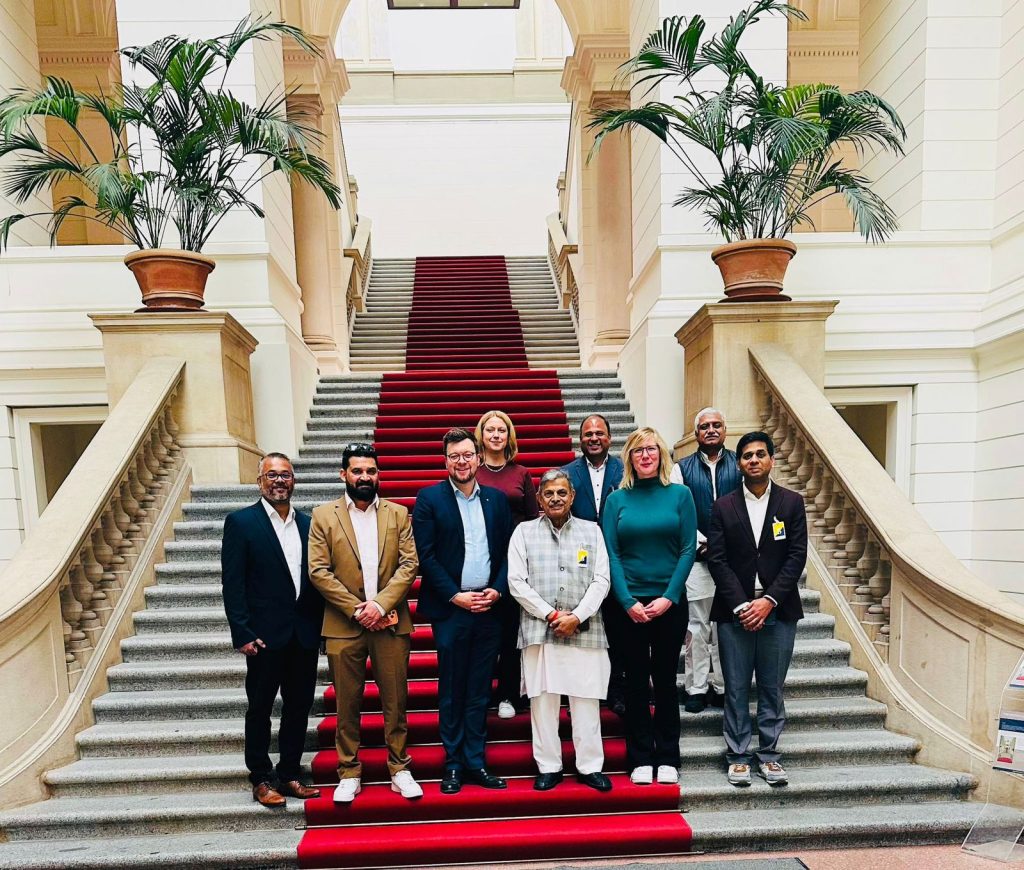
When Dattatreya Hosabale, General Secretary of the Rashtriya Swayamsevak Sangh (RSS), travelled to Berlin on April 28–29, the visit went beyond routine institutional outreach. It reflected a deeper and evolving dimension of India’s global engagement—one that is increasingly civilisational, societal, and dialogue-driven, rather than confined to the formal lanes of statecraft.
In a series of interactions with leading German policy institutions such as the Stiftung Wissenschaft und Politik and the Konrad-Adenauer-Stiftung, as well as individuals associated with the Abgeordnetenhaus of Berlin, the emphasis was not merely on aligning policy perspectives. Instead, the discussions moved toward a deeper inquiry: how do societies organise themselves, maintain cohesion, and adapt to rapid economic and cultural transitions? These are questions that transcend governments, electoral cycles, and even national boundaries.
At one level, such exchanges may appear exploratory. At another, they signal a shift in the grammar of international engagement. Increasingly, nations are discovering that enduring partnerships cannot be built solely on trade agreements or strategic convergence; they require an understanding of each other’s social structures, cultural impulses, and civilisational anchors.
A recurring theme in Berlin was the recognition that India and Germany, despite their distinct historical experiences, share certain structural similarities. Both societies place a premium on community orientation, value social organisation, and are navigating the transformation of family systems under the pressures of modernity. These parallels are not superficial—they offer a foundation for meaningful dialogue on issues ranging from social cohesion to sustainable development.
Equally significant was the focus on the Indian diaspora in Germany. Traditionally viewed through the prism of remittances or economic contribution, the diaspora today represents a far more complex and influential constituency. With high levels of education, professional expertise, and economic participation, Indians in Germany have emerged as a vital link between the two societies. Their contribution to the German economy—reflected in entrepreneurship, skilled employment, and tax participation—is widely acknowledged.
Yet, as Hosabale underscored, the role of the diaspora cannot remain confined to economic success. It carries with it a broader responsibility: to engage constructively with the host society, to contribute to its social fabric, and to serve as a cultural bridge that fosters mutual respect and understanding. In an era where migration often becomes a site of political contestation, such a perspective acquires added relevance.
What lends further depth to this engagement is the articulation of a long-term vision. Hosabale’s reference to the RSS’s outlook for the next century—focused on building sustainable societies grounded in universal values—positions the conversation within a global context. Sustainability, in this framing, is not restricted to environmental concerns. It encompasses the resilience of families, the stability of communities, and the preservation of cultural continuity.
This broader understanding resonates with contemporary global anxieties. Across regions, societies are grappling with fragmentation, identity conflicts, and the erosion of traditional support systems. In such a scenario, the role of civil society organisations becomes critical. Institutions like the RSS present themselves as platforms that operate at the grassroots level, engaging with everyday social realities while attempting to build long-term cohesion.
The Berlin visit also highlights a larger geocultural trend: the diffusion of influence beyond the state. Governments remain central, but they are no longer the sole actors shaping international perceptions. Think tanks, cultural organisations, diaspora networks, and civil society institutions are increasingly contributing to how countries understand each other. Dialogues such as these—informal, non-binding, yet substantive—often lay the groundwork for more structured cooperation in the future.
Importantly, the engagement was not one-sided. By inviting German counterparts to visit India and continue the dialogue, Hosabale emphasised reciprocity. Such exchanges, when sustained over time, can evolve into platforms for collaborative thinking on shared challenges—be it sustainability, social harmony, or the future of community life in an increasingly individualised world.
The interaction with the Hindu Swayamsevak Sangh (HSS) community in Berlin, marking 100 years of the RSS, added another dimension to the visit. Attended by over 200 volunteers, the gathering reflected the global spread of Indian civilisational thought and its capacity to connect communities across geographies. It also underscored a model of engagement that is rooted in cultural continuity while remaining open to dialogue.
Ultimately, the significance of Hosabale’s Berlin visit lies not in immediate policy outcomes or headline-grabbing announcements. Its importance is more subtle, yet potentially more enduring. It lies in the questions it raises and the conversations it initiates: How can societies remain cohesive in times of rapid change? What role do cultural frameworks play in sustaining social order? How can civil society complement state efforts in building a more balanced and sustainable future?
These are not questions with easy answers. But they are questions that Berlin—and indeed much of the world—is increasingly compelled to confront.