
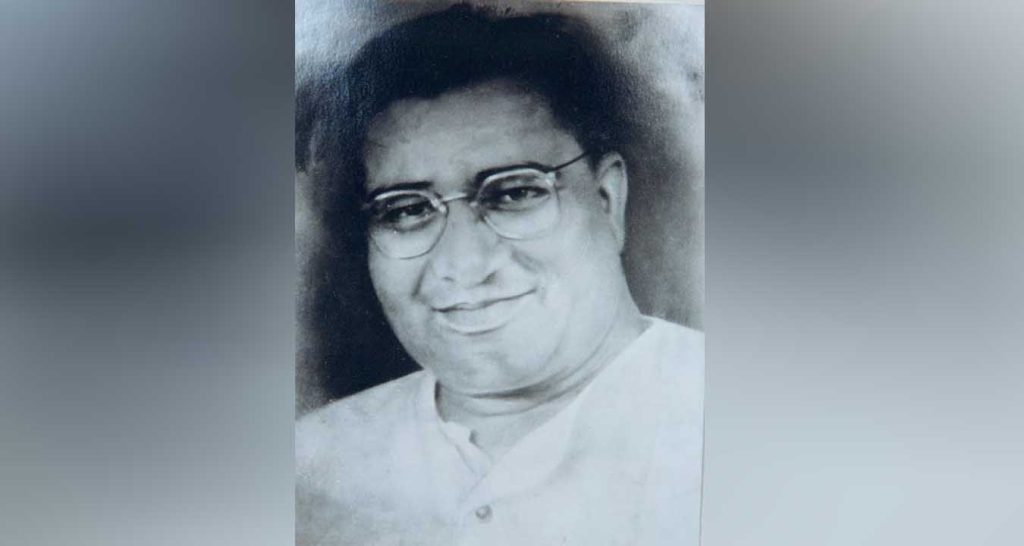
Bhaiyaji Dani was a prominent figure in the Rashtriya Swayamsevak Sangh (RSS) and served as its second Sarkaryavah (General Secretary). Born in 1908 in Umred in the Nagpur district of Maharashtra into a family of a rich landlord, Prabhakar Balwant Dani, popularly known as Bhaiyaji Dani, played a crucial role in the expansion of the organisation. Dani was instrumental in establishing the RSS’s presence beyond Nagpur and in navigating the organisation through challenging times, including the ban imposed on it in 1948 on fabricated charges after Mahatma Gandhi’s assassination.
Dani holds a special place in the Sangh’s history as he was one of the first RSS pracharaks (full-time workers) selected by RSS founder Dr. Keshav Hedgewar to take the Sangh’s philosophy to the masses. A pracharak in the Sangh is a full-time, dedicated volunteer, generally unmarried. Pracharaks work in different regions to strengthen the organisation at the grassroots, spreading the ideology of the Sangh. Key RSS leaders have been pracharaks, including the current Sarsanghchalak Mohan Bhagwat. Dani worked as Prant Pracharak for Madhya Bharat (Central India) during 1940–46, establishing a strong presence for the Sangh in the region.
Dani is credited with opening the Sangh’s first shakha (a daily gathering involving physical and character-building exercises for volunteers in an open ground) outside Nagpur at his alma mater, Banaras Hindu University (BHU). He also played an important role in identifying and nurturing talent. His efforts led to M.S. Golwalkar, or Guruji, joining the RSS. Guruji was a professor at BHU at that time and went on to become the second Sarsanghchalak of the RSS.
Dani held the position of Sarkaryavah (General Secretary) twice—from 1945 to 1956 and again from 1962 to 1965—with a brief break.
During his first stint, Dani made a number of contributions to the RSS, which he had joined as a swayamsevak in 1925, the same year it was established. He was associated with the Sangh from its initial phase.
Dani, along with Balasaheb Deoras and Eknath Ranade, negotiated with the government to lift the ban imposed on the RSS after the assassination of Mahatma Gandhi.
Dani’s dedication to the RSS was evident in his decision to leave family wealth to become a full-time pracharak. He belonged to a wealthy and well-connected family. His father, Bapuji Dani, was a follower of freedom fighter Lokmanya Bal Gangadhar Tilak. Whenever Tilak visited Umred, he would stay at Dani’s residence. During his matriculation exam, Dani was put up by his father at the house of Vishwanath Kelkar, a nationalist leader. Dr. Hedgewar, B.S. Munje, L.V. Paranjape, and Vinayak Damodar Savarkar’s brother, Babasaheb Savarkar, used to stay with Kelkar during their visits to Nagpur. Dani’s association with Dr. Hedgewar started from here. At that time, Dr. Hedgewar was planning to start the RSS.
After completing his graduate studies from BHU, Dani returned to Nagpur. Golwalkar also returned to Nagpur around the same time. Both of them studied law. After completing his law studies, Dani rented a house in Giripeth Basti, which also became a Sangh office. Golwalkar would often come there and hold long discussions.
When Guruji became Sarsanghchalak, Dani became more active in the Sangh. In 1942, Guruji gave a clarion call to the swayamsevaks (volunteers) to get involved in Sangh work as pracharaks (full-time workers). He entrusted Dani with the responsibility of Madhya Bharat (Central India), where he worked tirelessly, often travelling between Indore, Ujjain, and Gwalior. Later, Guruji called him back to Nagpur in 1945. By then, Madhya Bharat had become a Sangh bastion. Swayamsevaks used to communicate with Guruji through Dani, and Guruji would also convey his views through him.
He held the responsibility of Sarkaryavah for 11 years. The first six years of his tenure were very crucial in the Sangh’s history. The freedom struggle was in its final stage, followed by the country’s Partition. The Sangh carried out extensive rehabilitation work under Dani as well as Balasaheb Deoras, who later became the third Sarsanghchalak. When Mahatma Gandhi was assassinated, a ban was imposed on the Sangh and its activities, and Guruji was sent to jail. In his absence, Dani worked to boost the morale of the swayamsevaks. His home in Umred was attacked and property worth millions was ransacked, but he did not leave Nagpur. He had to run the Sangh in Guruji’s absence. He communicated Guruji’s message to the swayamsevaks that, whatever the extent of loss, they should not resort to violence at any cost. He was in charge of the Sangh along with Balasaheb Deoras.
During Dani’s tenure as Sarkaryavah, the Bharatiya Janata Party’s predecessor, the Bharatiya Jana Sangh, also came into being. The RSS deputed some of its functionaries to the BJS. In 1952, he ran a signature campaign to ban cow slaughter in India. In 1956, he conducted another signature campaign to raise funds for Sangh work on the occasion of Guruji’s 51st birthday. Around the same time, his father passed away, and he had to leave to take care of the family business. His health was also not good, so he was relieved from his Sarkaryavah duties for some time. After six years, on Guruji’s insistence, he returned after Eknath Ranade, the then Sarkaryavah, was given the responsibility of building the Vivekananda Rock Memorial at Kanyakumari in Tamil Nadu. However, the very next year, he was diagnosed with a heart ailment and had to stop travelling. Given his deteriorating health, Balasaheb Deoras was elected as Sarkaryavah in 1965.
In the same year, during a Sangh Shiksha Varg (RSS training camp) of Madhya Bharat, he became seriously unwell and passed away.
(The writer is a senior journalist and an independent commentator)