
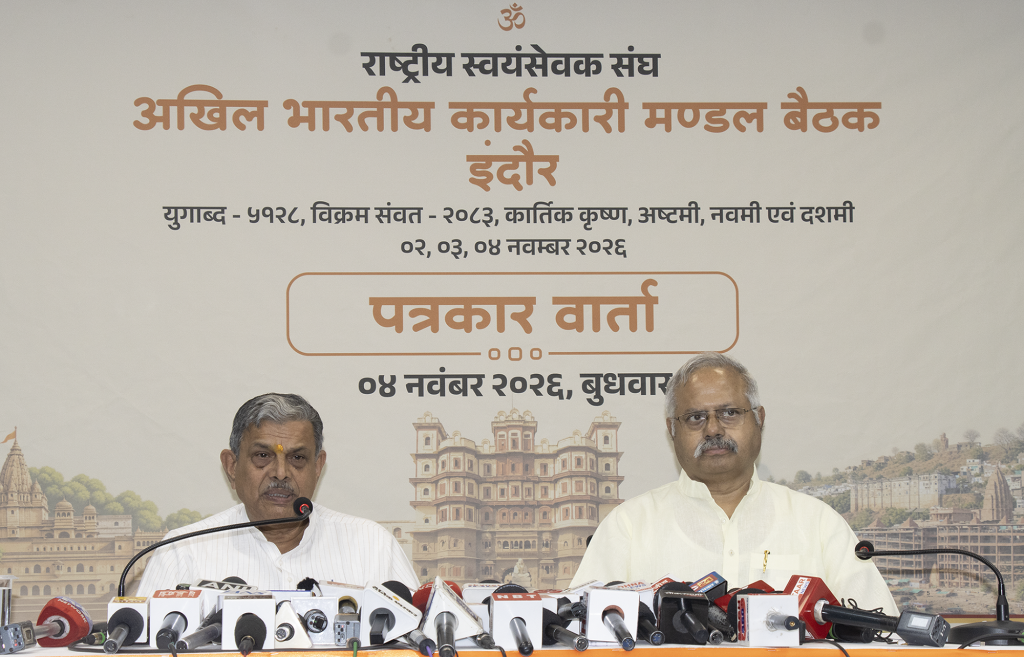
At its first national meeting since the centenary year, the Rashtriya Swayamsevak Sangh made youth engagement a central outcome, at a time when youth-led protests are being debated across Europe and beyond.
The Rashtriya Swayamsevak Sangh (RSS) says nearly 3.82 million young people took part in its programmes during its centenary year, and that what they said will shape its future work.
The figures came from Sarkaryavah (General Secretary) Dattatreya Hosabale after the Akhil Bharatiya Karyakari Mandal, the organisation’s all-India executive council, met in Indore from November 2 to 4. It was the council’s first meeting since the centenary programmes concluded.
The emphasis on youth comes amid a debate in recent months over protests presented as the work of “Gen Z”, and over whether those on the streets represent the generation at all.
The numbers
In his November 4 statement, Hosabale gave a detailed account of the centenary-year outreach: “In the centenary year, a total of 31,26,404 students participated in 57,243 programmes organised at 21,237 places for college students. Similarly, a total of 6,90,835 young [working] people participated in 14,285 programmes. In this way, a total of 38,17,239 youths were directly present in these programmes.”
The events were sittings, conversations and follow-up meetings held on campuses and in towns and villages. In an earlier statement ahead of the Indore meeting, the RSS said what it hoped to gain from them: “The aspirations of youth, their perspectives on society and the nation, and the suggestions received during these interactions will be considered while formulating future programmes.”
Hosabale: dialogue, and a warning
Asked at a press conference about democracy and Gen Z, Hosabale said: “There is an election system in the country for change of power. This work through anarchy, unrest is not in the interest of the country. Such conspiracies are going on in Bharat and abroad, we should remain alert about them.”
He also spoke of the concerns of the young: “There should be dialogue on the aspirations of youth. There should be positive deliberations with the new generation. A feeling of anger comes in youth, it should be channelised properly. They should be saved from anarchic conspiracy, and their aspirations should be understood.”
He described young people as an asset: “Youth are endowed with energy, social sensitivity and service spirit, efforts should be made to connect them with positive work.”
The RSS’s official statement also assigned a role to the wider public: “Anarchic forces should not dominate in Bharat and inactivity of Sajjan Shakti [the collective strength of good-thinking people] in society gives strength to anarchy, therefore sajjan shakti will have to become active.”
Bhagwat: agitation and its limits
Sarsanghchalak (Chief Mentor) Mohan Bhagwat addressed the same subject in his annual Vijayadashami address on October 20, delivered on the day the RSS observes its founding. He began by accepting that grievances are real: “In our vast society, problems do exist. It is only natural that these may lead to agitations. However, such agitations should aim to provide solutions.”
He then described what happens when that aim is lost, when “a movement becomes a tool of politics, driven by hostility and antagonism towards an individual, a group, or an ideology.” Such movements, he said, can “create an atmosphere of discord, intense discontent, separatism, disorder, and chaos in the country,” and “evoke a feeling of victimhood in the context of various problems.”
Bhagwat said the answer lies within the Constitution: “Even when emotions run high, our actions must remain within the bounds of our Constitution and the law.” He added that it is important to ensure “the lure of votes, cheap popularity, or political gains does not overpower our prudence and goodwill.”
Prime Minister Narendra Modi described it as “A very motivating address by Param Pujya Sarsanghchalak Dr. Mohan Bhagwat Ji during the Shatabdi Varsh Shri Vijayadashami Utsav in Nagpur.”
Equipping the young
Bhagwat’s remarks went beyond protest. He observed that “all kinds of information and news are now accessible to everyone through social media,” and that “the younger generation absorbs the information received through these media without exercising discernment.” His prescription: “the younger generation must be taught to exercise discernment between what is appropriate and what is inappropriate.” He gave families a part in this: “The present generation of parents and elders in the society must impart this discernment to the younger generation.”
On drugs, he said: “It is this same lack of discernment that is causing the younger generation across the world to fall prey to addiction to intoxicating drugs. Drug addiction is a serious national problem, and the government, administration, and the society must timely address it and start taking measures to overcome it.”
On technology, he said that “new knowledge, scientific developments, and technology should be welcomed and embraced. However, it must also be remembered that technology is merely a means.”
He said Bharat’s future “will rest on the shoulders of the coming generation,” and that “our youth must be fully equipped in every respect.”
Hosabale made a similar point in Indore: “The Sangh insists on sanskar [values] and discipline in the family. Leaving mobile phones aside, there should be discussion on positive subjects together in the family.”
The European backdrop
Youth-led protests in France over education and living costs escalated into riots, arson and looting. The protests disrupted more than 560 schools, police made more than 1,900 arrests in a single day, and curfews were imposed in parts of Paris. The unrest spread to Spain, Portugal, Italy, Albania and Belgium.
In Germany, demonstrations on October 31 under the banner “Gen Z regelt” ended with shops looted in Frankfurt and several police officers injured. German authorities blamed infiltrators from extremist factions. In Italy, thousands of young people joined demonstrations against the government, with clashes reported in Rome, Turin and Bologna.
The demands on these streets centred on housing, wages, education and jobs.
Over the same period in India, the RSS’s centenary outreach comprised 57,243 programmes for students and 14,285 for young workers.
What comes next
The RSS enters its second century with a larger organisational structure. Its official statement says: “In the Sangh’s geographical structure, now instead of 46 prants, there will be 88 Sambhags.” (Prants and sambhags are its provincial and divisional units.)
Organisational elections will run through the district, division, province and regional levels. The Akhil Bharatiya Pratinidhi Sabha, the RSS’s national representative assembly, meets in March 2027 where this structure is likely to be formalised.