
The Rashtriya Swayamsevak Sangh (RSS), one of India’s most influential social and cultural organisations, is increasingly engaging with audiences beyond India. RSS Sarsanghchalak (chief mentor) Mohan Bhagwat is scheduled to visit the United States, Canada and the United Kingdom beginning August 25, 2026. Earlier this year, the organisation’s Sarkaryavah (General Secretary) visited the United States and addressed a conference at the Hudson Institute. During his upcoming visit, Bhagwat is also scheduled to address the Indian-American community at an event titled “Universal Oneness Celebrations” at Madison Square Garden in New York on August 29.
Bhagwat is not the first RSS Sarsanghchalak to travel abroad. RSS functionaries have been visiting different countries since the 1950s. Over the decades, these journeys have served as an avenue for civilisational dialogue, interaction with diaspora communities and people-to-people engagement.
For a Western audience, the significance of this engagement is perhaps best understood not simply through the organisational expansion of the RSS, but through the ideas that the organisation seeks to take into the global conversation.
Vasudhaiva Kutumbakam: The World as One Family
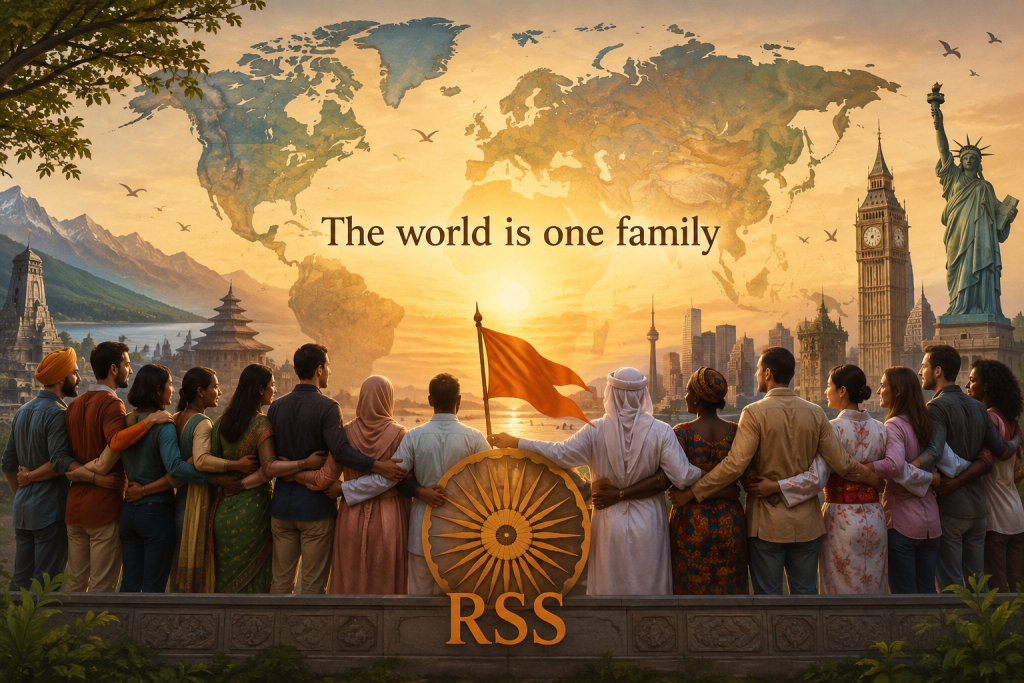
One of the central ideas invoked by the RSS in its global engagement is the ancient Indian concept of Vasudhaiva Kutumbakam, commonly translated as “the world is one family.”
The idea has acquired particular resonance at a time when international politics is increasingly marked by strategic rivalry, wars, social polarisation and mistrust between communities. It represents a distinctly Indian civilisational approach to the relationship between nations and peoples: the world should not merely be viewed as a collection of competing interests, but as an interconnected human community.
Bhagwat has repeatedly emphasised that Indian nationalism is not intended to threaten or dominate other societies. In the RSS’ conception, nationalism is compatible with a broader sense of human fraternity and is rooted in the principle of Vasudhaiva Kutumbakam.
There is an interesting contrast here with the way globalisation has traditionally been understood. Much of the modern discourse has focused on creating a global marketplace through the movement of capital, goods, technology and people. The Indian civilisational proposition goes beyond economic interdependence: it asks whether the world can also develop a deeper sense of social and human interconnectedness.
Whether such an idea can meaningfully address the conflicts of the modern world is open to debate. But its relevance is difficult to dismiss at a time when economic integration has not necessarily translated into greater social harmony or geopolitical stability.
Five Ideas for Social Transformation
The RSS has also developed what it calls Panch Parivartan, or “five transformations”, as a framework for social change.
These include Samajik Samrasta (social harmony), Kutumb Prabodhan (strengthening family values and awareness), Paryavaran Sanrakshan (environmental protection), Nagrik Kartavya (civic responsibility) and Swa or Swadeshi (self-reliance and a preference for indigenous capacities).
These themes have relevance well beyond India. Social fragmentation, weakening family structures, environmental degradation, declining civic participation and debates over economic dependence are issues confronting societies across the developed and developing world.
The RSS presents Panch Parivartan not simply as a set of abstract propositions but as ideas that its volunteers are implementing through social work and community activity in India.
Its international engagement therefore offers an opportunity for a two-way exchange. The objective need not be to export an Indian model wholesale to other societies. Rather, RSS functionaries can share experiences from India while learning from civic organisations, volunteer networks and communities in other countries.
That distinction is important. Genuine civilisational engagement is not a one-way process. It involves both sharing and listening.
A Global Engagement That Predates the Current RSS Leadership
The international dimension of the RSS and organisations inspired by it is not a recent development associated with Bhagwat’s travels.
In the early 1960s, Dadasaheb Apte, an RSS pracharak (full-time worker), travelled to around 30 countries as part of efforts that eventually contributed to the establishment of the Vishwa Hindu Parishad (VHP), an RSS-inspired organisation in 1964.
The VHP subsequently developed an international presence, particularly among Hindu communities living outside India. Its first World Hindu Conference was held in Prayagraj in January 1966 during the Kumbh Mela, bringing together tens of thousands of participants from India and abroad.
Other organisations inspired by the RSS have also developed international networks.
The Akhil Bharatiya Vidyarthi Parishad (ABVP), a student organisation inspired by the RSS, helped establish the World Organization of Students and Youth (WOSY) in 1985. Based in India, WOSY was conceived as an international forum for students and young people, emphasising international understanding, cultural exchange, peace and coexistence.
Its stated objectives included bringing young people from different countries together, facilitating exchanges of knowledge and culture, and encouraging opposition to terrorism, racism, colonialism, imperialism and other forms of oppression.
These initiatives illustrate that the RSS and organisations inspired by it have been involved in international engagement for several decades, although the nature, scale and objectives of different organisations vary and should not automatically be treated as identical to those of the RSS itself.
Why Bhagwat’s Visit Matters
Against this historical background, Bhagwat’s forthcoming visit can be seen as another stage in a much longer process of engagement between an Indian civilisational organisation and societies outside India.
For Western audiences, the significance may lie less in the immediate organisational implications and more in the ideas entering the conversation.
The world today faces a paradox. Technological and economic connectivity has never been greater, yet societies remain deeply divided. National interests increasingly collide with global challenges. Political polarisation is accompanied by social fragmentation, while environmental pressures have exposed the limitations of purely material measures of progress.
The RSS’ answer begins from an Indian civilisational premise: that social cohesion, responsible citizenship, environmental stewardship, family and community relationships, self-reliance and a sense of shared humanity are interconnected rather than separate concerns.
That proposition deserves to be examined on its merits.
The principle of Vasudhaiva Kutumbakam does not offer an easy solution to geopolitical conflict. Nor can a civilisational philosophy by itself resolve the complex political and economic disputes of the modern world. But it provides a different vocabulary for thinking about them—one that places fraternity alongside competition and responsibility alongside rights.
Bhagwat’s international engagement therefore represents more than a series of overseas appearances. It is part of a decades-long attempt by the RSS and organisations influenced by it to engage with Indians abroad, interact with other societies and present aspects of India’s civilisational worldview to a global audience.
In a world increasingly defined by walls—political, cultural and ideological—the proposition that humanity constitutes one family is an idea worth hearing, debating and testing through practice.