
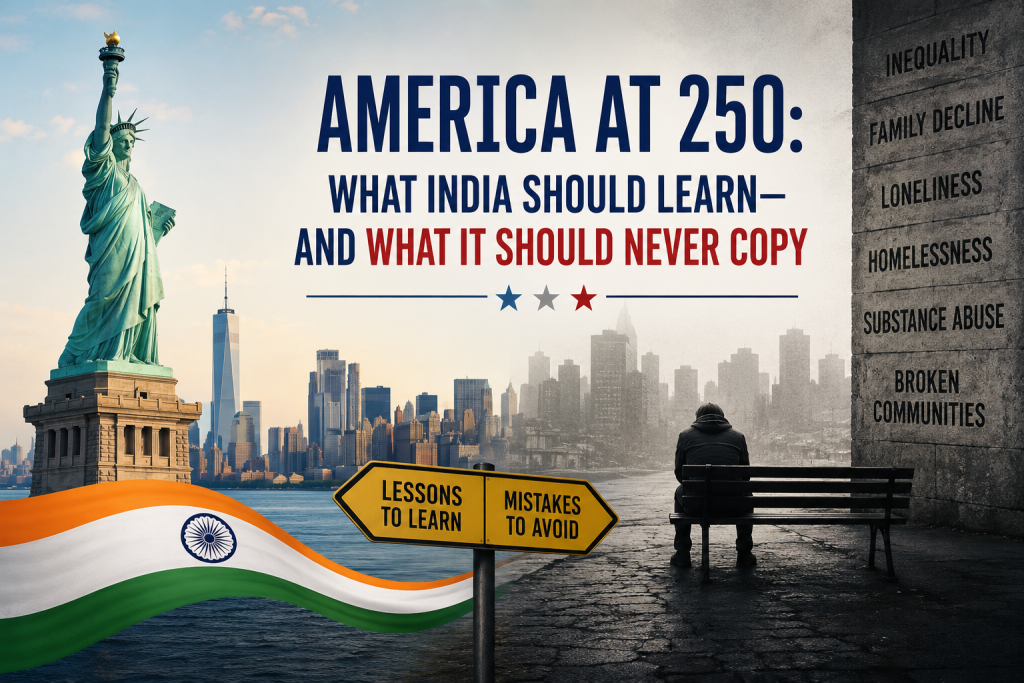
As the United States commemorated 250 years of its national journey on July 4, the occasion offered the world an opportunity to reflect on one of history’s greatest stories of economic success. The United States today is the world’s largest economy, the epicentre of technological innovation, home to Silicon Valley, issuer of the global reserve currency, and creator of the most influential higher education and research ecosystem in modern history. Few nations have shaped the global economic and technological order as profoundly as America.
Yet this remarkable success tells only part of the story. Alongside unparalleled economic achievement has emerged a set of deep social and economic challenges. For India, the American experience offers an important lesson: wealth creation is essential for national progress, but it is not sufficient. Economic dynamism must be accompanied by strong social institutions, stable families, and cohesive communities. The real challenge is to build a developed economy without creating a fractured society.
The Economic Contradictions
America’s economic success has been accompanied by growing inequality.
According to the U.S. Congressional Budget Office, income disparities have reached unprecedented levels. In 2022, the richest one percent of American households earned, on average, 103 times the income of the bottom 20 percent.
Despite being the world’s wealthiest nation, poverty continues to affect millions. A U.S. Congressional report notes that the official poverty rate stood at 10.6 percent in 2024, with nearly 35.9 million Americans living below the poverty line.
Homelessness has also risen sharply. According to the U.S. Department of Housing and Urban Development (HUD), 771,480 people experienced homelessness on a single night in January 2024—an 18 percent increase over the previous year.
The higher education sector, long regarded as America’s greatest strength, is also showing signs of stress. The Atlantic, in its report titled The Looming College-Enrollment Death Spiral, notes that the United States currently has around 4,000 colleges, with approximately 60 institutions closing every year. Undergraduate enrolment has been declining steadily since 2011, raising concerns about the sustainability of the country’s higher education ecosystem.
The Crisis of the Family
Economic prosperity has not prevented the weakening of the American family.
According to a U.S. Congressional Research Service report titled Fatherhood Initiatives: Connecting Fathers to Their Children, one in every four American children grows up in a single-parent household. In 2017, 23 percent of children lived only with their mothers, roughly double the proportion recorded in 1970.
A study published in Children and Youth Services Review (2015), titled Fragile Families in the American Welfare State, reported that more than 40 percent of American children are now born outside marriage. In 1960, this figure was just 5 percent. Approximately half of these unmarried parents are cohabiting at the time of birth.
The social implications of fatherlessness have long been recognised. In his influential 1995 book Fatherless America: Confronting Our Most Urgent Social Problem, David Blankenhorn warned that weakening family structures would have lasting consequences. More than a decade later, the U.S. Congressional Research Service echoed similar concerns, observing that children raised in single-parent families are, on average, more likely to experience poorer educational, emotional, and economic outcomes than children living with two married biological parents.
The Decline of Marriage
Marriage itself has undergone a dramatic transformation in the United States.
In 1920, shortly after the First World War, America recorded approximately 12 marriages per 1,000 people annually. Following a temporary decline during the Great Depression, marriage rates surged after the Second World War, reaching an all-time high of 16.4 marriages per 1,000 people in 1946.
The long-term decline began in the early 1970s. Since 1972, marriage rates have steadily fallen to around 6.1 marriages per 1,000 people, among the lowest levels ever recorded. At the same time, the divorce rate remains around 2.4 per 1,000 people, with nearly 45 percent of marriages ending in divorce.
The Epidemic of Loneliness
The weakening of social bonds has produced another crisis: loneliness.
In 2023, the U.S. Surgeon General issued an advisory titled Our Epidemic of Loneliness and Isolation, describing loneliness as a major public health challenge.
The report found that only 39 percent of American adults felt very emotionally connected to others. Approximately half of all adults reported experiencing loneliness, with the highest rates among younger generations.
The advisory further observed that loneliness and social isolation are now more widespread than several major public health challenges, including smoking, diabetes and obesity, while posing comparable risks to health and premature mortality.
Substance Abuse: Another Growing Crisis
Substance abuse represents another serious social challenge.
According to data published in the Pan American Journal of Public Health, around 17.7 million people in the Americas were living with drug-use disorders in 2021. The crisis resulted in nearly 78,000 direct deaths, a mortality rate almost four times the global average.
The Indian Lesson
As India pursues its ambition of becoming a developed nation, it must strive to replicate the economic success of advanced economies without importing their social fractures.
This has long been a recurring theme in the thinking of leaders and intellectuals associated with the Rashtriya Swayamsevak Sangh (RSS). From M.S. Golwalkar to Mohan Bhagwat, and from Deendayal Upadhyaya to Dattopant Thengadi, the consistent argument has been that India’s development model must remain anchored in its own civilisational ethos rather than imitate Western frameworks.
Within the Indian civilisational tradition, Artha (material prosperity) is an important objective of life, but it must always remain guided by Dharma. Wealth creation, therefore, is not an end in itself; it is meaningful only when it strengthens families, reinforces communities, promotes social harmony and contributes to national well-being.
If India succeeds in maintaining this balance while pursuing rapid economic growth, it can emerge not merely as a prosperous nation but as a civilisation that offers the world a development model that is economically dynamic, socially cohesive and rooted in its enduring civilisational values.