For decades, Indian academic sociology has remained deeply anchored in Eurocentric epistemologies. While Western thinkers, ranging from Hobbes, Locke, and Rousseau to Weber, Durkheim, and Marx, are routinely canonized in university curricula, indigenous conceptual frameworks have often been relegated to the margins. This academic asymmetry is not merely an institutional oversight. It reflects a long-standing intellectual dependency that evaluates non-Western societies strictly through Western socio-historical categories.
The consequences of this intellectual hegemony are evident in how modern social theory frames human organization. Western sociology remains trapped in a reactive binary: on one side stands individualist liberalism, viewing society through Social Contract theory as an artificial compromise forged by isolated actors to protect self-interest; on the other stands collectivist socialism, elevating the State to an absolute authority and reducing human beings to cogs in a centralized machine. Where the former breeds atomization and unrestrained exploitation, the latter stifles human diversity and strips away personal agency.
Pandit Deendayal Upadhyaya’s sociological thought offers an indigenous alternative that cuts cleanly through this Eurocentric dualism. Grounded in the civilizational ethos of Sanatan philosophy, Upadhyaya posits that society is neither a legal transaction nor an inanimate mechanism. Instead, society is a self-existent, living entity endowed with its own organic personality and autonomous evolution. Just as an individual possesses a distinct soul, a society possesses an essential spiritual consciousness, Chiti, and its corresponding collective social manifestation, Virat.
This foundational departure becomes most glaring when evaluating the flaws inherent in Western socio-political foundations. Western social contract models presuppose that individuals existed prior to society in a state of nature and later entered a transactional agreement. Upadhyaya notes that this creates an artificial, dualistic framework where the individual and society view each other with underlying hostility. If an individual becomes powerful, they manipulate political and economic machinery to exploit society. Conversely, if the state assumes total power, it centralizes control, suppresses smaller organic institutions, and subjects individuals to administrative dominance. In a capitalist order, individual exploits individual; in a socialist order, the state exploits the individual.
To overcome this perpetual conflict between the individual and the state, Upadhyaya grounds his framework in organic unity, or Ang-Angi Bhav, a civilizational concept derived from the ancient Vedic paradigm that views the whole (Angi) and its parts (Ang) as inextricably linked. He visualizes society as a cosmic body, Virat Purusha, offering a model of profound ecological interdependence. In this living structure, different social groups, institutions, and functions act as interdependent limbs. Just as the eye cannot claim superiority over the hand, nor the heart over the brain, no organ in society is complete in itself, nor can any single limb claim dominance over another. Recognizing this natural complementarity eliminates structural rivalry and class struggle. Functional specialization is thus understood not as a tool for hierarchy or exploitation, but as a mechanism for developing internal excellence and fulfilling mutual societal needs.
This organic understanding of social function directly transforms how we must diagnose systemic friction and social pathology. Upadhyaya argues that functional diversity is frequently mistaken for discrimination due to a “flawed perspective”. When social reformers attempt to erase natural diversity in a bid to eliminate discrimination, they commit a fundamental error. Attempting to enforce artificial uniformity is akin to “eliminating the patient instead of curing the disease”. Diversity is an inevitable strength that enhances the elegance of a well-organized society. The true solution lies in correcting systemic distortions while fostering an overarching sense of duty and belonging.
Yet, no social structure, regardless of how well-designed it appears on paper, can survive on external mechanics alone. To explain how social institutions function and decay, Upadhyaya distinguishes between external mechanics and internal sentiment. Consider a college: it can possess modern buildings, advanced laboratories, expansive libraries, structured classrooms, qualified teachers, and a strict timetable. This constitutes its external structure. However, if students lack the internal desire to learn, or if teachers shirk their moral responsibilities, the institution ceases to function. External frameworks change with time, but an institution survives only when animated by its internal spirit, its core cultural values, ethics, and mutual sense of duty.
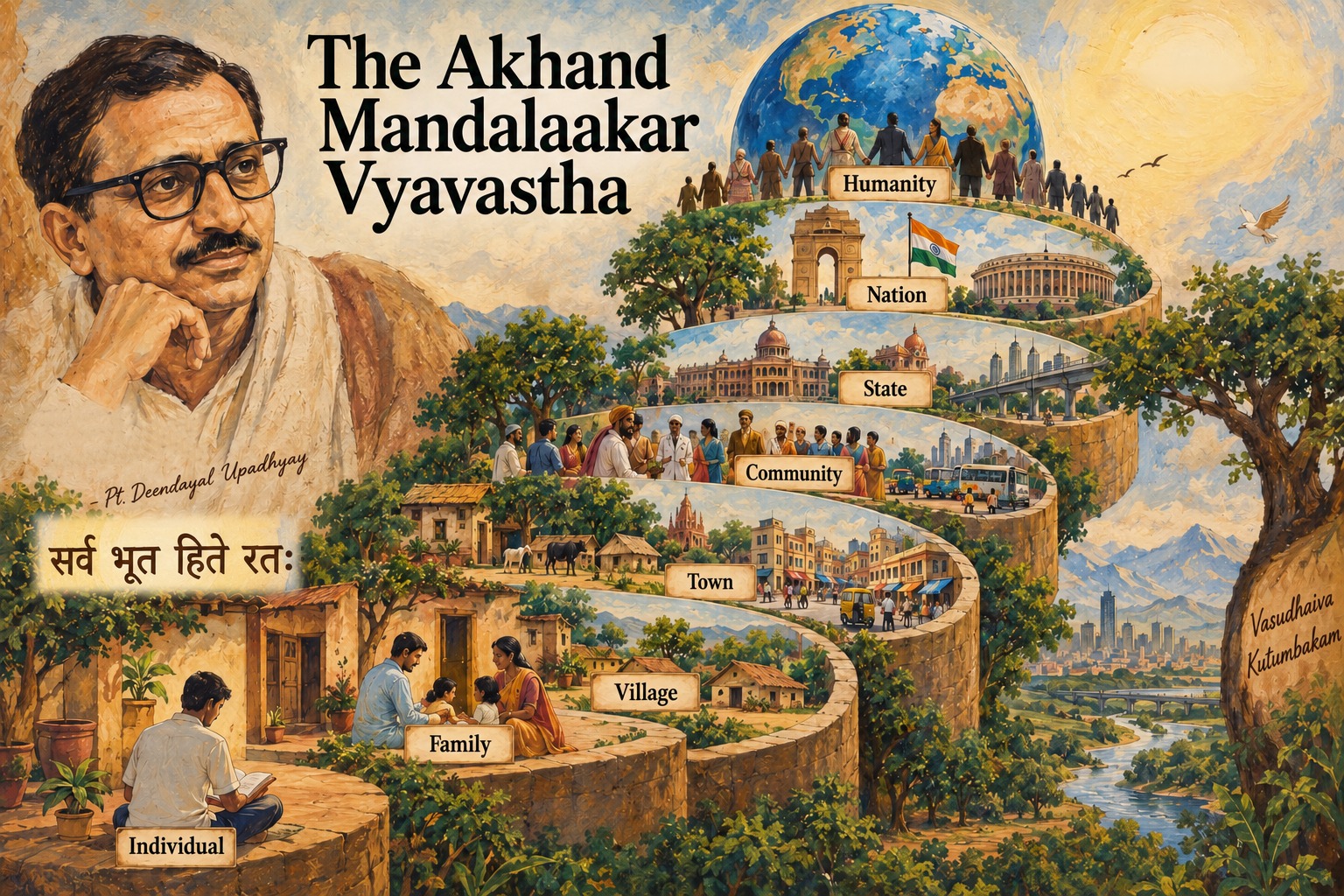
This interplay between internal vitality and outer structure culminates in a unique geometric vision of human social progress. Drawing upon Dattopant Thengadi’s commentary, Upadhyaya contrasts Western concentric social models with the Indian unbroken spiral, Akhand Mandalaakar Vyavastha. In Western thought, social units like individual, family, nation, humanity—resemble concentric circles, enveloping one another yet remaining structurally isolated, generating friction between national sovereignty and globalism.
In Integral Humanism, social evolution is a continuous, spiral expansion. The individual naturally expands into the family, the family into the community, the community into the nation, and the nation into global humanity and nature. Because each successive unit naturally originates from the previous one, social expansion occurs without generating anomie, or normlessness, or destroying the autonomy of smaller units.
Ultimately, reclaiming Upadhyaya’s organic sociology is an essential step toward decolonizing Indian social thought. By moving beyond Eurocentric contract models and re-anchoring social theory in mutual adaptability, internal values, and the unbroken spiral of human consciousness, his framework offers a powerful civilizational roadmap for genuine social harmony.
(This analysis draws from Munindra Mohan Chaturvedi’s 1988 study, ‘Pt. Deendayal Upadhyaya ki Samaj-Vigyan ko Den’)
(The writer is an author and columnist)