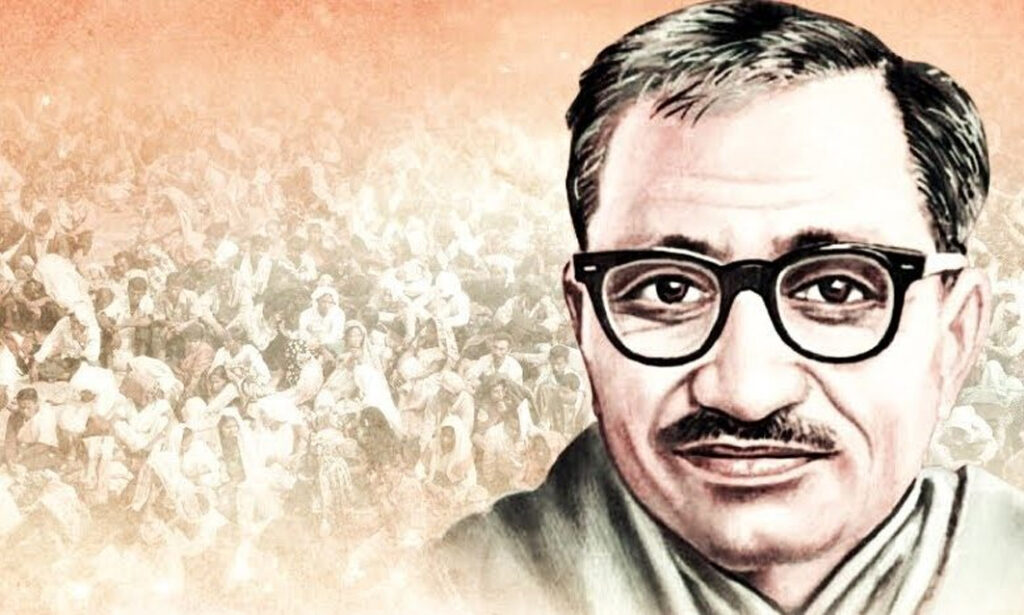
At a time when societies across the world are reassessing the relationship between individual freedom, social responsibility, economic development, cultural identity, and the authority of the State, the thought of Pandit Deendayal Upadhyaya acquires renewed relevance. First presented as a four-part lecture series in Bombay (Mumbai in Maharashtra) in April 1965, following its formulation as an ideological framework for the Bharatiya Jana Sangh at its Gwalior (in Madhya Pradesh) session in 1964 and its subsequent acceptance at Vijayawada (in Andhra Pradesh) in 1965, his doctrine of Integral Humanism (Ekatma Manavavad) sought to place the complete human being, rather than a rigid economic system or an all-powerful State, at the centre of social and national life. For Upadhyaya, the question before post-independence India was larger than a mere tactical choice between competing political or economic ideologies. It was fundamentally a question of civilizational direction: What kind of society should India build, and what conception of the human person should guide that construction?
National Self and Organic Growth
When India achieved independence, political priorities were consumed by the immediate mechanics of statecraft, removing colonial masters and establishing governance structures. Beyond a few philosophical markers, the long-term national blueprint for free India received limited attention, leaving political discourse to swing between imported models that fail to capture the true ethos of the land. Upadhyaya observed that political freedom by itself does not determine the direction in which a nation should travel. He emphasized that the idea of Swaraj (self-rule) remains incomplete without Swa (the national self), stating that without thinking about our self, self-rule loses its intrinsic meaning. This concept of Swa embodies a people’s historical consciousness, cultural values, and civilizational character, far beyond simple isolationism.
Foreign principles arise out of specific historical circumstances. They cannot be mechanically applied elsewhere as universal formulas. As Upadhyaya noted, transplanting systems like Marxism without adapting them to local realities is uncritical dogma rather than scientific inquiry. It is ironic that those seeking to free India from its own orthodoxies should become bound to foreign ones. Authentic progress blends historical heritage with universal knowledge. By adapting core values to modern times and customizing global insights, national life grows organically, assimilating new wisdom while preserving its civilizational soul.
Limitations of Imported Paradigms
The major Western political ideals like Nationalism, Liberal Capitalism, and State Socialism were originated in specific European historical contexts. While born out of impulses to solve real societal challenges, each has produced internal contradictions when treated as an absolute worldview. European nationalism frequently turned aggressive, driving imperial conflict; capitalist democracy yielded wealth but reduced human experience to economic competition where individual liberty can degenerate into exploitation; and state socialism, while seeking to eliminate exploitation, sacrificed individual freedom and created totalizing state machinery. Modern societies have thus grown kinkartavyavimudha meaning unsure of their ultimate direction. These ideologies share a fragmented view of humanity, treating man either strictly as a political animal seeking rights or an economic entity seeking bread.
Indian thought approaches existence not through fragmentation or class conflict, but through an underlying unity (Ekatmata). Bharatiya(Indian) culture recognizes the diversity of creation but seeks to discover the underlying harmony within it, viewing diversity not as a cause for conflict, but as complementary expressions of a unified whole. While the law of the survival of the fittest may describe the jungle, human civilization advances by creating conditions where mutual cooperation and protection prevail. Consequently, Integral Humanism synthesizes human needs into a holistic framework accounting for the complete person, composed of the Body (Sharira), Mind (Mana), Intellect (Buddhi), and Soul (Atma). Within this comprehensive worldview, the Purushartha framework, the organic alignment of Chiti and Swa, and the ethical governance of a Dharma Rajya seamlessly blend to secure balanced individual and collective progress.
Four Purusharthas and Human Flourishing
To ensure balanced development, Indian philosophy articulates four foundational goals of human endeavour (Purusharthas): Dharma, the foundational moral order, duty, and ethics regulating human action; Artha, economic wealth, administrative power, and material resources; Kama, the fulfillment of physical, aesthetic, and emotional desires; and Moksha, ultimate spiritual liberation and self-realization.
Bharatiya thought does not neglect the material body in its pursuit of the spiritual. Citing the classic maxim Shariram adyam khalu dharma-sadhanam (the physical body is the primary instrument for fulfilling moral duty), Upadhyaya affirmed that material well-being is essential. Economic security (Artha) is necessary to prevent poverty from eroding moral conduct and to avoid matsya-nyaya (the law of the big fish eating the small). However, material wealth and desire must be continuously guided by Dharma, ensuring that honesty, integrity, and self-restraint are treated as fundamental principles rather than temporary policies. Development is thus redefined from mere industrial output to total human flourishing.
Society as an Organic Whole: Chiti and Prana
Unlike Western social contract theories that view society as a mechanical compromise between self-interested individuals, Indian thought views society as an organic, living organism (Swayambhu). Just as an individual possesses a unique personality, every nation (Rashtra) possesses an innate civilizational soul known as Chiti. Chiti represents the foundational consciousness of a society, the timeless standard by which a civilization intuitively determines what is noble, enduring, and authentic to its character.
The vital life force that sustains this innate consciousness and drives national dynamism is its Prana. Chiti acts as the civilizational soul, while Prana functions as the dynamic, animating energy that turns core values into living practice. When governance structures, economic models, and social institutions align with a nation’s Chiti, society experiences resilience and creative growth. Conversely, when state structures clash with Chiti, cultural alienation and institutional instability follow.
Primacy of Dharma over the State
Integral Humanism establishes a clear distinction between the State (Rajya) and the Nation (Rashtra). The State is merely one of several functional instruments created by society to preserve order, enforce justice, and defend borders; it is neither absolute nor supreme. Sovereignty resides neither in an autocratic ruler nor purely in a parliamentary majority, but in Dharma the moral law and natural justice governing both ruler and ruled.
A Dharma Rajya must not be confused with a theocratic state or an amoral state. While a theocratic state derives authority from a single religious dogma or clergy, leading to discriminatory policies that enforce sectarian dominance, an opportunistic or amoral state relies on value-free administration that often ignores organic cultural traditions. In contrast, a Dharma Rajya bases its authority on natural justice and moral law. It guarantees genuine liberty, complete freedom of worship to all faiths (Panth Swatantrya), protects the vulnerable, and prevents any community, even a numerical majority from acting arbitrarily against basic ethical principles.
Decentralised Power
To safeguard human dignity and prevent power concentration, Integral Humanism advocates for structural decentralization across political and economic domains. In political governance, authentic national unity (Ekatmak Rajya) avoids hyper-centralized autocracy by empowering local self-governing institutions, such as Gram Panchayats with inherent, autonomous authority (Swayambhu Satta) rather than treating them as mere administrative subordinates of central authority.
In economic governance, arrangements must serve human dignity rather than reducing individuals to mere economic categories. Rejecting both state monopolies and corporate centralization, economic policies should prioritize widespread employment, resource conservation, and self-reliance, ensuring material growth harmonizes naturally with environmental sustainability and social welfare.
Aligning State Authority with Civic Responsibility
Ultimately, Integral Humanism addresses the core questions of nation-building by proposing a practical framework for both governance and citizenship. In response to the role of the State, it presents the concept of a Dharma Rajya, a government that is neither autocratic nor amoral, but bound by ethical law, natural justice, and decentralization to serve the public good. In response to the role of the individual, it replaces the passive consumer or rights-asserting contestant with a duty-conscious citizen whose active participation (Prana) drives national progress.
By grounding development in civilizational self-awareness (Swa) while remaining open to universal knowledge, Upadhyaya’s model seeks to balance individual well-being with collective stability. Rather than relying on rigid ideological dogmas or over-centralized state control, Integral Humanism provides an analytical blueprint for building a self-reliant nation through shared civic responsibility and institutional accountability.
(The writer is an author and columnist)