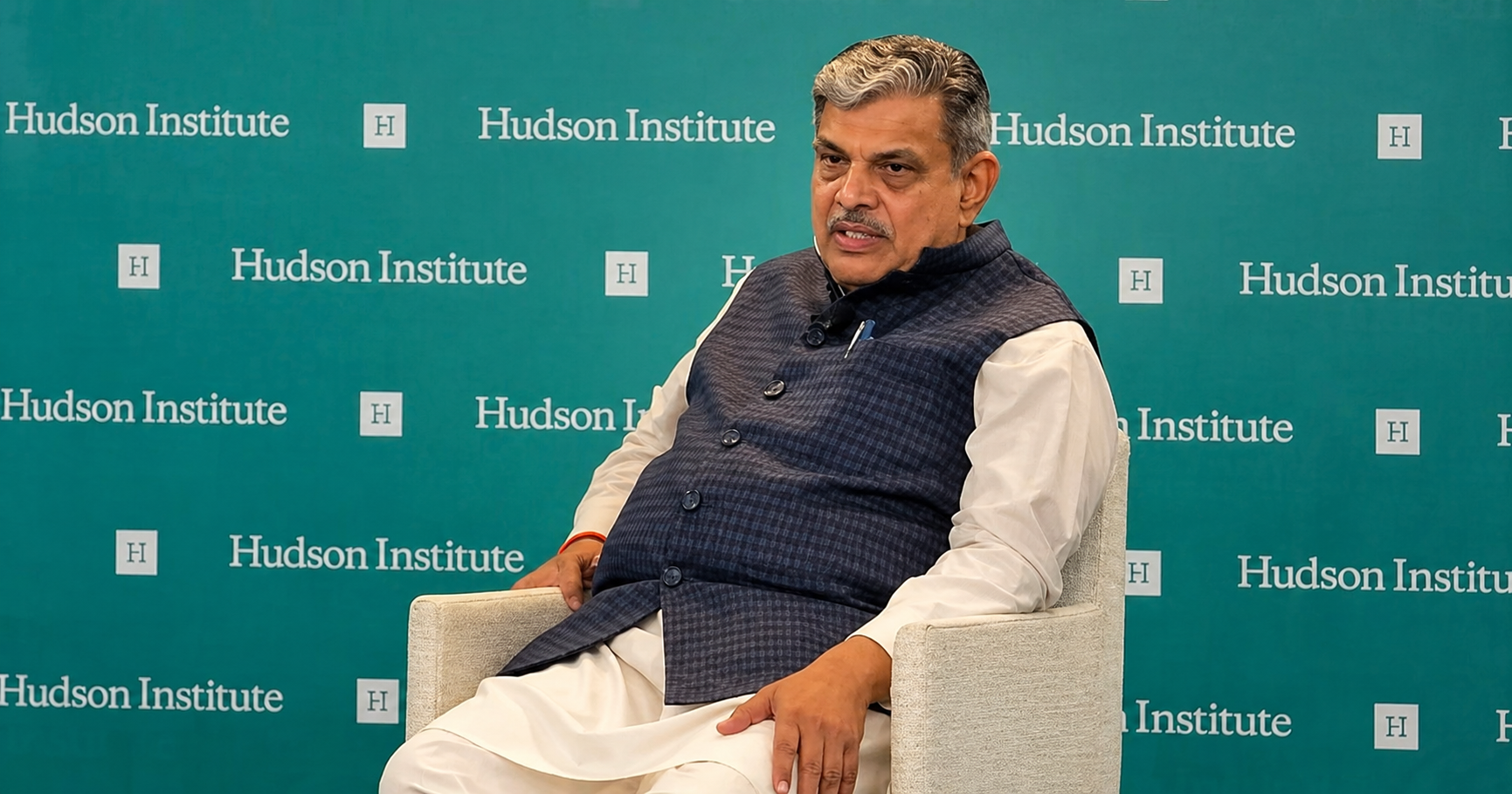
The General Secretary of the Rashtriya Swayamsevak Sangh (RSS), Dattatreya Hosabale, visited the United States in April 2026, a moment that coincides with the organisation’s centenary year and lends the visit added significance. While interactions of senior RSS functionaries abroad are not new—particularly in the post-independence period when such visits largely focused on engaging the Indian diaspora—this visit reflects an evolution in scope and intent.
What distinguishes this visit, however, is its movement beyond community engagement towards a wider intellectual exchange. Interactions at platforms such as the Hudson Institute and Stanford University point to a growing space of mutual engagement with American academic and policy circles—where ideas are not merely presented, but discussed, questioned and interpreted across civilisational perspectives.
Key Takeaways from the Visit
The RSS has been a misunderstood and, hence, much-maligned organisation in sections of the Western world. Lack of information, entrenched biases, and poor understanding of Hindu philosophical systems in Western academia and media have often portrayed the RSS as a Hindu supremacist organisation. Hosabale’s visit not only countered these misconceptions but also helped portray India’s civilisational strengths that hold significance in these times of growing global conflicts.
During his fireside chat with The Wall Street Journal columnist Walter Russell Mead at the Hudson Institute, the RSS General Secretary cleared many misconceptions in a no-holds-barred conversation. He unequivocally rejected comparisons of the RSS with racist organisations. He emphasised that the RSS is often misunderstood due to long-standing narratives portraying it as anti-minority, anti-Christian, anti-modern and supremacist.
Reframing Perceptions in the West
Hosabale explained quite convincingly to the audience that Hindu philosophy is based on oneness and a universal family, not supremacy. Hindus historically have not invaded or enslaved other nations. Most importantly, he credibly defined the RSS as a voluntary, cultural organisation rooted in India’s civilisational values.
When probed by Mead, he explained RSS activities like daily or weekly shakhas to build discipline, character and community service, and stated that the organisation sees Hindu identity as civilisational, not religious. He also highlighted RSS work in social service, including relief work, education, health, rural development and the environment, and asserted that tensions with minorities and neighbours arise from politics and misinterpretation of history, not ideology.
Philosophy, Identity and Dialogue
Countering the often prevalent academic and media-centric perception in the West about the RSS, Hosabale clearly said that the organisation advocates dialogue with minority communities to resolve misunderstandings. He also asserted that modernisation and cultural values can coexist and are not contradictory.
Earlier, speaking at a conference at Stanford University, Hosabale gave an interesting speech that bridged the gap between perception and the philosophy of the RSS. He said that, in our Indic tradition, there is no separation between spiritual and scientific knowledge; both are seen as parts of one whole. Texts like the Upanishads present human anatomy, the mind, action and inaction, perception and beyond, not merely devotional content. Technology, he argued, must be guided by economy, ecology and ethics, and knowledge (jnana) must be tempered with wisdom (viveka), so that it benefits both individuals and society rather than fostering arrogance or harm.
Civilisational Conversations
As mentioned earlier, it isn’t the first time that an RSS functionary has made a visit outside India. However, what makes the difference is the scale and nature of engagement. From Silicon Valley to the think tank ecosystem, the RSS is now finding space within American intellectual circles. This reflects not just growing familiarity, but also a willingness to engage with ideas rooted in India’s civilisational experience.
When it comes to the RSS, such interactions are seen through the lens of Vasudhaiva Kutumbakam (the whole world is one family). The underlying belief is that India’s civilisational frameworks can contribute meaningfully to contemporary global challenges—whether in fostering social cohesion, addressing ecological imbalance, or reducing conflict in an increasingly fragmented world.
As Hosabale said at Stanford University, reflecting the RSS’s worldview that could benefit humanity:
“Humility grows from the understanding that all beings arise from one original source of energy. When nature is treated as a slave, existing only to satisfy human needs and greed, exploitation naturally follows. The Hindu tradition teaches respect for every creature, seeing the same energy or divinity in oneself, in others, and in all flora and fauna. This sense of universal oneness leads to respect, humility, and a view of the entire universe as one interconnected whole.”
Seen in this light, the significance of these engagements lies in the emergence of a civilisational dialogue rather than any one-sided projection. As Indian and American intellectual traditions increasingly intersect, such conversations create space for mutual learning—where questions of ethics, identity, sustainability and coexistence can be explored beyond ideological binaries, and with a shared search for balance in a rapidly changing world.