As India observes the birth anniversary of Swami Vivekananda as National Youth Day on 12 January, it is an occasion to revisit the remarkable story behind the Vivekananda Rock Memorial—one of modern India’s most inspiring national monuments, rooted deeply in spiritual vision and collective participation.
The Vivekananda Rock Memorial was inaugurated on 2 September 1970 by the then President of India, V. V. Giri. Soon after its inauguration, Prime Minister Indira Gandhi visited the memorial and toured the site. She was guided through the memorial by Eknath Ranade (a full time worker of Rashtriya Swayamsevak Sangh), the chief architect of the project, along with Swami Ranganathananda of the Ramakrishna Mission. The Ramakrishna Mission had been consulted and involved from the early stages of the initiative. Eknath Ranade served as the organising secretary of the committee that led this historic effort.
Spiritual and Historical Significance of the Rock
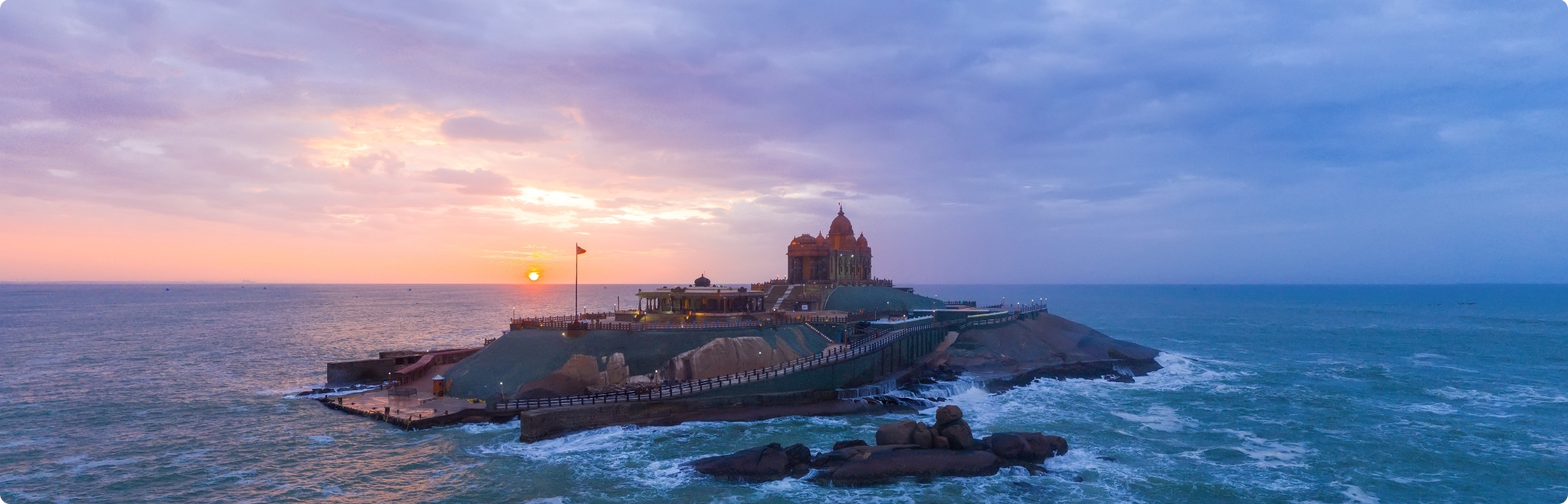
Swami Vivekananda’s mission for the spiritual and national rejuvenation of Bharat took a decisive shape at Kanyakumari, where he sat in deep meditation on what he described as “the last bit of Indian rock.” Today, that sacred site stands transformed into the Vivekananda Rock Memorial, symbolising his vision and message for the nation.
The rock, traditionally known as Shreepada Parai, holds immense spiritual importance. It is believed to be the place where Goddess Parvati, in the form of Kanyakumari Devi, performed penance while standing on one foot. After traversing the length and breadth of India, Swami Vivekananda reached Kanyakumari and meditated on this very rock from 25 to 27 December 1892. It was during this meditation that he resolved to carry the message of Vedanta and Indian civilisation to the West—a decision that later culminated in his historic address at the Parliament of Religions in Chicago.
Under the visionary leadership of Eknath Ranade, this sacred rock was transformed into a Shila Smarak—a rock memorial that gave concrete form to Swami Vivekananda’s ideals and inspiration.
A National Endeavour Rooted in Public Participation
The construction of the Vivekananda Rock Memorial was marked by unprecedented public involvement. Members of Parliament cutting across ideological and regional lines supported the initiative. The estimated cost of the project was approximately ₹1.35 crore, of which nearly ₹85 lakh was collected through small donations—often of one or two rupees—from ordinary citizens across the country.
This mass participation reflected the core objective of the movement: to take Swami Vivekananda’s message to the widest possible audience and to inspire individuals from all walks of life to contribute to national regeneration.
The detailed story of this extraordinary effort has been documented by Eknath Ranade himself in the book The Story of the Vivekananda Rock Memorial, available in several Indian languages. The narrative stands as a testament to how a dedicated group of volunteers was able to mobilise nationwide support for a project rooted in spiritual and cultural consciousness.
Beyond Stone and Structure: The Second Phase
Eknath Ranade often emphasised that his life’s work was not merely about erecting a structure of stone and concrete, but about creating a living and dynamic institution capable of translating Swami Vivekananda’s vision into sustained action.
This thought led to the second phase of the mission with the establishment of Vivekananda Kendra in 1972. Conceived as a spiritually inspired service organisation, Vivekananda Kendra was founded on the ideals of Man-Making and Nation-Building. Drawing inspiration from Swami Vivekananda’s teaching that service to humanity is a form of worship, the organisation has grown over the past five decades into a nationwide movement.
Today, Vivekananda Kendra operates more than 1,300 branch centres across India. Its full-time workers and volunteers engage in diverse activities including yoga and health programmes, study circles, cultural education, leadership development, youth and women’s initiatives, rural development, education, natural resource management, and the dissemination of literature inspired by Swami Vivekananda’s life and message.
From a solitary rock at the southern tip of India to a vibrant national service movement, the journey of the Vivekananda Rock Memorial and Vivekananda Kendra stands as a powerful example of how spiritual inspiration, collective effort, and selfless service can shape enduring national institutions.