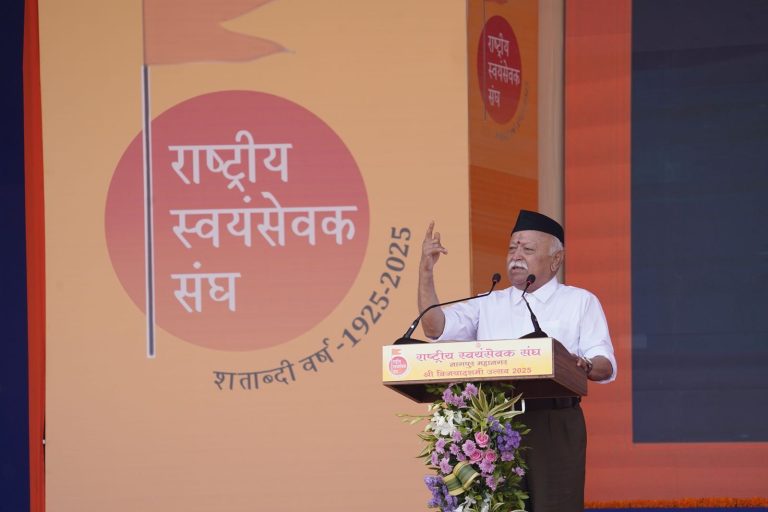
‘International Day of the World’s Indigenous Peoples’ is observed every year on August 9. For the last few years, this occasion has led to the clash of narratives. The Rashtriya Swayamsevak Sangh (RSS) and Akhil BharatiyaVanvasi Kalyan Ashram (ABVKA), an RSS-inspired organisation have taken a firm stand that this day has no relevance in the Indian context as it is a pure colonial and western construct. It is largely a colonial guilt project for the way they crushed the indigenous people under the ‘white man’s’ burden. There is a clear divide between the indigenous and non-indigenous people in the West.
In India, unlike the West, the indigenous people are no different from other natives. According to ABVKA, “We believe that everyone living in India is a ‘moolniwasi (original inhabitant)’ of the country. No one came from outside.”
India had always been civilisationally an integral part of the society unlike the West where the ‘White’ man carried out a brutal genocide across Europe, and the Americas. These campaigns were unparalleled in terms of brutality.
Raphael Lemkin, who is known for coining the term “genocide,” had identified two key phases in this process of colonial genocide carried out from 15th century onwards by Britain, France, Portugal, Netherlands, Denmark, Sweden. The first phase involved the destruction of Indigenous cultures leading to the second phase that comprised the forcible imposition of the colonizers’ religion, language, and societal norms on native populations.
Similar patterns of ‘genocides’ were repeated in South America, Canada, Australia, New Zealand, and several island nations. The western colonisers systematically exterminated Indigenous communities.
Americas
According to the Holocaust Museum Houston, When European settlers arrived in the Americas, historians estimate there were over 10 million Native Americans living there. By 1900, their estimated population was under 300,000. Native Americans were subjected to many different forms of violence, all with the intention of destroying the community. In the late 1800s, blankets from smallpox patients were distributed to Native Americans in order to spread disease. There were several wars, and violence was encouraged; for example, European settlers were paid for each Penobscot person they killed. In the 19th century, 4,000 Cherokee people died on the “Trail of Tears”, a forced march from the southern US to Oklahoma. In the 20th century, civil rights violations were common, and discrimination continues to this day.”
Australia
According to an Australian Human Rights Commission investigation titled, “Report of the National Inquiry into the Separation of Aboriginal and Torres Strait Islander Children from Their Families, “Indigenous children have been forcibly separated from their families and communities since the very first days of the European occupation of Australia. Violent battles over rights to land, food and water sources characterised race relations in the nineteenth century. Throughout this conflict Indigenous children were kidnapped and exploited for their labour. Indigenous children were still being ‘run down’ by Europeans in the northern areas of Australia in the early twentieth century. … the greatest advantage of young Aboriginal servants was that they came cheap and were never paid beyond the provision of variable quantities of food and clothing.As a result any European on or near the frontier, quite regardless of their own circumstances, could acquire and maintain a personal servant.”
The report further said. Governments and missionaries also targeted Indigenous children for removal from their families in Australia. Their motives were to ‘inculcate European values and work habits in children, who would then be employed in service to the colonial settlers’ .
Canada
In Canada, the Truth and Reconciliation Commission and various other inquiries brought out startling facts about the brutal repression of indigenous people. According to a CBS News report, “In May 2021, when archaeologists detected what they believed to be 200 unmarked graves at an old school in Canada, it brought new attention to one of the most shameful chapters of that nation’s history. Starting in the 1880’s and for much of the 20th century, more than 150,000 children from hundreds of indigenous communities across Canada were forcibly taken from their parents by the government and sent to what were called residential schools. Funded by the state and run by churches, they were designed to assimilate and Christianize indigenous children by ripping them from their parents, their culture and their community. The children were often referred to as savages and forbidden from speaking their languages or practicing their traditions. As Anderson Cooper first reported last year, many were physically and sexually abused, and thousands of children never made it home.”
Conclusion
Balasaheb Deshpande, founder of ABVKA had raised this issue in a letter to Prime Minister PV Narasimha Rao. He had argued that since every person living in India is Indigenous so there can’t be any division between the Indigenous and non-indigenous people. “(This) shrewd attempt of dividing India into Indigenous and non-Indigenous should be stopped immediately. This is in the country’s well-being,” Deshpande had stated. He had also appealed to PM Rao to present India’s side on the matter in the United Nations Working Group on Indigenous Population meeting who met for the first time on August 9 in 1982. The UN General Assembly chose this particular day in 1994 to be observed as ‘International Day of the World’s Indigenous Peoples’.