
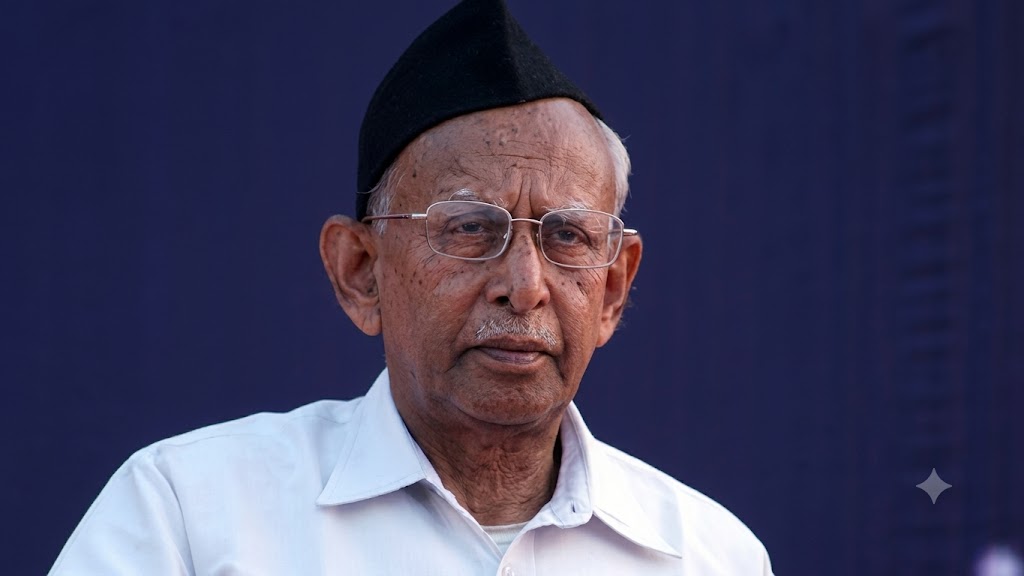
Kuppalli Sitaramayya Sudarshan, the fifth Sarsanghchalak of the Rashtriya Swayamsevak Sangh (RSS), was born on June 18, 1931 and passed away on September 15, 2012. His tenure as Sarsanghchalak (2000–2009) played a significant role in shaping the organisation’s intellectual direction for the new millennium.
Sudarshan was at the forefront of initiating an intellectual platform that helped shape the Sangh’s worldview on Swadeshi, the decolonisation of the education system, and indigenous models of development, especially in agriculture. Most significantly, he initiated the Sangh’s dialogue with Muslims and Christians to dispel misunderstandings created by the organisation’s detractors.
Building an Intellectual Platform
Former BJP President and Union Minister Dr Murli Manohar Joshi, who had worked closely with Sudarshan since the latter’s stint as a full-time worker in North-East India, recalled in one of his articles:
“Initially, discussions were started for creating an intellectual platform with five or six people, which, apart from myself, included P. Parameswaran, K.I. Vasu, Dr Sujit Dhar, Malkaniji (K.R. Malkani), Devendra Swaroopji, etc. Later, he (Sudarshan) brought more people on board, such as Dr Bajrang Lal Gupta. The discussions continued and the final outcome was an intellectual platform. It was named ‘Pragya Pravah’ (also spelt Prajna Pravah). Some programmes were organised under its banner and, gradually, regular seminars started taking place. Similar activities happened on the issue of Swadeshi and under the banner of Vigyan Bharati. Prominent scientists from across the country were approached, and they became associated with these activities.”
Today, Pragya Pravah is arguably the largest nationwide intellectual platform, exerting significant influence on national discourse as well as public policy.
Sudarshan was deeply concerned about the future of Indian agriculture and consistently advocated an indigenous, sustainable model of development. Decades before these issues entered mainstream debate, he cautioned against excessive dependence on genetically modified seeds supplied by multinational corporations, warning that they could degrade soil quality, increase farmers’ dependence on costly inputs, and make agriculture unsustainable for small and marginal farmers.
Instead, he strongly championed organic farming, which formed a central pillar of his economic thinking. He believed that development should be guided by the principle of the sustainable use of natural resources rather than their unlimited exploitation.
His commitment to sustainability extended well beyond agriculture. He practised conservation in his daily life, avoiding the wastage of even a single drop of water, and actively encouraged scientists to develop environmentally friendly technologies. A strong advocate of biodiesel and alternative energy sources, he promoted research into innovations such as producing fuel from plastic waste.
Throughout his life, he remained closely engaged with scientists and innovators, encouraging research that combined technological progress with environmental responsibility while improving the lives of the poor and the marginalised.
M.G. Vaidya recalled an interesting incident about Sudarshan’s outreach during his tenure as the RSS spokesperson. Vaidya, who was based in Delhi, was approached by a Christian member of the National Commission for Minorities with a query on whether the RSS leadership would be interested in interacting with the Christian clergy.
After discussions, it was agreed, at the insistence of the Roman Catholic leaders, that Protestant representatives would not attend the meeting. Another condition was that the bishops would interact only with the RSS leadership and not with its spokesperson.
“I contacted Sudarshanji, and he agreed to the meeting. The date and time were fixed,” recalled Vaidya.
A couple of days before the meeting, however, the RSS spokesperson received a message that, if the RSS wished to hold the meeting, its functionaries would have to come to the church and the venue would be changed.
Vaidya recalled: “I was upset about it and said that this meeting is going to be cancelled.”
Sudarshanji was touring Kerala for organisational work when Vaidya received this message. He contacted the Sarsanghchalak and received an unexpected reply: “We will go to their church.”
Sudarshan said this without thinking twice.
“I was quite surprised,” Vaidya recalled.
He conveyed the message to the member of the Minorities Commission, who informed the clergy. Accordingly, Sudarshan, Vaidya and the Prant Karyavah of Maharashtra went to meet the Christian leaders at a Catholic church, where they were received with great warmth.
A similar meeting was later held with Protestant leaders at the RSS headquarters, Dr Hedgewar Bhawan, in Nagpur. It was attended by 29 Christian leaders and lasted for about one and a half hours. Afterwards, everyone dined together at the RSS headquarters.
Sudarshan also held several rounds of discussions with Muslim leaders. He inspired senior RSS Pracharak Indresh Kumar to establish the Muslim Rashtriya Manch, an organisation working among Muslims. Sudarshan made it a point to attend all the major programmes organised by the Manch.
The common thread running through his speeches at its conventions and camps was: “You (Muslims) belong to Hindusthan. You haven’t come from outside. Only your way of worship is different. Your forefathers are Hindus, and you should be proud of them.”
The popularity of the Manch gradually grew among Muslims. When the Muslim clergy at Deoband issued a fatwa banning the recital of Vande Mataram, the Manch organised successful programmes in several places where Muslims sang the song in large numbers.
Around one million Muslims also signed a petition demanding a ban on cow slaughter across the country. The petition was submitted to the President of India.
In 2012, the Manch organised a three-day national camp at Pushkar, one of Hinduism’s holiest places, and Sudarshan remained present throughout the event. Following his demise later that year, several leaders from minority communities paid tribute to him.