
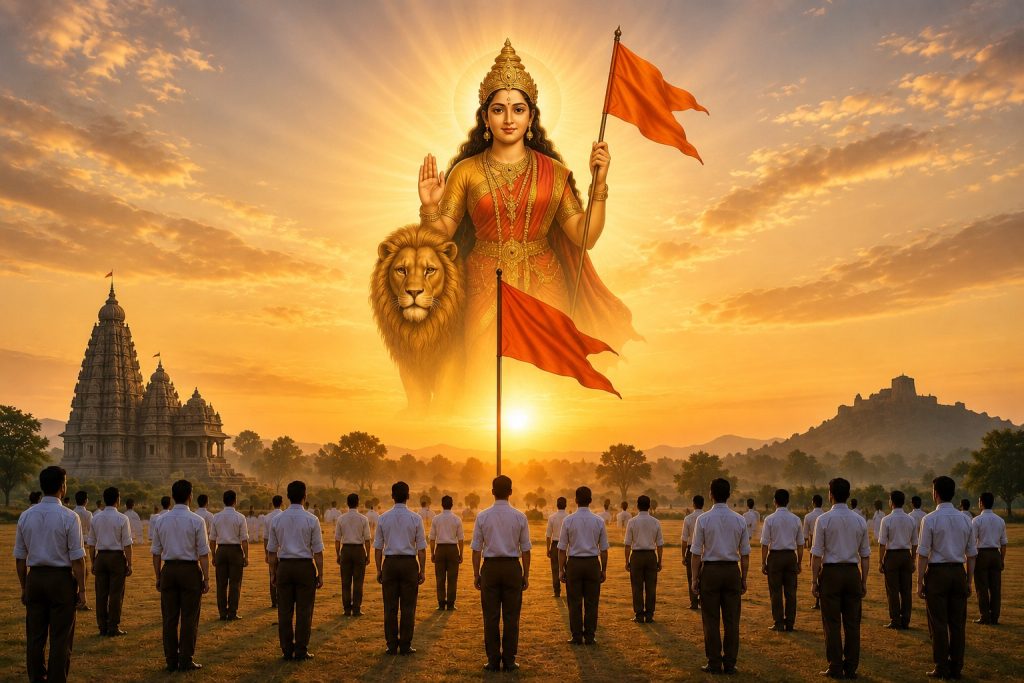
About the Source
This article is Part 1 of a three-part series providing a curated translation and analysis of the handbook Vishay-Bindu. The excerpts are drawn from the Fifth Edition of the manual, published on Deepawali, Vikram Samvat 2069 (November 2012) by Sharad Prakashan, Agra.
As noted in the book’s Prastavana (Preface), the text is designed to serve as Pathey, an essential intellectual and spiritual nourishment for karyakartas (volunteers) engaged in the task of Rashtrotthan (national resurgence). The manual provides a concise, point-wise synthesis of the insights of various thinkers, focusing on the Indian perspective of history, social life, and current global challenges. While intended as a guide for internal training, it offers a primary window into the Saidhantik Adhishtan (philosophical foundation) of the Rashtriya Swayamsevak Sangh (RSS). Parts 2 and 3 will be published subsequently.
The idea of a nation is often understood in modern terms as a political construct defined by territory and the state. The following excerpts present the foundational ideas of the Rashtriya Swayamsevak Sangh (RSS) on nationhood, culture, and civilisational identity. Unlike purely political definitions of a nation, these ideas emerge from a long-standing Indian intellectual tradition that views society, culture, and shared consciousness as central to national life.
These sections outline how the concept of Rashtra (nation) has been understood in Bharat as a cultural, civilisational, and emotional entity that surpasses political structures and historical disruptions.
At the core of this perspective lies a fundamental question of what constitutes a nation?
It states –
Our Conception of the Nation is Cultural, Not Political
What is the Nation (Rashtra)?
- A Nation (Rashtra) is constituted by the land, the people (Jan), and the culture (Sanskriti). In the Vedas, the sages (Rishis) have said:
“भद्रं इच्छन्त ऋषय: स्वर्विदस्तपो दीक्षां उपसेदु: अग्रे। ततो राष्ट्रं बलं ओजश्च जातम् तदस्मै देवा उपसं नमन्तु॥” अथर्ववेद १९-४१-०१
“Bhadram icchant rishayah svarvidas-tapo diksham upaseduh agre | Tato rashtram balam ojashcha jatam tadasmai deva upasam namantu ||”Atharva Veda 19.41.01
“Desired of the welfare (of the people), the far-seeing sages perform austerity (Tapas) and initiation (Diksha) first. From that (the austerity), the Nation’s strength and spiritual energy (Ojas) are born. Therefore, may the learned ones (Devas) always bow respectfully (to this process).” Atharvaveda 19.41.01 – Pandit Shripad Damodar Satwalekar (specifically drawing from his renowned Atharva Veda Ka Subodh Bhashya).
This reflects the idea that a nation is a product of shared spiritual effort, cultural continuity, and collective consciousness.
In this framework, the relationship between society and the state is understood differently from modern political theories.
The Nation is Not Dependent on the State:
- The society here (in Bharat) has never been dependent on the state (Rajya). Centres of cultural consciousness, such as Shalas (schools), Mutts, temples, the tradition of Sanyasis (ascetics), and the joint family system remained independent of the Rajya (state). National unity was maintained through decentralised traditions, including Melas (fairs), Utsavs (festivals), and pilgrimages like Kumbh and the Char Dham. These institutions fostered a self-reliant economic system and a shared cultural perspective that integrated the land independently of centralised political authority.
- Through all the above mentioned systems, this society, while maintaining its values (Sanskars), continued to receive inspiration to remain firm on its Dharma even during periods of struggles.
This leads to the principle that moral authority precedes political authority.
Dharmadanda is Supreme: Here, rulers have always accepted the authority of Dharma (the moral force of society) over themselves. In other words, the ethical authority of society has remained above the authority of the state. Above state power, it is the power of the people and the authority of Dharma (the moral and civilisational order) has remained paramount.
Diversity in Unity: Differences in language, attire, and dietary habits are not obstacles to national integration. Instead, these reflect a vision of unity within diversity and act as nutrients (Poshak) for the nation’s integrity.
The State as a Mere Instrument: In the West, the State is often treated as the end goal. In Bharat, however, the State (Rajya) is merely an instrument (Saadhan) to sustain and organise social life. Our tradition moves beyond purely material considerations. The state has historically functioned as a collaborator in establishing lasting life values. For example, Shivaji did not struggle merely to acquire a kingdom, he fought to establish Hindu Swarajya (self-governance) and restore national self-respect. This purpose allowed him to institutionalise these core life values within his state.
The Western Conception of Nation: In the West, small states joined to form nations, thus nations developed from states. Their concept of a nation is therefore primarily political. For example, England was formed by combining Scotland, Ireland, and Wales, and the United States by uniting 50 states. Consequently, Western thought regarding the nation revolves entirely around the mechanics of the State.
The Indian Conception of Nation: In Bharat, states changed, but the Nation remained intact (Akshunnu). Even through a succession of foreign invasions and the establishment of foreign rule, the Indian Nation did not perish. While renowned nations like Ancient Greece, Rome, and Egypt collapsed under the shock of invasion, the Indian Nation endured. Because the foundation of Western nations was political, the destruction of the State led to the destruction of the Nation. In contrast, the foundation of Bharat is social and cultural, therefore, our Nation is eternal (Chirantan). In the West, the State is the Nation, in Bharat, the Nation transcends the State.
- Now, the Indian conception of the Nation is also gaining recognition globally. (International conferences in France and Singapore).
- Even Marx accepted that ‘a nation is not merely a homogeneity of material sentiments but also has an emotional character.’
Thus, while Western nationhood is largely state-centric, the Indian conception rests on a deeper social and cultural foundation.
Building upon this cultural understanding of the nation, the following section elaborates on the antiquity and identity of Bharat.
Bharat is a Nation, an Ancient Nation, and a Hindu Rashtra
An Ancient Nation:
- Eternal Continuity: This land has existed as one single nation across ages (Yugo-Yugon). The consciousness of nationhood is clearly present even in the Vedas.
- Genetic Unity: Modern research has established that the DNA (genetic makeup) of all people in Bharat has remained identical for approximately 40,000 years.
- The Organic Composition: Just as a family is composed of parents and children, a Nation is formed by the union of the Motherland (Matrubhumi), Common Ancestors, a Society in the form of progeny (Putraroop Samaj), and a Common Culture. The Nation is an emotional and spiritual concept, a sentiment visible since ancient times as documented in the Vedas and Puranas.
The Antiquity of Bharat:
- Based on historical and archaeological evidence, Bharat has existed as a nation for at least 8,000 years. It is neither a “new nation” nor a “nation in the making” (Ban raha Rashtra).
- Bharat is an ancient nation where people live as one Jan (People/Collective) from the perspective of Dharma, lineage (Jati), and nationality.
- It is not a mere collection of many nations (a subcontinent), but a single, indivisible nation from the North to the South.
“उत्तरं यत्समुद्रस्य हिमाद्रेश्चैव दक्षिणम्। वर्षं तद्भारतं नाम भारती यत्र सन्ततिः॥” (विष्णु पुराण २-३-०१)
“Uttaram yat samudrasya himādreśchaiva dakṣiṇam,
varṣam tad bhāratam nāma bhāratī yatra santatiḥ.”
(Vishnu Purana 2.3.1)
“The country that lies north of the ocean and south of the snowy mountains is called Bharat; there dwell the descendants of Bharata.” (Vishnu Purana 2.3.1)
The term “Hindu” is used in a civilisational sense, referring to a cultural and philosophical tradition rather than a narrowly defined religious identity.
- Bharat is a Hindu Rashtra. It is the Hindus who have shaped this nation and gave it its identity. The Dharma, culture, and society here are known by the name ‘Hindu.’ The philosophy and way of life are also Hindu.
- For us, Bharat is not just a piece of land but our revered Deity. The Hindu society holds a uniform outlook toward rivers, mountains, trees, plants, animals, and the like where they all are regarded as sacred and worthy of reverence.
- A shared outlook towards life ideals such as “women, wealth, guests, and renounced men (Tyagi).”
- The society that followed the philosophy came to be known as Hindu. For example –
“हिमालयं समारभ्य यावदिन्दु सरोवरम्। तं देव निर्मितं देशं हिन्दुस्थानं प्रचक्षते॥”
“Himālayaṁ samārab hya yāvadindu sarovaram, taṁ deva nirmitaṁ deśaṁ hindusthānaṁ pracakṣate.”
“Starting from the Himalayas and extending to the Indian Ocean, is the nation created by the Gods, which is called Hindusthan.” (Barhaspatya Shastra)
- Swami Vivekananda also gave the message of Hindu philosophy to the entire world.
- Hindu is the identity of this nation.
- Despite diversity, this is an integrated Hindu Rashtra.
From this understanding emerges the concept of Hindutva as a form of national identity.
Hindutva itself is Nationality
- Synonymous Identity: Hindutva and Nationality are mutually synonymous, just like the term “Indian.”
- The Nature of the Word ‘Hindu’: The word ‘Hindu’ is a signifier of the Nation (Rashtra-vachak); it is not a signifier of a sect (Panth) or a community (Sampradaya).
- The Three Categorical Units: * Desh (Country) – A geographical unit.
- Rajya (State) – A political unit.
- Rashtra (Nation) – A cultural unit.
- Essential Pillars of Nationality: Nationality is manifested through the following sentiments: a common Motherland, common ancestors, common history, tradition, culture, ideals, centres of faith, common life-goals, shared joys and sorrows, a common sense of friends and foes, and shared hopes and aspirations.
- Response to the Nation’s Fate: It is natural for all National Forces to feel joy at Bharat’s progress and victory, and grief at its defeat. Anyone whose conduct is contrary to this falls into the ‘Un-national’ (Arashtriya) category.
- Official and Administrative Usage: Hindu, Bharatiya, and National are used with the same meaning. This is evident in names used by the government itself, such as Hindustan Machine Tools, Hindustan Aeronautics Limited, Hindustan Petroleum, Bharat Petroleum, Indian Railways, and the National Defence Academy (Rashtriya Suraksha Sansthan).
- Global Logic of Identity: Just as Germany belongs to the Germans, Japan to the Japanese, and Britain to the British—in the same order, Hindustan (Hindusthan) belongs to the Hindus.
- Core Identity and Progeny: The identity of this nation is Hindutva alone. Hindus are the children (Santana) of this land (Nation).
- Global Recognition: People from the entire world come to Bharat to study Hindu philosophy and Hindu scriptures, not the Quran or the Bible. This signifies that this is a Hindu country.
- The Sacred Bond: It is the Hindu who considers this country as Matrubhumi (Motherland), Pitrubhumi (Fatherland), and Punyabhumi (Sacred Land).
- Etymological Proof: The very name ‘Hindusthan’ reveals itself as the place where Hindus reside.
- National Icons: The great personages of this country Shri Ram, Shri Krishna, Chhatrapati Shivaji, Maharana Pratap, Guru Gobind Singh, etc., were Hindus. Therefore, this is the country of Hindus.
- History and Inhabitation: The history of the rise and fall of Hindus is the history of Bharat. Hindus have resided here since the time the world first opened its eyes. While Christians, Parsis, and Muslims arrived later, the original inhabitant (Mool Nivasi) is the Hindu.
- Prosperity and Attachment: It is the Hindus who have made this country happy and prosperous. The deepest attachment to this land is felt by Hindus; therefore, Hindutva is Nationality.
- The Wheat Field Analogy: Even if there are a few other plants in a wheat field, it is still called a “wheat field.” Similarly, the mere presence of some other people cannot change the fundamental character (Swaroop) of this country. Therefore, the country will remain that of the Hindus.
- Unity in Crisis: When a crisis befalls this country, the agony is generally felt by Hindus. Hindu and Bharat are of one form. The pain of the Partition of Bharat was felt by the Hindus.
- (Reference to Savarkar and Shri Guruji’s example: In the dispute between two mothers over one son, only the real mother prevented the child from being cut in half to save its life; the false mother did not.)
- The Global Message: The message that Swami Vivekananda gave to the world was that of ‘Hindu Philosophy.’
- Sacrifice for the Sacred: To save Hindu scriptures while traveling with the Chinese traveler Hiuen Tsang (Xuanzang), a Hindu boy jumped from the boat. He ended his own life but did not let the Hindu texts sink.
Final Conclusion: Therefore, Hindus alone are the nationals (Rashtriya) of this land. Consequently, Hindutva is Nationality.
While the state provides the organisational framework, the actual unity of the nation is an internal, emotional phenomenon. This transition from the external state to the internal conscience is captured in the following section:
Emotional Unity and National Unity
- The Role of Sentiment: Emotion is related to the heart. For emotional unity, the foremost requirement is an inner feeling arising from the Antahkaran (conscience). Heartfelt intimacy, the firm foundation of shared traditions, and unity in diversity are all possible on the basis of an inner realisation. Programmes that instil such sentiments must continuously take place at the national, provincial, district, and village levels.
- The Social Foundation: The Centripetal Force (Kendrabhimukh Shakti) must be extremely strong. This should not be based on political power (Satta), but on the firm foundation of Samaj Sangathan (social organisation).
Elements of a Unified Consciousness
The document identifies specific symbols and beliefs that serve as the anchors for this emotional unity, ranging from sacred geography to historical faith.
- Our Elements of Unity:
- Sacred Entities: Bharat Mata, Gau Mata (Mother Cow), Ganga Mata, Gita Mata, Tulsi Mata, etc.
- Cultural Sphere: Our shared perspective toward the Dhams, the sites of Kumbh and Ardh-Kumbh (Haridwar, Prayag, Ujjain, and Nasik), Jyotirlingas, Shaktipeeths, rivers, and mountains.
- Literature: The Shad-Darshanas (six philosophies), Vedas-Vedangas, Brahmanas, Ramayana, Mahabharata, Gita, etc.
- Beliefs: Faith in rebirth (Punaryanma), Avatars (divine incarnations), Atma-Paramatma (Soul and Supreme Soul), the law of Karma (Jaisi karni vaisi bharni), and faith in great personages like Shri Ram, Shri Krishna, and Guru Gobind Singh.
- Traditions: The Sant (Saint) tradition, mutual respect, honouring saffron robes (Gerua vastra), shared festivals, noble traditions, and indigenous sports.
Critique of Current Integration Models
Finally, the document contrasts this organic, value-based unity with modern attempts at national integration based on material incentives.
- Critique of Modern Methods: Today, attempts are being made to create emotional unity by satisfying people through job rights/reservations, exchanges, and pleasing traders, employees, and students. However, this is not correct. Emotional and National unity cannot be created through Tushtikaran (appeasement). Due to appeasement, the ‘National Integration Council’ has failed to build emotional and national unity. Various other efforts by the government have also been unsuccessful.
The idea of unity is further illustrated through the lived realities of diversity across Bharat.
Unity in Diversity
External Diversities:
- Geographical Diversities: From the snow-capped mountains of the North and the heatwaves (Loo) of Uttar Pradesh, Punjab, and Rajasthan, to the torrential rains of Cherrapunji and Assam, while other regions of Rajasthan yearn for every drop of water. The land varies from fertile plains to barren wastes.
- Social Diversities: Numerous castes (Jatis), sects (Panths), communities (Sampradaya), diverse attires, many languages, and nearly 200 dialects. Even the Constitution recognises 22 regional languages (Note: The Hindi text says 18, reflecting an older draft/version of the document). While diversity in attire and dialect is found in all countries, ‘Unity’ remains our unique specialty (Vaishishtya).
- Geographical Unity:
- Integral Vision: One Country, One People, One Land, One Culture. As the Vishnu Purana states: “The country north of the ocean and south of the Himalayas is Bharat; there dwell the descendants of Bharata.”
- Sacred Geography: The daily invocation of the seven sacred rivers before bathing: “Ganga, Yamuna, Godavari, Saraswati, Narmada, Sindhu, and Kaveri—manifest your presence in this water.”
- Sacred Sovereignty: “Mother and Motherland are superior even to Heaven.” This is not a collection of subcontinents, but a single, indivisible land (Ek Bhu).
- Cultural and Social Unity:
- Common Sacred Texts: The Vedas, Upanishads, Brahmanas, Aranyakas, Smritis, Agamas, Pitakas, Sri Guru Granth Sahib, Ramayana, Mahabharata, and the Gita. Universal reverence for the “Omkar” and the “Swastika.”
- Shared Pilgrimage (Teertha): The four Mathas established by Adi Jagadguru Shankaracharya, the 12 Jyotirlingas, the 52 Shaktipeethas, and the sacred sites of Ganesha-worshippers, Vaishnavas, Jains, Buddhists, Sikhs, and other sects spread across Bharat Varsha. There is a profound sentiment of mutual respect among all sects.
- Common Festivals: Fairs like the Kumbh; and festivals like Varsha Pratipada (Hindu New Year), Makar Sankranti, Vijayadashami, Deepawali, and Holi.
- Spiritual Tenets: Belief in the immortality of the soul, the law of Karma (Karmaphal), rebirth, and the supreme glory of sacrifice (Tyag).
- Maan Bindu (Points of Honor): Shared reverence for the Cow, the Guru, the Bhagwa Dhwaj (Saffron Flag), and the Ganga.
- Common Ideals: “He who views another’s wife as his mother… is a wise man (Pandit).”
- Historical Unity:
- Shared Heritage: The glorious past prior to the 7th century is the common heritage of all Hindus (Indians).
- The Tradition of Resistance: A noble history of resisting foreign invaders without regard to province or language. In 326 BCE, after the invasion met the resistance of Porus, the retreating Greek army split: one under Philip and the other under Alexander.
- Alexander was defeated through the organised efforts of the tribes like Malavas and Kshudrakas. He later died due to the wounds sustained in those battles.
- With Chanakya’s guidance, Chandragupta’s sovereignty reached Gandhar.
- In 190 BCE, King Kharavela of Kalinga broke the siege of Pataliputra and defeated the Greek (Yavana) king, Demetrius.
- Political unity was consistently pursued by leaders like Vikramaditya, Shalivahan, Yashodharma, and Samudragupta.
- Common National Heroes: Maharana Pratap, Chhatrapati Shivaji, Guru Gobind Singh, Rani Chennamma, Lachit Borphukan, Banda Bairagi, Tatya Tope, Rani Laxmibai, Bhagat Singh, and Subhas Chandra Bose.
- Shared Sentiment: A common reaction to historical events; a unified sense of “friend and foe” derived from reading history.
Linguistic Unity:
- Sanskrit as the Source: Sanskrit is equally venerable across the land. It is the mother of Hindi and all provincial languages. All Sanskaras (life-cycle rituals) and Mantras (chants)are in Sanskrit.
- Common Cultural Expressions: Idioms and beliefs regarding omens (Shakun-Apshakun) are identical across all languages.
- Unified Narrative: The subject matter and stories of folk songs in every language are identical, serving as glowing evidence of national unity.
- The Tapestry of Diversity: Bharat’s diversities are merely various beautiful scenes of its natural splendour and its manifold expressions. There exists a fundamental unity throughout the entire country. These diversities are like distinct, beautiful, and captivating pearls within the alphabet-form unity (ekta-rupi varnamala) of Mother India.
- Legacy of Knowledge: Since ancient times, the Vedas, Upanishads, Puranas, Ramayana, Mahabharata, and all other foundational texts of Knowledge and Science (Gyan, Vigyan) were composed in Sanskrit alone.
Conclusion: Bharat’s diversities are expressions of its natural splendour. There exists a fundamental, organic unity throughout the land. These diversities are like distinct, captivating pearls in the alphabet-garland of Mother India’s unity.
These excerpts collectively present a civilisational perspective on nationhood the one that places culture, continuity, and shared consciousness at its core. Whether examined philosophically, historically, or socially, this framework seeks to define the nation not merely as a political entity, but as a living, enduring collective shaped by time, tradition, and shared values.
(The writer is an author and columnist)