
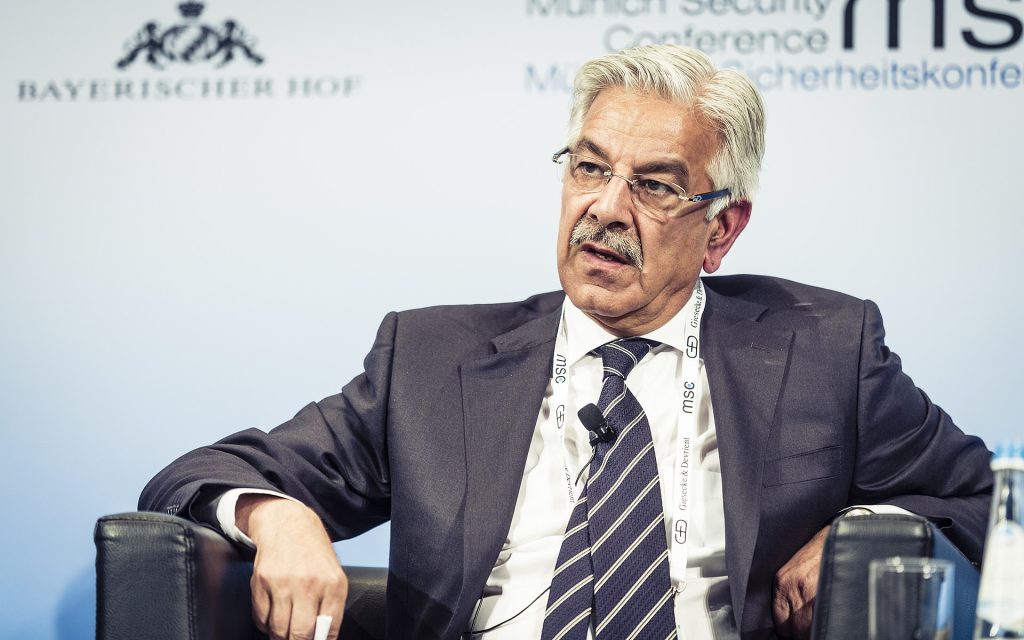
Pakistan’s Defence Minister, Khawaja Asif, has chosen a curious target in his latest burst of anti-India rhetoric. Warning that in any future conflict Pakistan would strike “RSS camps”, he appears to have mistaken the Rashtriya Swayamsevak Sangh (RSS) for a conventional military force with fixed barracks and installations.
The statement is not merely provocative; it is bizarre. The RSS has no “camps” in the military sense that Asif seems to imagine. It is a vast socio-cultural organisation whose shakhas are held in open grounds, parks and neighbourhood spaces across India. By threatening to bomb something that does not exist, Pakistan’s Defence Minister has only exposed either his ignorance of the organisation he invokes so casually, or the desperation behind Islamabad’s latest attempt at chest-thumping.
Perhaps it is time to give Asif and the Pakistanis of his ilk, who routinely target the RSS in their rhetoric, a primer on how the organisation actually functions.
An Organisation Unlike Any Other
The RSS does not fit into conventional organisational theories. It has a fluid character, held together not by rigid structures but by a shared value system.
Anyone who joins an RSS shakha — a daily or weekly gathering of volunteers for about an hour — becomes a swayamsevak. The RSS essentially does one thing: it organises shakhas and prepares volunteers with a strong sense of character, discipline and service.
Today, the organisation runs more than 80,000 shakhas across India. Some volunteers remain within the organisation to continue this work. Others move into different fields of public life. Over time, they have helped establish institutions, organisations and platforms in education, social work, labour, tribal welfare, youth mobilisation, rural development and public service.
Many people who join these institutions are not themselves RSS volunteers. They enter laterally, drawn by the work and values of these organisations. This is what makes the RSS difficult to understand for those accustomed only to rigid command-and-control structures.
Why Pakistan’s Rulers Fail to Understand the RSS
Beyond a point, one cannot entirely blame Pakistan’s Defence Minister and the RSS detractors in Pakistan. For them, the idea of building an organisation that serves all sections of society is perhaps unimaginable.
The RSS simply does not fit the worldview of a state whose ideological foundations lie in religion and whose establishment has, for decades, patronised extremist groups as instruments of policy.
In Pakistan, Islamist organisations often run seminaries, madrassas and institutions where intolerance and radicalism are nurtured. Many such networks have historically been linked to terror camps operating with varying degrees of state patronage. Young men are trained, indoctrinated and then sent out to spread violence — especially against India.
Seen from such a mindset, it may indeed be difficult for Pakistani leaders to comprehend that an organisation can spend a century serving society through more than one lakh welfare projects.
These include over 20,000 schools providing modern education to more than 3.5 million children, including many from marginalised communities and minority groups in remote areas. There are also more than 75,000 single-teacher schools functioning in some of India’s most difficult terrains.
In addition, RSS-inspired initiatives run hundreds of healthcare facilities, hostels for boys and girls from tribal regions, vocational training centres, self-help programmes and disaster-relief efforts.
If one contrasts this with what often emerges from sections of Pakistan’s madrassa network and the terror infrastructure built under the guise of charities and non-governmental organisations, it becomes easier to understand why Khawaja Asif appears unable to comprehend the RSS.
A Stark Difference in Social Vision
RSS volunteers work among Muslims, Christians, Sikhs, Buddhists and members of every community. People from different faiths participate in and benefit from institutions inspired by the RSS.
The record of Pakistan’s so-called social organisations presents a very different picture. Religious minorities — particularly Hindus — have long faced discrimination, intimidation, abduction, forced conversion and the forced marriage of minor girls.
That is the difference between an organisation built around social service and national integration, and a system that has too often legitimised sectarianism and radicalism.
Why Pakistan Is Wary of the RSS
Pakistan’s discomfort with the RSS stems from the fact that the organisation has emerged as a powerful binding force within India. It has cultivated patriotism and national consciousness not through jingoism, but through service.
Pakistan is also uneasy because RSS volunteers have played an important role in countering Islamism and Islamic terrorism. Organisations inspired by the RSS, such as Seema Jagaran Manch, work in border areas to support local communities, strengthen national resolve and assist the administration in difficult terrain.
Beyond India, millions of people of Indian origin associated with RSS-inspired values have settled in other countries and built reputations as hardworking, law-abiding and community-oriented citizens.
By contrast, Pakistan’s international image has repeatedly been damaged by its association with terrorism, radical networks and extremist violence.
A Suggestion for Pakistan’s Defence Minister
Khawaja Asif would do well to study the RSS more carefully before making reckless threats about imaginary “RSS camps”. If Pakistan were able to adopt even a fraction of the social-service ethos, educational work and nation-building values associated with the RSS, it might begin the difficult process of de-radicalisation and social reform.
But perhaps that is asking too much of a state that still struggles to distinguish between a volunteer organisation and a military installation.