
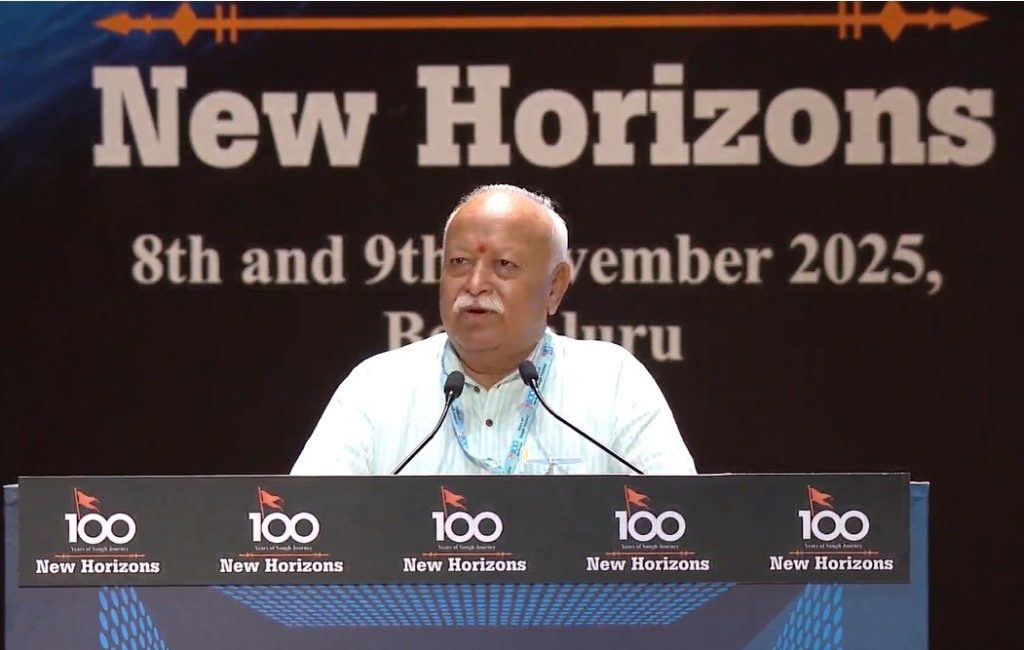
The recent emphasis on “Rashtraneeti” articulated by Rashtriya Swayamsevak Sangh (RSS) Sarsanghchalak (Chief mentor) Mohan Bhagwat during 100 Years of Sangh Journey: New Horizons, a two-day lecture series held in Bengaluru on November 8–9, 2025, marking the RSS’s centennial yearoffers a timely opportunity to revisit the deeper philosophical principles that have guided the organization since 1925. As the RSS enters its second century after its founding on Vijayadashami 1925, Bhagwat’s interpretation of Rashtraneeti(National Civilizational Orientation) reaffirms an idea central to the organization’s worldview: nation-building is not a political activity, but a civilizational process rooted in culture, character, and social unity. This moment, therefore, provides an important intellectual lens through which to examine how the RSS understands the nation, the individual, and the long-term direction of society.
Rashtra as the Civilizational Core
To understand the RSS’s vision of Rashtraneeti, one must first revisit the foundational idea of Rashtra, which forms the civilizational bedrock of the RSS worldview. This articulation elevates national purpose beyond transient material concerns, asserting that the country must move in a direction informed by deep-seated Bharatiya values. The Bharatiya concept of Rashtra differs fundamentally from the modern European notion of the nation-state. While “nation” and “nationalism” are products of post-18th century political thought, Rashtra is an ancient concept with its roots in the Vedas, particularly the Atharva Veda.
Rashtra is not merely a territorial or administrative formation; it is a geo-cultural consciousness. It denotes the collective mindset of a people, their relationship to nature, their memory of the past, their attitudes to tradition, and their shared aspirations. As one classical RSS formulation puts it: “Nation is material, while Rashtra is adhyatmik, spiritual.” The Vedic verse “Mātābhūmiḥputro ’ham pṛthivyāḥ” (“This land is my mother, and I am her son”) expresses this sacred relationship between people and territory, a bond seen as cultural and eternal rather than political.
The strength of Rashtra lies in its inclusivity. It is founded on Sanskriti cultural synthesis not ethnicity, race, or denominational identity. Its parameters are timeless:
“The parameters of a Nation have constantly changed over time, but those of a Rashtra have withstood the test of time and still the base remains the same.”
If Rashtra is a civilizational constant, then Rashtraneeti the ethos or guiding orientation of the nationmust also be continuous and insulated from shifting political contingencies. Rashtraneeti does not change with political leadership because its foundation is cultural, ethical, and spiritual, not partisan. As Bhagwat reiterated, the Rashtra continues regardless of who rules: “We were independent. We were Rashtra. We were slaves. Still we were that Rashtra. Hindu Rashtra continues.”
Since the continuity of Rashtra cannot depend on political structures, the practice of Rashtraneeti must begin with society itself. This naturally leads to the organisation’s century-long emphasis on man-making as the practical route to civilizational renewal.
Rashtraneeti: A Stable Civilizational Orientation of Society
Rashtraneeti, in the RSS’s framework, is best understood as the civilizational policy of society, not a political programme of the state. It denotes the cultural, ethical, and social direction that should guide national life across generations.
Rashtraneeti emphasises:
- cultural cohesion grounded in common civilizational inheritance
- social discipline and ethical life as the basis of national strength
- shared national memory rooted in lived tradition
- strengthening foundational institutions such as family, community networks, and social organisations
- long-term societal orientation rather than short-term political gains
In this conceptualisation, the nation’s stability comes not from political regimes but from the ethical and cultural strength of society. This places the responsibility of nation-building on social institutions, cultural organisations, and citizen character — not solely on the state.
Intellectual Foundations: From Hedgewar to Integral Humanism
The intellectual roots of Rashtraneeti emerge from millennium old Indian socio-cultural thought.Dr Keshav Baliram Hedgewar, the founder of RSS, consistently emphasised that the weakness of Indian society during colonial rule stemmed RSS, consistentlybiographers note his belief that society not the state is the real locus of national strength, and unless society is cohesive and self-organised, political freedom cannot endure. This idea became the foundational ethic of the RSS’s “man-making” process.
The second Sarsanghchalak MS Golwalkar’s writings underscore the link between national character and long-term unity, arguing that cultural cohesion and ethical behaviour form the basis of a stable national life.
Deendayal Upadhyaya, a thinker, philosopher, social worker and a full-time RSS workprovides one of the clearest conceptual frameworks relevant to Rashtraneeti in his philosophy of Integral Humanism. He argues that society is an “organic whole” and that national life must balance material, ethical, and spiritual dimensions. His insistence that political power must serve societal ethics, not dominate them, is central to understanding Rashtraneeti.
DattopantThengadi, an RSS ideologue repeatedly emphasised samajik shakti (social power) as superior to state power, warning against the over-politicisation of national life. He argued that India’s strength must arise from organised society rooted in culture, not from political structures alone.
Together, these intellectual strands show that Rashtraneeti is not a slogan but a coherent civilizational doctrine.
The Rashtriya Swayamsevak Sangh’s commitment to Rashtraneetihas been expressed through the steady cultivation of social preparedness and character-building. In 1925, when Hedgewar founded the RSS, he was convinced that independence of Hindu society would be fragile without social cohesion. RSS began as a modest group but with clear purpose: to rebuild the cultural backbone of Bharat i.e. India by instilling discipline, selflessness, strength and unity.
The RSS even after 100 years serve as a space where physical discipline, cultural learning, community bonding, and ethical training are woven together to produce the “ideal swayamsevak.”
Through this model, Rashtraneeti becomes a lived practice:
- Community-building across caste and class
- Caste harmony and social cohesion through shared activities
- Educational and cultural initiatives preserving local traditions
- Relief and rescue volunteerism during crises
- Work in tribal and rural regions, strengthening self-reliance
These initiatives illustrate that Rashtraneeti operates in the domain of society. Its objective is to build a social ethos that naturally shapes national direction.
Why Rashtraneeti Matters in 2025
Rashtraneeti gains relevance today because India is experiencing rapid transformations through urbanisation, technological acceleration, demographic expansion, and new forms of social mobility. These shifts have created both new opportunities and new forms of fragmentation, placing pressure on social trust and shared identity. In such a context, political processes alone cannot maintain cohesion; they operate within short electoral cycles, while the challenges facing society are long-term and structural. An alternative lens is needed for directing attention to cultural continuity, social capital, and ethical norms as stabilising forces within a rapidly changing society.
Looking ahead, the importance of such an orientation is likely to increase. India’s future will be shaped by a young population navigating globalisation, digital technology, climate pressures, and complex identity negotiations. These dynamics require resilient social institutions like families, community networks, voluntary organisations that can provide continuity and shared meaning. Rashtraneeti emphasises the role of society in producing these stabilising structures. It draws on the sociological insight that a prepared and cohesive society is more capable of sustaining democratic functioning, managing diversity, and absorbing external shocks.
Seen this way, Rashtraneeti is not a prescriptive moral doctrine but a framework that highlights the long-term cultural and social foundations necessary for national resilience. Its relevance lies in identifying the non-political capacities a society must cultivate if it is to remain coherent and confident amid accelerating change.
Conclusion
As the RSS begins its second century, Rashtraneeti offers a framework for understanding how the organization views India, not as a modern nation-state alone, but as an ancient civilizational entity whose strength lies in cultural continuity, social unity, ethical character, and collective memory. This approach to national directionrooted in the concept of Rashtraplaces society, not politics, at the heart of nation-building. Through man-making and social preparedness, the RSS sees Rashtraneeti as the long-term path through which India sustains its cultural identity and navigates the challenges of a changing world.
References
C.P. Bhishikar, Dr. Keshav Baliram Hedgewar: Charitra, Karya, Suruchi Prakashan, 2014.
M.S. Golwalkar, Bunch of Thoughts, Sahitya Sindhu, 1966.
Deendayal Upadhyaya, Integral Humanism, 1965 (Approved Texts).
DattopantThengadi, The Third Way, Sahitya Sindhu, 1995.
H.V. Seshadri, RSS: A Vision in Action, Suruchi Prakashan, 2002.
Arun Anand, Know About RSS, Prabhat Prakashan, 2016
(The writer is an author and columnist)