
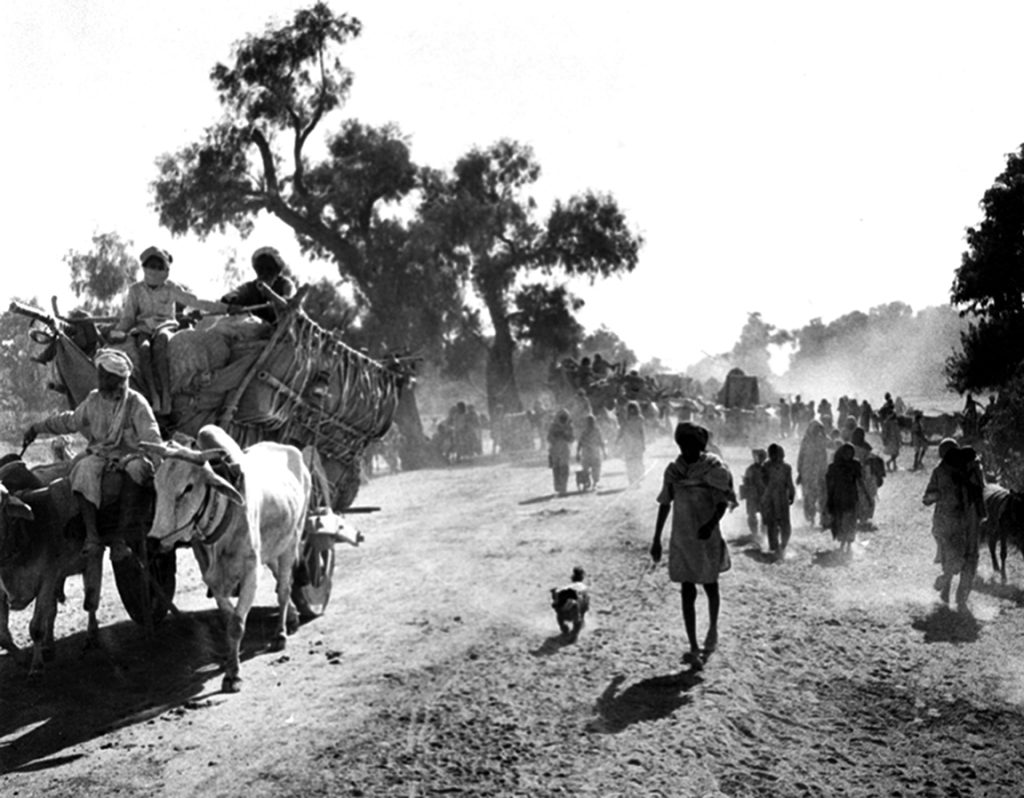
The partition of India on 14 August 1947 resulted in the displacement of nearly fifteen million people and the deaths of over one million. Some seventy-five thousand women were raped, and many of them were then disfigured or dismembered.This period was marked by widespread communal violence, forced migrations, and territorial conflict. The impact of partition remains significant in regions such as Jammu and Kashmir, where conflict and insecurity persist.
Although Maharaja Hari Singh, the ruler of Jammu and Kashmir, acceded to India in October 1947, the subsequent invasion by tribal militias and Pakistani forces led to the illegal occupation of some portions of the state by Pakistan.These areas include the western and central districts that now constitute Pakistan Occupied Jammu and Kashmir, such as Kotli, Mirpur, Muzaffarabad, and parts of Poonchas well as the northern territories known as Gilgit-Baltistan (formerly the Northern Areas), encompassing Gilgit, Skardu, and Hunza.
RSS Presence in Jammu & Kashmir
The Rashtriya Swayamsevak Sangh (RSS) began its work in Jammu and Kashmir well before Partition. In 1939, Balraj Madhok started the first RSS shakha at Diwan Mandir in Jammu. By 1943, attendance had grown to around 2,000 daily. A core group of seven volunteers, including Jagdish Abrol of Sialkot, expanded activities to areas such as Bhaderwah, Mirpur, and Srinagar. By 1946, RSS shakhas were active in Baramulla, Anantnag, and Pahalgam.
During this period, senior RSS functionaries, and secondSarsanghchalak(chief mentor)M.S. Golwalkar, held a meeting with the Maharajaof Jammu and Kashmir, Hari Singh, to convincing him to sign the instrument of accession. Meanwhile, RSS swayamsevaks (volunteers)focused on organizing and training local Hindu communities to provide protection and assistance during increasing communal tensions.
RSS Activities During Partition
Following partition, violence and armed incursions affected Jammu and Kashmir. Pakistani tribal militias and irregular forces launched attacks on towns and villages, targeting Hindu and Sikh populations. RSS swayamsevaks played a role in organizing relief efforts, supporting Indian army personnel, gathering intelligence, and defending communities in several areas including Srinagar, Rajouri, Kotli, and Mirpur.
Manikchandra Vajpayee and Sridhar Paradkarhave given accountsofRSS’s relief, rescue, and defence operations across Punjab, Sindh, Bengal, Delhi, and Jammu & Kashmir during the partitionin their seminal work ‘Partition Days: The Fiery Struggle of the RSS’
Kotli: Defence and Sacrifice
Kotli, a town near the Pakistan border on the Mirpur–Poonch road, had a population of approximately 4,000, split roughly equally between Hindus and Muslims. The RSS established a formal presence in Kotli on 13 April 1941. By 1946, most Hindu families in Kotli were associated with RSS shakhas.Shakhas had also spread across surrounding villages, embedding themselves into the social fabric.
On 6 October 1947, Pakistan-backed tribal forces attacked the nearby town of Pattan. As feared, several Muslim officers and men from the Maharaja’s army defected. The Hindusamong the forces at Pattan were massacred. As the invaders advancedburning villages, killing civilians, and assaulting women, Hindu refugees fled to Kotli. Swayamsevakswith community support, arranged for their shelter, food, and security.
Even army personnel had to be provided for by civilians. The Swayamsevakstook the responsibility of transporting supplies to jawans, often under fire. The military headquarters, thus, was relieved of logistical burdens thanks to local initiative.
The town’s defence included about 250 of army personnel and swayamsevaks, although many Muslim members were considered unreliable. Kotli’s defences comprised sealed gates, sandbanks, and 26 battle stations manned jointly by army and RSSSwayamsevaks.
Palandhari Rescue Mission and Betrayal
When the nearby village of Palandhari, with approximately 1,200 Hindus, was besieged, an RSS delegation led by Mirpur district pracharak(full-time worker) Kedarnath Saini requested army support. The army agreed withswayamsevakscommittment to assisting in the operation.
A rescue team comprising 39 soldiers under Lt. Ishwar Singh, police officers under Inspector Hari Singh, and 100 RSS swayamsevaksProminent among them Master Manohar Lal Bakshi,Krishan Lal, Lal Singh Zargar and Pandit Raja Bakshi Durgadas and Laxmi Chand of Sarsawa,was dispatched but was ambushed near a nullah, due to information leaked by the Kotli’s Muslim tahsildar to enemy forces. Many were killed or captured. Captured Swayamsevaks, including Bakshi Durgadas and Master Manohar Lal, refused to convert under threat and replied “we are Hindus and would die as Hindus”. They were all executed.
Ammunition Retrieval Under Fire
During the siege of Kotli, ammunition supplies ran low. Colonel Baldev Singh Pathania requested an air drop, marked by the code “KFT” at the Sanatan Dharm Sabha grounds. Enemy forces duplicated the code near their camp causing supplies to be dropped in a crossfire zone.
The Sangh office bearers realise the gravity of the situation and knew that the city could not be defended unless the boxes were retrieved and reaching those boxes in the hall of bullets was suicidal”.Sixteen swayamsevakswere given training in how to creep forward on elbows by the army officers and they set out to retrieve the supplies under heavy enemy fire. Ved Prakash Chadha, leading the group, was fatally wounded. Other volunteers, including 22-year-old Somraj Kohli and Amrit Lal, also died during the mission, but they succeeded in recovering most of the ammunition.There were six swayamsevak martyrs who received military funerals with full honours.
Final Stand and Aftermath
When Pakistani forces approached within 35 feet of Kotli, the defenders, including RSS swayamsevaks and army jawans, held their positions. Dharamvir, the young son of RSS worker Kripa Ram, destroyed a key enemy position butlost his life.
Besieged by Pakistani forces for 56 days, Kotli finally saw the arrival of Indian troops under Brigadier Paranjpe on 24 November 1947. Their mission was to evacuating civilians and not to defend the town. Despite protests from Swayamsevaks, Kotli was abandoned and came under Pakistani control.
Hundreds of swayamsevaks fought alongside the state forces for 56 days to defend Kotli from Pakistani incursions in 1947. The town sheltered thousands of refugees from surrounding villages. More than 125 swayamsevaks and several soldiers of the State Forces lost their lives in the defence. Despite their resistance, Kotli eventually came under the control of Pakistan-occupied territory following political decisions in Delhi and local administrative actions under Sheikh Abdullah. Today, these areas remain inaccessible to the people for whom they were defended, and the memory of those who fell there is largely absent from public discourse.
(The writer is an independent columnist and has authored two books)