
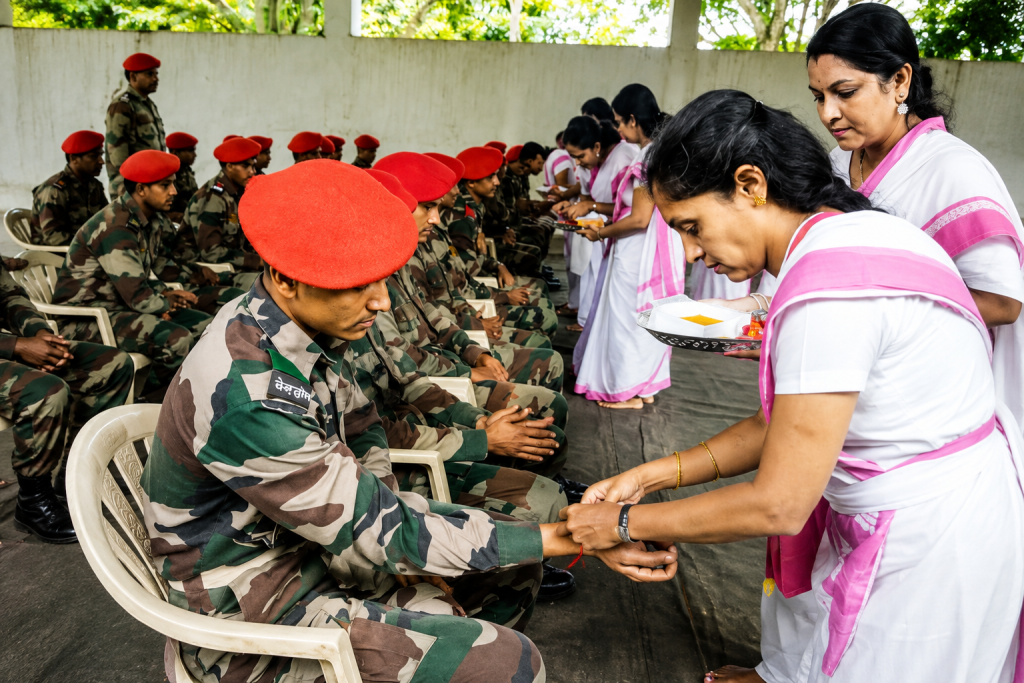
For many people outside India, Rakshabandhan may appear to be a simple Hindu festival celebrating the bond between brothers and sisters. Within the Rashtriya Swayamsevak Sangh (RSS), however, the festival carries a broader meaning. It represents a commitment to protection, social responsibility and solidarity that extends beyond the family to society as a whole.
Founded in 1925 by Dr Keshav Baliram Hedgewar, the RSS is one of India’s largest volunteer organisations. Among the six annual festivals that Hedgewar institutionalised for RSS volunteers, Rakshabandhan occupies a distinctive place because of its emphasis on relationships, mutual responsibility and social cohesion.
The word Rakshabandhan literally refers to a “bond of protection”. Traditionally, sisters tie a sacred thread, or rakhi, around their brothers’ wrists. The gesture expresses affection and trust, while the brother’s acceptance of the thread signifies a commitment to stand by and protect his sister. Although the festival is commonly described in terms of the brother-sister relationship, its symbolism can extend considerably further.
Rakshabandhan is observed on the full-moon day of the Hindu month of Shravan, generally falling in July or August. For RSS volunteers, the occasion provides an opportunity to translate the festival’s symbolism into a wider social practice.
Across RSS shakhas—regular local gatherings of volunteers—the celebration begins with a distinctive ritual. A karyavah, or local organisational functionary, ties a rakhi to the Bhagwa Dhwaj, the saffron flag of the RSS. The flag is regarded within the organisation as its Guru, or guiding ideal. The symbolism is important: rather than placing an individual leader at the centre of the organisation, RSS tradition places its ideals and civilizational ethos above any particular person.
Volunteers then offer pranam, a respectful salutation, to the flag before tying rakhis to one another. The act symbolises fraternity and a mutual commitment to stand by one another and contribute to the well-being of society.
The celebration does not remain confined to the shakha. RSS volunteers commonly take rakhis into their neighbourhoods and interact with people from different walks of life—including shopkeepers, auto-rickshaw drivers, police personnel, sanitation workers and other residents.
The underlying idea is that social responsibility begins with personal relationships. Protection, in this understanding, is not merely a private obligation between members of a family. It is also a responsibility that citizens have toward one another and toward the wider community.
For the RSS, this interpretation of Rakshabandhan is connected to the broader concept of samrasta, or social harmony. The festival is therefore presented not simply as a celebration of family affection but as an occasion to reinforce social bonds across occupational, economic and social boundaries.
The Stories Behind Rakshabandhan
Like many Hindu festivals, Rakshabandhan draws its significance from a range of traditional stories and narratives preserved through India’s civilizational literature.
One popular story comes from the Mahabharata. According to the traditional account, Lord Krishna injured his finger while handling the Sudarshan Chakra. When Draupadi saw the injury, she tore a piece of cloth from her sari and used it to bind his finger. The story is subsequently associated with Krishna’s promise to protect Draupadi and, most famously, with his intervention to preserve her dignity when she was subjected to an attempted disrobing in the court of Hastinapur.
Another traditional narrative connects Rakshabandhan with Goddess Lakshmi and King Bali. According to the story, Lord Vishnu had agreed to remain with Bali as the guardian of his kingdom. Goddess Lakshmi, wishing to have her husband return to Vaikuntha, approached Bali in disguise. She eventually revealed her identity and tied a rakhi on his wrist. Bali accepted her as a sister and agreed to let Vishnu return with Lakshmi.
These narratives convey a recurring theme: protection is understood as a moral relationship based on trust, affection and obligation. It is not necessarily restricted to biological relationships.
A Festival That Once Became a Symbol of Hindu-Muslim Unity
One of the most striking modern examples of Rakshabandhan being used as a symbol of social solidarity emerged during the anti-partition movement in Bengal in 1905.
When the British government under Viceroy Lord Curzon partitioned Bengal, Rabindranath Tagore, the Bengali poet and later Nobel laureate, encouraged people to use the rakhi as a symbol of unity. Hindus and Muslims were urged to tie the sacred thread to one another as a public expression of solidarity.
The symbolism was significant. At a time when political divisions threatened to deepen communal identities, Tagore sought to use a familiar cultural practice to communicate a message of social fraternity.
For the RSS, this episode illustrates the potential of cultural symbols to create social bonds in ways that formal political rhetoric often cannot. The lesson is that shared cultural practices can sometimes build interpersonal trust more effectively than political declarations.
Why the RSS Gives Rakshabandhan a National Meaning
The RSS’s interpretation of Rakshabandhan reflects a broader feature of its organisational philosophy: the belief that national life is sustained not only by political institutions but also by everyday social relationships.
This is particularly relevant in an era characterised by increasing individualism, online interaction and, in many societies, declining face-to-face community engagement. A festival that requires people to physically approach another person, establish a bond and express a commitment to mutual well-being can serve as a reminder of the importance of human connection.
For the RSS, it also provides an opportunity for volunteers to engage directly with their local communities. The rakhi becomes less a private family ritual and more a symbolic invitation to build relationships across the social landscape.
RSS Sarsanghachalak Mohan Bhagwat has repeatedly emphasised the cultural significance of Hindu festivals and their role in sustaining social values. The Sarsanghachalak also participates in the organisation’s annual Rakshabandhan observance at the RSS headquarters in Nagpur.
The RSS sees the festival as an occasion to reinforce social cohesion among its volunteers while also connecting them with the wider community.
The Six Festivals of the RSS
The institutionalisation of Rakshabandhan was part of Dr Hedgewar’s effort to give the RSS’s annual calendar a cultural and national orientation. The organisation observes six major festivals, each associated with a particular theme.
Varsh Pratipada, the Hindu New Year, is observed as a day of renewal and fresh resolve.
Hindu Samrajya Diwas commemorates the coronation of Chhatrapati Shivaji Maharaj, the seventeenth-century Maratha ruler whom the RSS regards as an important symbol of indigenous statecraft and resistance.
Guru Dakshina, observed around Guru Purnima, centres on the saffron flag as the organisation’s symbolic Guru and involves offerings made by volunteers as an expression of gratitude and commitment.
Vijayadashami, or Dussehra, marks the founding of the RSS and is associated with the broader Hindu theme of the triumph of good over evil.
Makar Sankranti, a harvest festival celebrated across much of India, is interpreted by the RSS as a symbol of cultural unity.
And Rakshabandhan represents samrasta—social harmony and mutual responsibility.
Taken together, these observances reveal how the RSS uses familiar cultural traditions to communicate organisational and social values. Whether one agrees with the RSS’s wider political or ideological outlook or not, its interpretation of Rakshabandhan offers an example of how a traditional religious festival can acquire a contemporary civic meaning.
At its heart is a simple proposition: protection is not only something owed by one family member to another. It can also be understood as a social ethic—the willingness to stand with others, build trust across social boundaries and accept responsibility for the well-being of the community.
For the RSS, that is the deeper meaning of Rakshabandhan: a thread tied around a wrist becomes a reminder of a much larger bond between the individual and society.
(The writer is a senior journalist.)